Is French Worth Learning in 2026? The Honest Answer for New Learners
You know that feeling. You're watching a French film, or you overhear a colleague switch naturally into French on a call, or you're scrolling through photos from a trip to Marrakech and realize that French would have opened so many more doors. Something stirs. You think: maybe I should finally learn French.
And then the second thought arrives, right on schedule: isn't French supposed to be really hard? And honestly — is it even practical for me?
That hesitation is real and it's worth addressing directly. This guide is not here to sell you on French. It's here to help you figure out whether French is actually the right call for your life, your goals, and your schedule. (For learners who want conversation practice with real speakers, apps like HelloTalk can help — but more on that later.)
French Is More Global Than You Think
Most people picture France when they think about French. But that picture misses roughly 270 million people.
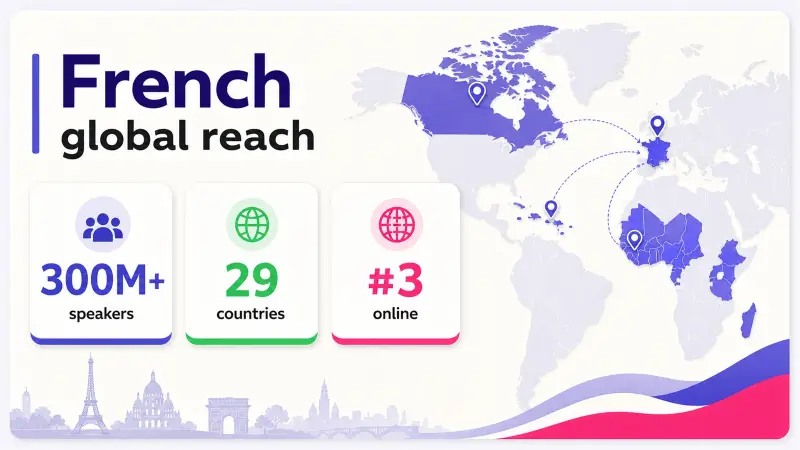
French is an official language in 29 countries and is spoken by more than 300 million people worldwide. It's one of the six official languages of the United Nations, and it holds official status at the EU, NATO, the International Olympic Committee, and the Red Cross. When diplomats and international lawyers need a shared language, French is still in that room.
More importantly for anyone thinking about the future: Africa is where the French-speaking world is growing fastest. Countries like Senegal, Côte d'Ivoire, the Democratic Republic of Congo, and Morocco have large and growing French-speaking populations, and their economies are expanding. The DRC alone is projected to have one of the largest French-speaking populations in the world within a generation. If you have any interest in international development, business, journalism, or NGO work with an African dimension, French isn't a nice-to-have — it's a genuine advantage.
French is also the second most-taught language in the world after English, which means the infrastructure around it — teachers, textbooks, courses, media, apps, exchange partners — is enormous. You will never struggle to find resources.
What's Actually Hard About French (Honest Edition)
Let's not pretend French is a walk in the park.
Silent letters will catch you off guard for a while. French words often have letters that simply aren't pronounced, and which letters are silent can feel arbitrary at first. Beaucoup (a lot) is pronounced roughly "boh-coo" — the "p" vanishes entirely. Vous mangez (you eat) ends in a "z" sound on paper but not in speech.
Liaison adds another layer: in certain contexts, a normally-silent final consonant does get pronounced — but only when the next word starts with a vowel. Les amis (the friends) links the "s" from les to amis, giving you "lay-za-mee." Rules exist for this, but it takes time to internalize.
Gendered nouns mean every object is either masculine or feminine: le café (the coffee) vs. la table (the table). There's rarely a logical reason why — you mostly have to learn genders alongside vocabulary. It's not painful, but it does require deliberate attention early on.
Formal vs. informal registers — specifically tu vs. vous for "you" — can feel socially loaded. Getting this wrong in France has a social cost. Getting it right signals real cultural awareness.
None of this is a wall. It's a set of patterns that your brain will gradually absorb, especially with enough listening practice. But knowing these friction points ahead of time means you won't be blindsided.
What's Easier Than You Probably Expect
Here's what often surprises English speakers when they start French: you already know a lot of it.
Roughly 30% of English vocabulary comes directly from French, largely as a legacy of the Norman Conquest in 1066. Words like nation, culture, restaurant, communication, important, possible, impossible, future, present, professional, natural — those are all French, adopted wholesale into English. When you read a French newspaper, cognates light up everywhere. Your reading comprehension head-start is significant.
Beyond vocabulary, French has some genuine structural advantages:
- No tones — unlike Mandarin or Vietnamese, French pitch doesn't change word meaning, so you don't have to train your ear to a new tonal system.
- Familiar word order — subject-verb-object in most declarative sentences, close to English.
- Consistent pronunciation — once you understand the rules, French spelling maps to sound reliably. The sounds themselves require practice, but native English speakers master them regularly.
- Simpler verb conjugation than many European languages — more forms than English but far fewer than, say, Polish or Russian.
Who French Is Genuinely a Great Fit For
French rewards certain types of learners more than others. You'll likely love it if you:
-
Love food, film, fashion, or art. French culture has a global footprint in all of these. Being able to engage with French cinema without subtitles, read French food writing, or follow fashion commentary in its original language is a genuine pleasure.
-
Have professional interest in Africa. If you work in international development, public health, journalism, or trade with Sub-Saharan or North Africa, French is probably the most practically useful language you could add.
-
Work in international organizations or diplomacy. French remains a working language of the UN, EU, and multiple treaty bodies. It's not ceremonial — it's used in actual negotiations.
-
Enjoy languages with depth and history. French literature runs from Montaigne to Camus; French philosophy gave us Descartes, Sartre, Simone de Beauvoir. If you like the idea of eventually reading in the original, French is worth the years.
-
Already speak another Romance language. If you have Spanish, Italian, or Portuguese, French will come faster than you expect. The grammar structures are close cousins.
The Career Case for French
French is the second most useful language for business in Europe, behind English. France is consistently one of the top five global economies, and Paris is a major hub for fashion, luxury goods, aerospace, and finance.
But the longer-term career story is in Africa. The African continent has more French speakers than France does, and that gap will widen significantly over the next two decades as populations grow. For anyone building a career with an international or emerging-market dimension, French fluency in 2026 is an asset that will compound.
For specific sectors: international law and diplomacy (French is a working language at the International Court of Justice), development and NGO work (a huge proportion of OECD and UN programs operate in French-speaking Africa), and luxury and hospitality (French signals sophistication in ways that still matter commercially).
If you're comparing French to other best languages to learn for career purposes, French consistently ranks among the top practical choices for English speakers.
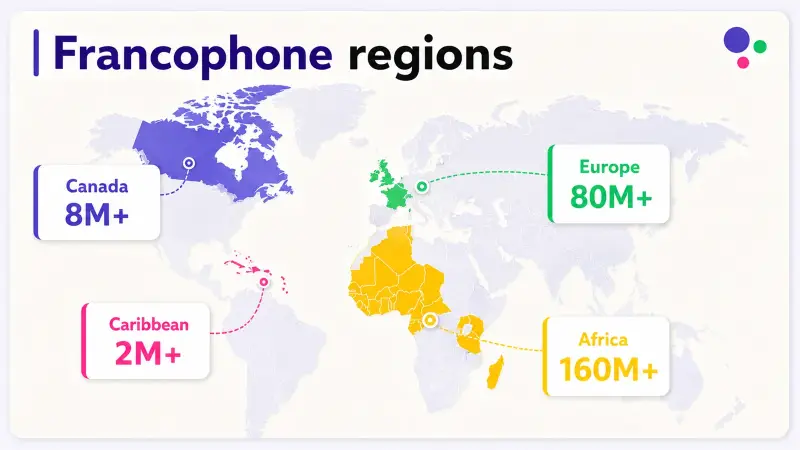
Where French Is Spoken: A Global Snapshot
| Region | French Speakers | Why It Matters |
|---|---|---|
| France & Europe | ~80 million | Cultural origin, diplomacy, EU |
| Sub-Saharan Africa | ~160 million+ (growing) | Fastest-growing French-speaking population |
| Canada (Quebec) | ~8 million | North American French access |
| Caribbean & Pacific | ~2 million | Travel, island French varieties |
| International orgs | Official in UN, EU, NATO, IOC | Diplomacy and global institutions |
How Long Will It Actually Take?
The U.S. Foreign Service Institute (FSI) classifies French as a Category I language — their "easiest" tier for English speakers, estimated at around 600 class hours to professional working proficiency.
In practice, this means:
- 3-6 months of daily practice to hold a basic conversation and handle common situations (ordering food, asking directions, light social exchanges).
- 1-2 years of consistent effort to read novels, follow native-speed podcasts, and have genuinely substantive conversations.
- Several more years to feel truly at home in the language — but by that point you're deep in enjoyment, not effort.
Reading typically comes faster than speaking for English learners of French, and that's a perfectly valid path. Many learners start by reading extensively — news articles, graded readers, French subtitles on films — and build spoken confidence later. There's no wrong order.
Compared to easiest languages to learn like Spanish or Italian, French sits at roughly the same difficulty level or slightly higher, mostly because of the pronunciation and spelling conventions. But it's firmly in the "achievable in a reasonable timeframe" category.
Practicing with Real French Speakers: Where HelloTalk Comes In
One of the biggest mistakes French learners make is treating language learning as a solitary textbook exercise. Grammar rules and vocabulary lists are necessary — but they're not sufficient. You need actual conversations with actual people.
That's where HelloTalk becomes genuinely useful. HelloTalk connects you with French speakers from France, Canada, Belgium, Senegal, Morocco, Côte d'Ivoire, and dozens of other countries — not a curated simulation, but real people who want a language exchange partner. You help them with English; they help you with French. The correction features let native speakers mark up your text in real time, which builds accuracy faster than most classroom methods.
Take someone like Maya, a beginner who'd spent six months with apps and textbooks but still froze in actual conversations. She connected with a French speaker from Dakar on HelloTalk for casual weekly exchanges. Within two months her comprehension had jumped — not from extra studying, but from being gently corrected in real conversation rather than drilling isolated exercises.
French speakers on HelloTalk come from wildly different regional backgrounds. Practicing with a speaker from Dakar versus one from Lyon versus one from Montréal will expose you to different accents, vocabulary choices, and registers. That diversity is an asset — the more variety you're exposed to early, the more adaptable your listening comprehension becomes.
HelloTalk is 90% free, has 70M+ users across 260+ languages, and was named Google Play's Best Social App. For anyone serious about going from textbook French to living French, it's one of the most efficient practice tools available.
Frequently Asked Questions About Learning French
Is French hard to learn for English speakers? French is classified by the U.S. Foreign Service Institute as a Category I language — among the easier options for English speakers. The main hurdles are silent letters, gendered nouns, and formal/informal registers. The large overlap in vocabulary (roughly 30% of English words trace back to French) gives beginners a significant head start.
How long does it take to learn French to conversational level? Most learners reach basic conversational ability in 3-6 months of daily practice. Getting to genuinely fluent, natural conversation — following movies without subtitles, discussing complex topics — typically takes 1-2 years of consistent effort. The FSI estimates around 600 class hours to professional working proficiency.
Which French accent should I learn — France or Quebec? Start with standard metropolitan French (as spoken in Paris and most of France) since it's the international reference point and the accent most teaching materials use. Once your ear is trained, Quebec French becomes much more accessible. Exposure to both early on — through media or HelloTalk partners — helps you adapt faster.
Is French useful in Africa? Extremely. Sub-Saharan Africa is home to over 160 million French speakers, and that population is growing faster than anywhere else in the Francophone world. French is a working language for business, government, education, and NGO work across more than 20 African countries. For careers in international development, public health, or trade, African French is arguably more strategically valuable than European French.
What's the difference between formal and informal French? The most visible difference is the second-person pronoun: tu (informal, used with friends, family, children) vs. vous (formal, used with strangers, superiors, older people). Beyond pronouns, formal French uses the subjunctive and conditional more often, avoids contractions like c'est in writing, and tends toward longer, more structured sentences. In everyday spoken French, informal registers are very common — understanding both is important.
Where can I find French speakers to practice with for free? HelloTalk (hellotalk.com) connects you with French native speakers worldwide for language exchange at no cost — 90% of features are free. Speaky offers a similar exchange format. For one-way listening practice, Radio France Internationale (RFI) produces content at adjustable speeds for learners, and France 24 streams free news in French. The key is combining passive listening with active conversation practice.
So — Is French Worth It?
If you're drawn to it, almost certainly yes.
French is genuinely useful: globally spoken, professionally relevant, and increasingly important in one of the world's fastest-growing regions. It's not the hardest language you could choose — in fact, for an English speaker, it's one of the more accessible options. The vocabulary overlap alone gives you a head start most learners in other language families don't have.
The question isn't really whether French is worth learning. The question is whether you'll do the work consistently. If you start with honest expectations, build a daily practice habit, and use tools that connect you to real speakers, French will repay you — in conversations, in travel, in career opportunities, and in the quiet pleasure of understanding something you once couldn't.
Start small. Stay consistent. The rest follows.
If you've made the decision and want a practical daily practice routine, this guide to online French practice tools covers specific app and course combinations that fit into a real schedule.
Ready to practice with real French speakers? Join HelloTalk for free and find your first conversation partner today.