Hardest Languages to Learn: FSI Rankings, What Makes Them Difficult, and How to Actually Make Progress
According to the Foreign Service Institute (FSI), Mandarin, Arabic, Japanese, and Korean fall into Category IV — the hardest classification for English speakers. Reaching professional fluency takes around 2,200 hours, roughly four times longer than French or Spanish. The difficulty concentrates in three areas: tonal systems, complex writing systems, and highly agglutinative grammar.
The good news: HelloTalk's 70M+ registered user network — across 260+ languages — is helping learners compress that journey through real human conversation and immediate correction. This guide explains why these languages are hard, how to think about difficulty relative to your starting point, and what actually works when you're committed to one of the difficult ones. (Still deciding which language to take on? Best Languages to Learn in 2026 helps you compare your options before committing to one of the harder ones.)
Why Some Languages Are So Much Harder: Three Core Barriers
My first attempt at Japanese was in my second year of university. I figured that having some Chinese characters in my background would help — and it did, partially. But three overlapping writing systems plus a layered honorific system derailed me twice before I figured out a sustainable approach.
Linguists have been measuring language difficulty for decades. "Hard" isn't just a feeling — it's quantifiable. FSI breaks languages into four difficulty categories based on learning hours to professional proficiency. Category IV languages require an average of 2,200 hours.
The difficulty almost always comes from one or more of these:
- Tonal systems: Mandarin has 4 tones, Cantonese has 9, Vietnamese has 6. The same syllable means entirely different things depending on pitch.
- Writing systems: Arabic runs right to left; Japanese combines three scripts plus Chinese characters; Korean's Hangul alphabet follows a completely different construction logic from Latin scripts.
- Grammar structure: Japanese and Korean are agglutinative — verb suffixes stack nearly infinitely. Arabic nouns have dual forms, and verbs conjugate by gender.
FSI Difficulty Rankings: Complete Overview
| Language | FSI Hours | Core Difficulty | Who Has an Advantage |
|---|---|---|---|
| Mandarin | 2,200 | Tonal system + thousands of characters + gap between written and spoken forms | Learners with Chinese character background |
| Arabic | 2,200 | Right-to-left script + complex root system + severe dialect fragmentation | Learners with clear regional target (MSA vs. specific dialect) |
| Japanese | 2,200 | Three writing systems + deep honorific hierarchy + ~2,000 common characters | Learners with Chinese character exposure or strong cultural motivation |
| Korean | 2,200 | Agglutinative grammar + SOV word order + multi-level honorific system | K-pop/K-drama fans with high exposure; Chinese heritage learners |
| Cantonese | 2,200+ | 9 tones + shared characters with Mandarin but completely different pronunciation | Mandarin speakers (characters transfer; pronunciation doesn't) |
| Polish | 1,100 | 7 grammatical cases + consonant clusters + complex gender agreement | Learners with other Slavic language background |
| Russian | 1,100 | Case system + Cyrillic alphabet + verbal aspect system | Learners with any Slavic background |
| Thai | 1,100 | 5 tones + 44 consonants + no word spacing in writing | Southeast Asia enthusiasts or those with tonal language exposure |
| Finnish | 1,100 | 15 grammatical cases + agglutinative structure + vowel harmony | Learners with linguistics background or strong Scandinavian context |
CEFR B2 ("independent user") typically corresponds to the first 600–800 hours of a 1,100-hour Category III track. For Category IV languages, B2 often requires well over 1,000 hours.
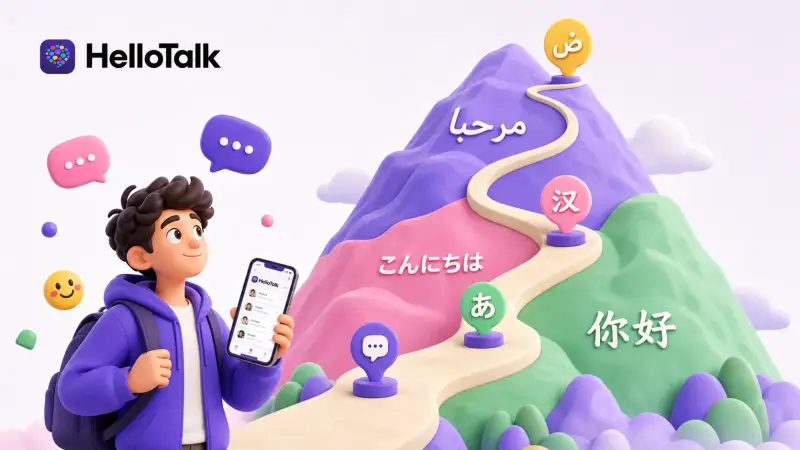
"Hardest" Depends Entirely on Where You Start
This is the point most difficulty guides skip: language hardness is relative to your native language background.
For Mandarin Native Speakers
Arabic is usually the top difficulty — zero shared vocabulary roots, opposite writing direction, and a root-based word construction system that has no parallel in Chinese. Russian and Polish case systems are also deeply foreign, since Mandarin has virtually no morphological inflection. On the other hand, Japanese and Korean — often rated hardest for English speakers — come considerably faster for Mandarin speakers because of shared character vocabulary.
For English Native Speakers
The FSI data is most directly applicable here: Mandarin, Arabic, Japanese, and Korean form the Category IV group. The core blockers are writing systems and tonal pronunciation — both essentially absent from Indo-European languages. An English speaker learning Spanish uses the same alphabet, shares thousands of cognates, and encounters a familiar grammatical skeleton. None of that applies to Category IV.
For Japanese Native Speakers
Arabic typically ranks hardest (root-based word construction is alien to Japanese logical structure). Finnish follows, despite Japanese itself being agglutinative — the specific suffix logic is entirely different. Interestingly, Japanese native speakers often progress in Korean faster than in most other languages because word order and grammatical structure are nearly parallel.
Matching HelloTalk's Tools to Each Difficulty
I've been learning Japanese on HelloTalk for nearly two years. This table reflects what actually helped:
| Difficulty | HelloTalk Feature | How to Use It |
|---|---|---|
| Tonal pronunciation | Voice messages + native speaker voice correction | Record the same sentence multiple times; ask your partner which sounds most natural; compare against their recording |
| Complex grammar | Moments text correction | Write a short daily diary entry in your target language; native speakers annotate errors with explanations |
| No practice context | Voicerooms + voice/video calls | Join a language-specific interest group; let real topic discussions drive output rather than example sentences |
| Can't find a partner | 70M+ user matching system | Filter by language + interest + time zone; a three-way filter surface genuinely compatible partners |
| Unfamiliar writing system | Translation + phonetic reading tools | Arabic and Japanese text gets phonetic annotation on top, reducing the initial reading barrier |
Compared to Duolingo, HelloTalk's core difference is this: Duolingo gamifies drilling, which works well for A1–A2 foundation-building. HelloTalk is built around real human conversation, which is what Category IV learners need past the intermediate stage — especially for tonal and phonetic issues that no quiz can fully address.
Compared to Babbel, HelloTalk doesn't offer a structured course, but the density of real native speaker interaction is much higher — and for learners who already have a foundation and need large quantities of comprehensible input, that's the more valuable resource.
Real Experience: 180 Days of Learning Japanese on HelloTalk
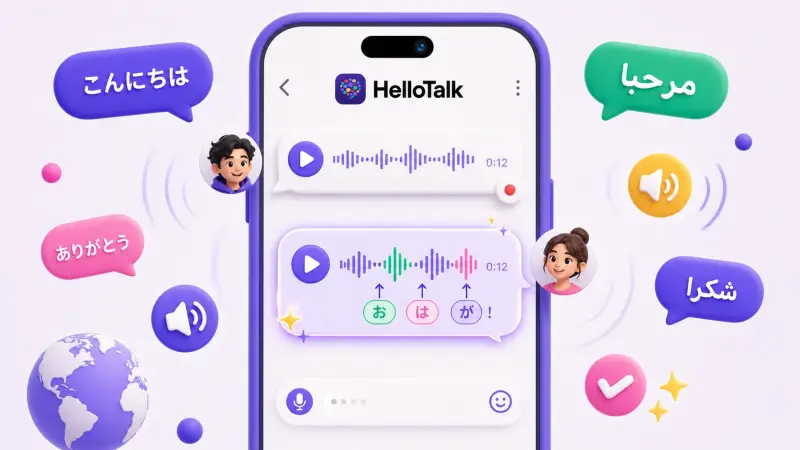
The first month, I almost exclusively sent voice messages — the same sentence recorded three different ways, asking my partner which sounded most natural. The difference between は functioning as a topic marker versus a vowel sound, depending on context, is something no app course explained as clearly as a real Tokyo native did in a five-minute voice exchange.
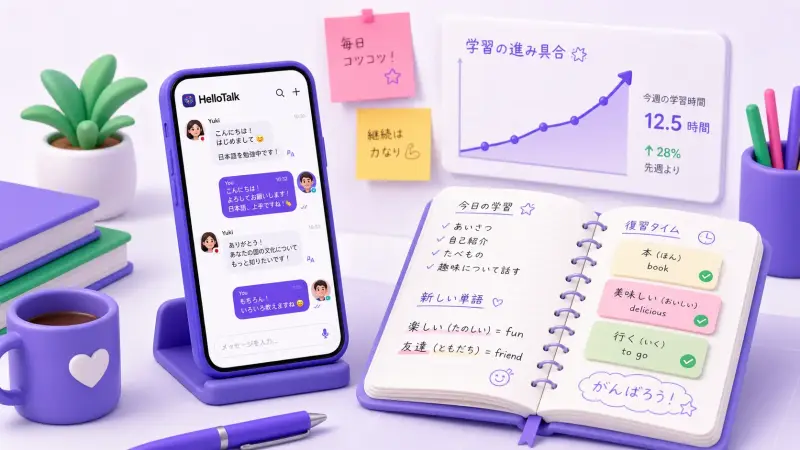
By month three, I was writing 50-character "moment diaries" daily in Japanese. Errors got marked up by native speakers; I logged each one in Anki using spaced repetition. By month six, my JLPT N3 practice test accuracy had gone from 52% to 79%.
The 2024 global Google Play homepage feature reflects what real learners keep reporting: HelloTalk's approach to authentic conversation practice delivers measurable results that course-based apps don't.
FAQ: The Questions That Come Up Most
Q: What is the hardest language in the world?
No absolute answer exists, but combining writing system complexity, grammatical difficulty, and pronunciation barriers, Arabic and Mandarin are most frequently cited by linguists as the joint hardest. Japanese ranks close behind because it's the only major language that simultaneously requires three scripts.
Q: Hardest language for English speakers?
FSI is unambiguous: Mandarin, Arabic, Japanese, and Korean — all Category IV at 2,200 hours. Among these, Arabic is often considered hardest in practice because of dialect fragmentation: Modern Standard Arabic (MSA) is used in writing and formal contexts, but everyday conversation runs in one of a dozen mutually unintelligible regional dialects.
Q: Is Mandarin really the hardest language to learn?
For English speakers, yes — FSI data supports this clearly. For Mandarin speakers, the relative difficulty reverses on Japanese and Korean. "Hardest" is always relative to your starting point, which is why identifying your background before planning your study path matters.
Q: Is Arabic hard to learn?
Very. Beyond the FSI Category IV classification, Arabic presents a structural choice: which Arabic? MSA is the written and formal standard; daily speech is regional — Egyptian, Gulf, Levantine, and others — and these dialects are not mutually intelligible. The practical recommendation: use HelloTalk to find native speakers from your target region and learn from the dialect you'll actually use.
Q: Can adults actually master a Category IV language? How long does it realistically take?
Yes — but with realistic time expectations. An adult investing 1–2 hours daily typically reaches CEFR B2 in a Category IV language in 5–8 years. Age is not the primary variable; accumulated comprehensible input and quality of feedback are. HelloTalk provides both at a higher density than any course-based approach.
There's no shortcut through a Category IV language. But there's a meaningful difference between efficient practice and wasted time.
HelloTalk's 70M+ user network means that whatever language you're targeting — a specific Arabic dialect, Cantonese, or any of the other harder options — there's a native speaker willing to exchange. Thirty minutes of voice conversation daily builds tonal and phonetic accuracy in a way that two hours of course videos simply doesn't.
Start at www.hellotalk.com. Find your first native speaker partner today.