
What Are the Most Effective Beginner Steps for Learning Thai Today?

Your first week with Thai is almost over. The alphabet chart is half memorized, the tone video is half watched, the vocabulary app is full of new words, yet you still cannot build one short sentence and send it anywhere that would tell you whether it is right. Thai punishes exactly this kind of scattering: its own script, five tones, and near-zero vocabulary overlap with English stall vague plans within a month.
The most effective beginner path is a fixed sequence of four steps: build a script and sound foundation, listen in volume at your level, produce short sentences you fully control, then route every piece of output somewhere it gets checked. Step One is the foundation, Step Two is listening, Step Three is controlled output, Step Four is feedback routing, and they run in that order because each one leans on the last. Before Step One sits one genuine decision about where to start, and at the end you get a first-month plan you can bend to your schedule.
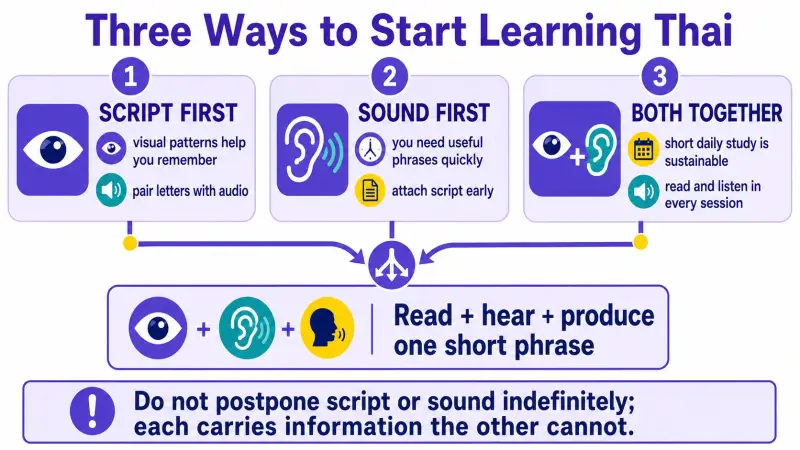
Start With a Decision: Script First, Sound First, or Both Together
One decision shapes your first six weeks, and it exists because of how Thai writing works. Every Thai syllable carries one of five tones (mid, low, falling, high, or rising), and the written form encodes that tone through the initial consonant's class, the vowel length, the syllable ending, and one of four optional tone marks. The script is not just spelling. It is the tone notation system, and script-first learners keep reporting the same shift: tones stop being guesses and start being calculations.
The system is real but bounded. Thai script uses 44 consonant letters and 16 vowel symbols that combine into at least 32 vowel forms, written left to right without spaces between words. Two of the consonants are obsolete in modern writing, and the rest sort into three classes, mid, high, and low, that feed the tone rules. Sound-first learners have a fair counterargument: train your ear on the five tones and on vowel length before touching letters, and you will not silently read everything in a flat English accent. Both-together learners split daily time between a script course and pure listening.
All three routes work. The only losing choice is the unexamined one. Want tones rule-governed as early as possible? Go script-first. Know from past languages that your ear needs a long runway? Go sound-first for two or three weeks, then add script. Have 45 minutes a day or more? Run both. Whatever you pick, the four steps below keep their order; your decision only changes how much of Step One and Step Two overlap.
Step One: Build a Thai Script and Sound Foundation That Transfers to Reading
Everything later leans on this step. Listening improves when you can mentally spell what you hear, and speaking improves when you know why a syllable carries its tone. The goal is narrow and testable: one structured pass through the consonant classes, the vowel forms with their short and long versions, and the tone rules, until you can sound out an unfamiliar written syllable, even slowly.
A named resource built for exactly this job is Learn Thai from a White Guy, a script-and-tone-rules course organized around mnemonics and consonant-class groupings, with a core reading module designed to be finished in a few weeks of short daily sessions. Structure matters more than willpower here: the tone rules only feel learnable when the consonants arrive pre-sorted into classes with memory hooks attached. Free chart-style references cover lookup, but a chart is reference, not curriculum.
One sound-side detail deserves its own drill time: vowel length. Thai distinguishes short and long vowels, and the distinction changes both word identity and tone outcomes, so ignoring length means mispronouncing and misreading at the same time. If you have never trained a length contrast before, the drill logic we laid out for Finnish learners working on long and short sounds transfers almost directly: isolate minimal pairs, exaggerate the contrast, then shrink it back to natural speed.
Your exit test: open a short Thai word you have never studied and name its consonant class, vowel length, and tone before checking. When you get it right more often than not, move on. Perfection here is procrastination.
Step Two: Choose Your First Listening Units and How to Work Through Them
With sounds now legible, the second step is volume: hours of listening at a level you mostly understand. The mistake to dodge is random native content, which in week three is just noise. You want graded listening units, and two named resources cover the two main formats.
For pure comprehensible input, the Comprehensible Thai YouTube channel is the standout free option: a nonprofit listening program of roughly 1,000 hours in eight sequential playlists from complete beginner to advanced, taught entirely in Thai, with gestures and drawings doing the explaining. For structured dialogue lessons, ThaiPod101 builds each lesson around a short native dialogue with line-by-line audio breakdowns and lesson notes, arranged in level pathways from absolute beginner upward, with a free tier and a paid subscription. The two formats train different muscles. Comprehensible input builds intuition and the tolerance for not catching everything. Dialogue lessons hand you reusable sentence patterns.
How you work a unit matters as much as which unit. Run each beginner unit at least twice: first pass for gist, second pass consciously tracking tones and vowel length on the words you catch. Do not pause on every unknown word; this method runs on volume, and per-word lookups kill it. A workable target is 20-30 minutes a day, logged, because the payoff is cumulative and invisible week to week.
Once graded units feel comfortable, HelloTalk adds a live extension. HelloTalk's Voicerooms run around the clock as group audio rooms you can enter as a silent listener, and HelloTalk's Livestreams offer interactive sessions, so real Thai voices become available in listening-only mode long before you are ready to talk to anyone.
Step Three: First Controlled Output With Short Messages You Can Actually Build
Recognition never turns into speech on its own, so start output early and keep it controlled. Controlled means every part of every sentence is something you already understand, not a mystery string pasted from a translator. Thai grammar cooperates unusually well here. Thai verbs do not change form for tense, person, or number, so a beginner can build correct short sentences from fixed word order plus time words, without conjugation tables.
Start with message types, not topics: a self-introduction (name, country, why Thai), a today-report (one thing you ate, one thing you did), and a preference line (one thing you like). Each is two to four short sentences built from your listening units' vocabulary. Write them. Read them aloud, checking each syllable's tone against its spelling. Record yourself once per message type. The recording feels awkward and is non-negotiable, because it is the only way you will notice your rising tone flattening at the end of sentences.
Hold one hard boundary: no sentence enters your output set unless you can say what every word in it is doing. Ten sentences you fully own beat a hundred you pasted. This set is not throwaway practice. It is exactly what the next step sends to real readers and listeners, so quality now saves embarrassment later.
Learners who prefer a calendar to a step list, with a self placement check at the front, can run the week by week Thai plan instead.
Step Four: Route Your Output for Feedback, Including HelloTalk and a Thai-Speaking Partner
Output without feedback just rehearses errors, so decide in advance where each type of output goes to get checked. This is the step where HelloTalk does its concrete job in a Thai plan: HelloTalk connects the script and tone work from Step One with text messages, voice messages, and live listening in real contexts. Keep those activities tied to the lesson objective, and bring the feedback back into the next review. The HelloTalk platform spans 200+ countries, and HelloTalk users send over 1 billion messages daily, which for you means one thing: the pool of potential Thai-speaking partners runs deep. HelloTalk also received a 2024 global Google Play homepage feature.
Different outputs need different checks, so a routing table beats a pep talk. The table below maps each output type from Step Three to a channel and to the specific thing that channel can verify.
| Output type | Where to route it | What gets checked there |
|---|---|---|
| Written self-introduction | HelloTalk one-on-one chat | Whether a real reader understands it; HelloTalk's in-chat correction, translation, and transliteration tools keep the whole exchange in one thread |
| Today-report sentences | HelloTalk Moments post | How several native speakers who choose to respond read the same sentences, since Moments posts are public to the community |
| Recorded voice message | HelloTalk chat voice message plus HelloTalk's AI pronunciation scoring | Intelligibility to a human listener, and syllable-level pronunciation issues flagged with specifics by the AI tool |
| Any sentence before sending | HelloTalk's AI grammar correction | Mechanical errors, fixed in real time with an explanation attached, so human attention goes to meaning |
A Thai-speaking partner sits at the center of this routing as a concrete human practice resource: someone who can receive short original messages, tell you how a phrase landed in context, and check whether your recording was intelligible. Keep your side of that exchange honest. A partner is a person, not a service, so build your routine around what you control: send your controlled-output set regularly and ask one specific question per message. It is the same sentence-level discipline that works for Arabic learners routing their speaking practice. And treat any single answer as evidence about that conversation, not a universal rule of Thai. One speaker's phrasing is one data point.
Hidden Prerequisites and Tone Mechanics: Where This Guide Sends You Next
Two topics got compressed above on purpose, because each has its own deep dive and duplicating them here would shortchange both. The first is the quiet assumptions inside beginner materials: plenty of popular Thai resources presume you already handle romanization quirks, consonant classes, or polite particles before lesson one. Our breakdown of the hidden prerequisites in Thai beginner resources names those assumptions and shows how to close each gap before it costs you a month of confusion.
The second is tone mechanics as a practice discipline. You now know tones are encoded in spelling and that your ear needs deliberate training, but the drill-level detail, including minimal-pair work and production exercises for each of the five tones, lives in our dedicated guide to Thai tone practice for beginners. If tones are your current wall, read it before buying or bookmarking anything new. More input does not fix an untrained ear.
Treat both pieces as branches, not detours. The four-step sequence stays your trunk, and you come back to it after each branch.
A Realistic First-Month Sequence You Can Adjust
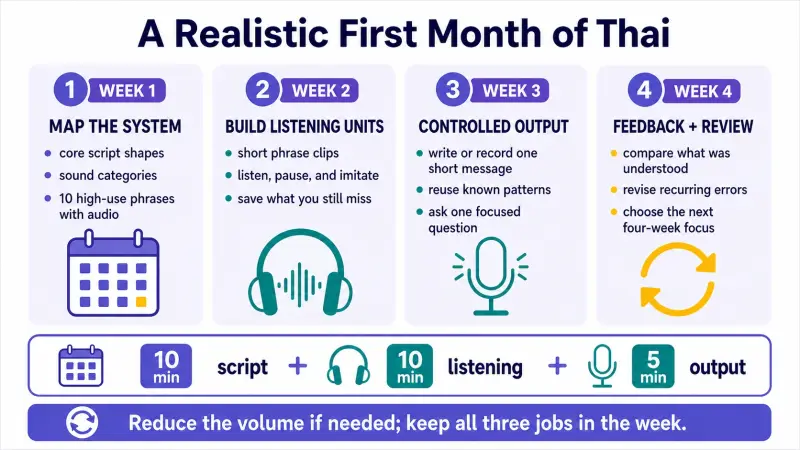
One framing fact keeps month one honest. The US Foreign Service Institute groups Thai with its hard languages, estimating roughly 1,100 class hours for an English speaker to reach professional working proficiency. So month one installs the system; it finishes nothing, and that is the plan working. The table below lays out four weeks at 30-60 minutes a day. Read it as a default to edit, and notice that each week only shifts weight between the four steps. Nothing new appears.
| Week | Main focus | Daily core work | Output milestone |
|---|---|---|---|
| Week 1 | Step One heavy | Script course session plus 10 minutes of tone and vowel-length listening | None required; sound out five written syllables aloud |
| Week 2 | Step One and Step Two split | Script course continues; add one beginner listening unit daily | Read one studied sentence aloud and record it |
| Week 3 | Step Two heavy, Step Three begins | Two listening units daily; draft self-introduction and today-report messages | Run drafts through HelloTalk's AI grammar correction, then send the self-introduction in a HelloTalk chat |
| Week 4 | Steps Two through Four running together | Listening continues; post a today-report to HelloTalk Moments; enter one Voiceroom as a listener | Send one voice message to a Thai-speaking partner and ask one specific intelligibility question |
Adjust the obvious levers. Sound-first deciders stretch Week 1 listening and push script back a week. Both-together deciders can hit the Week 3 milestones in Week 2. The order of the steps is the part to protect.
Do I need to learn the Thai script before speaking at all?
No, but you need it before independent reading, and starting early turns tones into calculations instead of memorized guesses. The decision section covers the sequencing; skipping the script entirely is the one option this guide argues against.
Should I use romanization while I learn?
As scaffolding inside listening lessons that provide it, yes. For anything you write yourself, no. Romanization systems disagree with each other and hide the tone and vowel-length information Thai spelling shows you.
How long until I can sound out written Thai?
Structured script courses built for this job plan around a few weeks of short daily sessions, and the Step One exit test tells you when you are actually there. Sounding out is a separate skill from understanding, and it arrives first.
What should my first HelloTalk message contain?
Your controlled self-introduction from Step Three plus one specific question, for example whether one sentence sounds natural. A short message with one clear question is easy to engage with. A wall of text with no question is not.
What if I cannot hear the tones yet?
Normal at week two, and fixable with deliberate minimal-pair training rather than more volume. Work through the dedicated tone guide linked above, and keep vowel length in every drill, since length and tone interact in Thai spelling.
No single app changed what works for beginner Thai: decide your entry point, build the script and sound foundation, listen in volume at your level, produce small sentences you fully own, and send every piece of output somewhere it gets checked. What has changed is how much of Step Four fits in one place. If you want your first Thai messages, voice recordings, public posts, and listening rooms inside a single free-to-start app with real native speakers, start with HelloTalk and make week three's milestone a message a real person reads.