
Typing, Voice, or Group Rooms: Picking a Language Chat App by Format

Most people who feel stuck in a language chat app assume they picked the wrong one. They start reading comparison posts, download two more apps, import their goals, and three weeks later they are stuck in exactly the same place. The app was rarely the problem.
What changed, quietly, is that they settled into one conversation format and stopped leaving it. Usually that format is typing. Typing is comfortable, it is editable, and it lets you look like a better speaker than you are. The cost shows up the first time somebody talks to you out loud.
This piece is about the three formats you actually have available in a chat-based language app, what each one trains, and how to pick one for today based on how much pressure you can handle right now. If you also want a straight product comparison, that lives in the 2026 roundup of language learning chat apps. This one stays on format.
Three Conversation Formats, Three Different Kinds of Progress
Text, voice notes, and live group rooms are not three difficulty levels of the same activity. They are three different activities that happen to share an inbox. Treating them as a single ladder is why so many learners plateau at the bottom rung and blame the software.
Typing trains retrieval and accuracy. You have time to search for the word, time to notice you used the wrong tense, time to fix it before anybody sees. That is genuinely useful, and it is how most vocabulary gets consolidated in the first place. It also builds almost no speed.
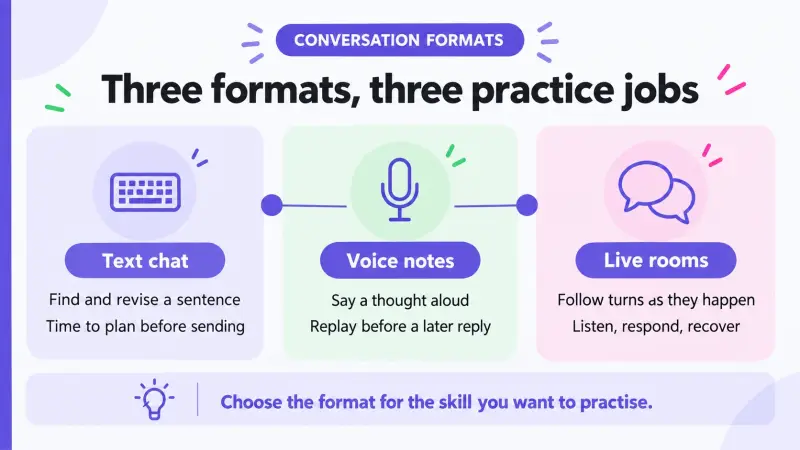
Voice notes train production under mild time pressure. You have to commit to a sentence, say it in one breath, and live with what came out. There is no live listener waiting, so the pressure is real but bounded. Voice notes are the only format where you produce spoken language at full speed without a live listener waiting on the other end, which is exactly why they close the gap between reading fluently and speaking at all. That middle position is the whole point of them.
Live rooms train comprehension, turn-taking, and recovery. You hear three or four accents at once, you lose the thread, you catch it again. Nobody slows down for you. It is the closest thing to being in the country, and it is also the format most people avoid for months.
On HelloTalk these three sit in the same place rather than in three separate products, which is what makes switching between them a same-day decision instead of a new download. That matters more than it sounds. The friction of opening a different app is usually enough to stop the switch from happening at all.
Typing First: Lowest Pressure, Slowest Mouth
Text chat is where nearly everyone starts, and that is fine. If you are at the point where forming a sentence takes conscious effort, doing it out loud in real time is not a reasonable ask. Type first. Just do not live there.
The thing that makes typing productive rather than idle is correction density. A chat where nobody fixes your errors is a chat where you rehearse your mistakes until they set. HelloTalk's in-chat correction tool lets a partner mark up your sentence directly inside the message thread, so the fix arrives attached to the thing you actually wrote instead of as a vague comment. HelloTalk pairs that with in-chat translation, phonetic transcription, and read-aloud playback, so you can check a word, hear it, and reply without leaving the conversation.
That last part is not a small convenience. Every time you leave a chat to look something up in a dictionary tab, you lose the thread and some of the willingness to continue. Keeping translation, transcription, and correction inside the message thread removes the single most common reason beginners abandon a conversation halfway through. Fewer exits, longer conversations, more repetitions.
There is a second typing surface worth using that is not one-to-one chat. HelloTalk's Moments feed works like a public post that native speakers can correct, so instead of one partner reviewing your sentence you might get four people weighing in on the same paragraph. Private chat gets you fluency of exchange. Moments gets you consensus on what actually sounds natural.
Where typing fails you is speed. You can spend six months typing well and still freeze when someone says hello in a call. Text gives you unlimited planning time, and your brain learns to expect it. The moment that planning time disappears, the sentences do too. If you are a beginner wondering whether that means you should wait before speaking, the answer is covered in this look at whether HelloTalk works for beginners. Short version: no, you should not wait as long as you think.
Voice Notes: The Format Most Learners Skip and Should Not
Ask ten intermediate learners why they do not send voice notes and you get roughly three answers. My accent is bad. I need to prepare first. I do not want to waste their time. All three are the same answer wearing different clothes, and all three are avoidance with a reasonable face on.
Here is the mechanism underneath it. Typing lets you edit before anyone sees the output, which means every message you have ever sent represents your best possible self. A voice note does not. It exposes hesitation, filler sounds, wrong stress, and the half-second pause where you hunt for a word. That gap between how good your writing looks and how rough your speech sounds is uncomfortable, so people avoid producing the evidence. The avoidance feels like modesty. It functions as a cap on progress.
The cost compounds in a specific way. Speaking is a motor skill as much as a knowledge skill, and motor skills need reps at something close to real tempo. If your only reps happen at typing tempo, you build a large passive vocabulary attached to a mouth that has never used it. Learners who type for months without recording their voice usually discover their comprehension and their speaking ability have drifted years apart, and closing that gap later takes far longer than keeping it closed would have. That is the actual price of skipping voice, and it is paid at the worst possible moment, usually in a real conversation you cared about.
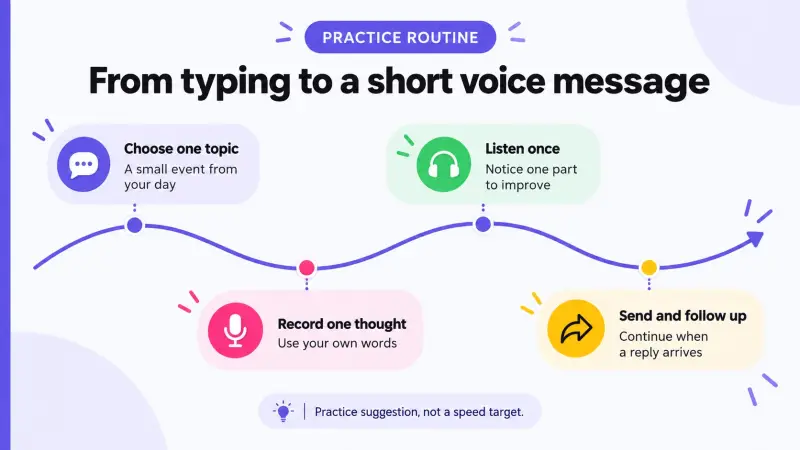
Voice notes are the cheapest fix because they are asynchronous. You record when you feel like it, they listen when they feel like it, and nobody is sitting in silence waiting for you to finish a sentence. One re-record is training. Nine is procrastination with a microphone.
HelloTalk supports voice notes inside the same chat thread as text, which means you can send a written line and a spoken version of it back to back and let your partner comment on both. The AI pronunciation scoring on HelloTalk is worth using alongside that, because it tells you which specific sound or stress placement went wrong rather than giving you a single number and leaving you to guess. A human partner will often be too polite to tell you your vowel is off. Software has no such instinct. HelloTalk's AI grammar correction works the same way on the text side, returning an explanation of why a sentence was wrong rather than just a rewrite, and HelloTalk's image translation handles the menu or sign you photographed and could not read.
A practical starting shape: thirty seconds, one topic, no script. Describe what you ate, what annoyed you today, what you are watching. The content does not matter. The tempo does. Tools like ELSA exist specifically for drilling pronunciation in isolation, and they are useful for that, but isolated drills do not teach you to keep talking when you lose a word mid-sentence. Only unscripted production does.
Live Rooms: Listening in Before You Speak
Live group audio is the format with the worst reputation among learners and the best return on time. The reputation problem comes from a misunderstanding: people assume walking into a room means being called on. It does not.
HelloTalk's Voicerooms run around the clock across time zones, and you can enter as a listener. That single detail changes the risk calculation entirely. You are not committing to speak. You are committing to sit in a room where the target language is happening at native speed and let your ears adjust. Twenty minutes of that is worth more than twenty minutes of a graded listening exercise, because nobody in the room is slowing down for a learner.
What you train as a listener is different from what a podcast trains. A podcast is edited, single-voiced, and evenly paced. A live room has overlapping turns, interruptions, people trailing off, background noise, and jokes you do not get. Comprehension in real conversations depends far more on handling overlap, interruption, and unfamiliar accents than on knowing additional vocabulary. You cannot build that from clean audio. You build it from messy audio.
The natural progression inside a room looks like this. Week one, listen only. Week two, use the text channel in the room to react so you are participating without speaking. Week three, unmute for one sentence, ideally a question, because questions are shorter and the pressure moves to the other person once you finish. Week four, answer something. Nobody in the room is tracking your arc. That is the useful part.
Livestreams on HelloTalk work similarly for the listening phase, with a host carrying most of the talking and an audience that can chime in. If the room you land in is too fast or the topic is dull, leave and find another one. Learners who treat room selection as disposable get far more practice than learners who feel obligated to stay.
Keep live listening connected to what you are studying. Take a topic from a lesson or interactive learning session, notice how speakers use it in a HelloTalk room, then try a short contribution yourself. Review the questions or corrections afterward and revisit the topic in the next lesson. A course, an interactive lesson, and a conversation can all support that same sequence; choose the combination that fits your level and goal. The trade-offs between these approaches are laid out further in this comparison of HelloTalk and other language chat apps.
Format Picker by How Much Pressure You Can Take Today
The table below is organized by one variable only: how much real-time pressure you can tolerate at this moment, from lowest at the top to highest at the bottom. It is not a ranking of formats and it is not a ranking of apps. Read the row that matches your energy today, do that thing, and read a different row tomorrow. Most people can move one row down within two weeks of steady use.
| Pressure level | Format to use today | Where to find it | What it trains |
|---|---|---|---|
| Very low, you do not want anyone to hear you | Text chat with correction turned on | HelloTalk text chat using the sentence pattern from your lesson, with in-chat translation and correction to support practice and review | Retrieval, accuracy, written sentence building |
| Low, you will write publicly but not speak | Public post reviewed by several native speakers | HelloTalk Moments, where multiple correctors can mark the same paragraph | Natural phrasing, noticing what sounds off to natives |
| Medium, you will speak but not in real time | Thirty-second unscripted voice notes | HelloTalk voice notes in the same chat thread, with AI pronunciation scoring flagging specific sounds | Speaking tempo, pronunciation, committing to a sentence |
| High, you will listen live but stay muted | Group audio room entered as a listener | HelloTalk Voicerooms running 24 hours, plus Livestreams with a host | Real-speed comprehension, accent range, following overlap |
| Highest, you will take a live turn | One spoken question or answer in a live room | HelloTalk Voicerooms, unmuting briefly once the topic is familiar | Turn-taking, recovery after losing a word, real-time output |
Notice that four of the five rows describe something you can do without a live listener. The pressure ramp is real, but it is gentler than most learners assume when they write off group audio entirely.
Why Switching Format Beats Switching App
Switching apps feels like progress because it produces activity. New profile, new interface, new set of people to introduce yourself to. What it does not produce is a different kind of practice, because most people carry their format habit with them. If you typed for six months in one app, you will type for six months in the next one.
Switching format changes the actual demand on your brain, which is the only thing that moves the needle. HelloTalk is built around this specific idea: text, voice notes, Moments, Voicerooms, and AI feedback tools sit in one place so that changing format costs nothing but a tap. HelloTalk has grown to 70M+ registered users across 200+ countries and territories studying 260+ languages, with 90% of core features free, which mostly matters here for one reason. At that size there is a room running and a partner awake in your target language whenever you happen to feel brave.
The other thing worth being honest about: no single format gets you there. Text without voice builds a silent vocabulary. Voice without listening builds confident nonsense. Rooms without text leave your accuracy unchecked. A learner who rotates through all three formats in a single week makes faster progress than one who uses any single format perfectly for a month. Rotation is the strategy. The app is just where it happens.
So here is the concrete action. Before you download anything else, open the chat app you already use, find one partner you have exchanged text with in the last month, and send a thirty-second voice note today. No script, no re-recording more than once. If that lands, join one HelloTalk Voiceroom this week as a listener and stay for twenty minutes without unmuting. Two moves, one week, no new accounts.
If after that you still think the product is the bottleneck, then go comparison shopping with a clear head. Broader options are covered in this guide to language exchange apps and, if the format you have been avoiding is public output, HelloTalk Moments is where a single post gets corrected by several native speakers at once. Most of the time, though, the fix is a format you have been avoiding, not a product you have not tried.