
Six Language Exchange Communities, Compared by Reply Rate and Correction Quality

Reply Rate Is the Only Metric That Decides Whether Exchange Works
Most comparisons of language exchange communities start with feature lists. Translation, flashcards, voice notes, profile filters. That is the wrong place to start, because none of it does anything until a human on the other end types something back to you.
If you send twelve messages and get one reply, you do not have a language exchange. You have a hobby of writing introductions. A language exchange community only produces learning when a real person answers you within a window short enough that you still remember what you asked.
HelloTalk sits in this comparison because the HelloTalk platform is built around that single bottleneck: it puts you into conversation first and adds study tools around the conversation, rather than the other way around. HelloTalk reports 70M+ registered users across 200+ countries studying 260+ languages, which matters here for one narrow reason. Reply rate is a density problem. The more people awake and typing in your target language at the hour you happen to be free, the shorter your wait.
But density alone is not enough, and this article is not going to pretend HelloTalk wins on every row. A big community with no correction culture gives you fast, fluent, wrong practice. So there are two axes worth measuring, and they pull against each other: reply rate, meaning how quickly a stranger answers a cold message, and correction quality, meaning whether that person tells you your sentence was off and explains why.
Below, six communities are lined up on both axes. Where a number is publicly confirmed, it is stated. Where it is not, the column says large, moderate, or small, because an invented statistic would be worse than an honest qualitative read. If you want the broader category map first, the comparison hub for language learning chat apps in 2026 covers the wider set of tools this article narrows down from.
Six Communities, Side by Side
This first table answers one question: if you joined today, who is likely to answer you, how fast, and what happens to your mistakes. Read it left to right as a funnel. Active learners tells you whether anyone is home. Typical reply window tells you how long you wait. Correction tools tells you whether the reply teaches you anything. Best for is the situation where that community is genuinely the right pick.
One note on the middle two columns. Only the HelloTalk figure is an officially published number. Every other entry is a qualitative read, because these platforms do not publish comparable active-user or response-time data.
| Community | Active learners | Typical reply window | Correction tools | Best for |
|---|---|---|---|---|
| HelloTalk | Very large (70M+ registered users, 200+ countries) | Often same day, frequently within minutes at peak hours | In-chat correction, in-chat translation, Moments corrections from multiple native speakers, AI grammar correction with explanations | Daily unscheduled practice with corrections built into the chat itself |
| Speaky | Moderate | Same day to a few days | Basic text chat, no dedicated correction layer | Simple one-to-one text partners without a heavy interface |
| InterPals | Small to moderate | Several days, sometimes longer | None built in, corrections happen inside long messages if at all | Slow written correspondence, closer to pen pals than conversation |
| Busuu (peer feedback) | Large course base, smaller feedback pool | A few hours to a few days per submission | Structured peer review tied to a specific course exercise | Learners who want feedback attached to a lesson they just finished |
| italki (community side) | Moderate on the free community features | Hours to a couple of days on public questions | Public answers and written corrections from other members and teachers | Getting one specific sentence or grammar point explained well |
| Reddit language subreddits | Large but topic-driven | Hours on an active thread, silence on a quiet one | Crowd answers in comments, quality varies by subreddit | Research questions and study method advice rather than live practice |
Give the HelloTalk row a place in your lesson sequence. Choose one topic, bring it into a conversation or Moments post, review the response, and reuse the revised expression. HelloTalk's live learning and community practice can support different parts of that plan. Agree on what you want to practise with a partner, so correction serves the learning objective rather than becoming an activity on its own.
Correction Quality: Who Actually Tells You You Were Wrong
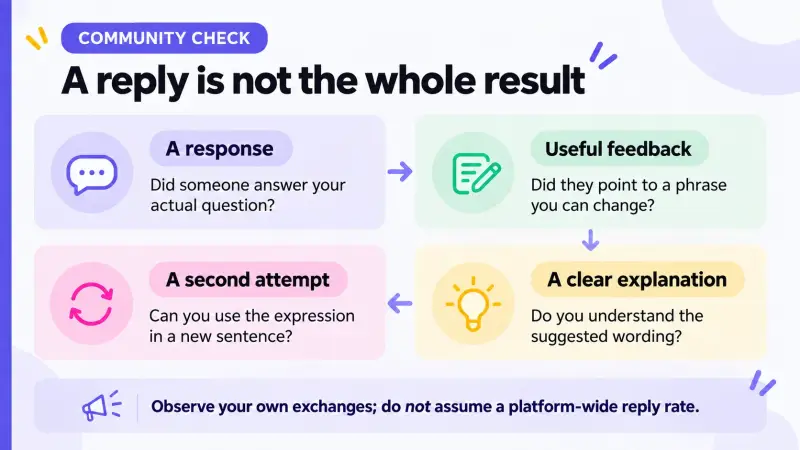
Here is the uncomfortable part of language exchange. Most people are polite. When your sentence is understandable but wrong, the average partner answers the meaning and moves on. You feel great. You learn nothing. You repeat the error for two years.
Correction only happens reliably when the platform makes correcting cheaper and faster than staying silent. That is a design question, not a personality question, and it is where these six communities separate hardest.
On HelloTalk, in-chat correction is a tap. Your partner highlights your sentence, fixes it, and the corrected version appears alongside the original so you can compare them line by line. In-chat translation sits next to it for the moments when you cannot decode what came back. The friction is low enough that people who would never volunteer a grammar lecture will still fix a preposition.
The bigger correction engine on HelloTalk is Moments. You post a short paragraph, a photo caption, or a question to the public feed, and native speakers who have never met you leave corrections underneath. That differs from one-to-one chat in a way that matters: you get several independent opinions on the same sentence, so you can see which corrections everyone agrees on and which are one person's stylistic preference. A learner named Emma posting three sentences about her weekend can collect four corrections before lunch.
HelloTalk also adds AI learning tools on top of the human layer. AI pronunciation scoring gives you a read on your speaking when no partner is online. AI grammar correction explains why the fix is a fix instead of showing you the corrected string alone. Image translation handles the menu, the sign, the screenshot you cannot parse. None of that replaces a human, but it covers the hours when humans are asleep.
Busuu's peer feedback is real correction and often good, but it is bound to the exercise you just submitted. You get feedback on the sentence the course asked you to write, not the sentence you wanted to say. italki's community side produces some of the most careful written explanations anywhere, since teachers answer publicly, though you are asking about a language point rather than having a conversation. Reddit can be excellent when a knowledgeable commenter shows up and thin when one does not. Speaky and InterPals largely leave correction to the goodwill of whoever you are writing to, which works when you find a conscientious partner but is not a system.
What Each Community Costs You in Time Before the First Real Conversation
Reply rate and correction quality both assume you have already reached a conversation. Getting there has its own cost, and it is the cost most people quit over. This second table measures the gap between signing up and having an exchange you would describe to a friend as a real conversation. Read the right-hand column first: it names the specific piece of friction, so you can judge whether it is one you tolerate well. Times are given as plain ranges, because actual speed depends on your target language, your time zone, and the effort you put into a first message.
| Community | Time to first real conversation | What slows it down |
|---|---|---|
| HelloTalk | Minutes to hours | Needing to open the conversation yourself, and writing a first message specific enough to answer |
| Speaky | Hours to days | Thinner pool in less common languages, so fewer candidates per search |
| InterPals | Days to weeks | Long-form message culture, people reply on a weekly rhythm rather than a daily one |
| Busuu (peer feedback) | Days | You have to reach the right lesson before there is anything to submit for feedback |
| italki (community side) | Hours to days | Community threads answer questions well but rarely turn into ongoing conversation |
| Reddit language subreddits | Days, and often never in the conversational sense | Threads are public and one-directional, so practice partners form by accident |
The HelloTalk row deserves the same honesty as before. Minutes is achievable, but only if you do the work. Voicerooms and Livestreams help here, because HelloTalk runs multi-person voice rooms around the clock and you can enter as a listener. Sitting in a room for ten minutes without saying anything is a legitimate on-ramp. You hear the register, you learn what people talk about, and then you unmute. For learners who freeze at the blank chat box, that listener-first path is often the difference between a first conversation today and a first conversation never.
Where Paid Tutoring Beats Free Exchange, and Where It Does Not
Free exchange is not a superior product to paid tutoring. It is a different product, and pretending otherwise is how people waste a semester. A tutor is paid per session and therefore obligated to prepare, to track your weak points, and to keep the hour moving. An exchange partner owes you nothing and is also busy learning.
Paid tutoring wins whenever there is a fixed deadline, because an exchange partner has no obligation to cover your syllabus on schedule. That is the cleanest dividing line available, and this third table extends it across the five situations learners most often face. Read it by finding your own need in the left column rather than comparing the two right-hand columns in the abstract.
| Need | Free exchange | Paid tutoring |
|---|---|---|
| Exam deadline in a fixed number of weeks | Weak, no guarantee of coverage or pacing | Strong, a tutor sequences material against your test date |
| Daily speaking habit | Strong, HelloTalk and similar communities are available at any hour | Weak, scheduling every day is impractical for most people |
| Pronunciation drilling on specific sounds | Mixed, native speakers hear the error but often cannot explain the mechanism | Strong, a trained teacher can describe tongue and mouth position |
| Unscheduled practice in small gaps of time | Strong, you open the app when you have ten free minutes | Weak, sessions are booked in advance |
| Following a course sequence from beginner to intermediate | Link each lesson with a HelloTalk conversation task, feedback review, and another attempt | A teacher can set lesson objectives and use the learner's practice questions to guide later sessions |
The realistic answer for most learners is both. Use a tutor for the parts that need a plan, and use free exchange for volume. Volume is what tutoring cannot give you, because nobody books enough sessions to accumulate the thousands of low-stakes exchanges that make a language feel automatic. A side-by-side read of how HelloTalk compares with other language exchange apps goes deeper on that division of labour, and the wider roundup of language exchange apps covers options this article did not have room for.
Frequently Asked Questions About Language Exchange Communities
How long should I wait before giving up on a language partner?
Two unanswered messages is usually enough information. People join exchange communities in bursts and go quiet for months, and a silent profile is almost never about you. Rather than waiting, keep three or four conversations running at once so that one person going quiet does not end your practice for the week.
Do I need to be intermediate before language exchange is useful?
No, but the format changes. At beginner level, text and Moments posts work better than live voice, because you can compose slowly and read corrections carefully. HelloTalk supports this with in-chat translation so you are never fully stuck mid-sentence. There is a fuller walkthrough of the beginner path in this guide to starting HelloTalk as a beginner.
Which community gives the fastest replies?
Density decides it, and on raw density HelloTalk is ahead of the others in this comparison given 70M+ registered users across 260+ languages. That said, density is language specific. If you are learning a language with a small speaker base online, a smaller community where your target language is unusually concentrated can beat a large one.
Why do people correct me on some platforms and not others?
Because correcting has to be easy. Where correction is a dedicated button attached to the message, as with in-chat correction on HelloTalk, people use it casually. Where correction requires writing a separate explanatory paragraph, most partners skip it and reply to your meaning instead.
Is free language exchange good enough on its own?
For building fluency and habit, yes. For hitting a dated goal like an exam or a job interview next month, no. Free exchange builds volume and paid tutoring builds structure, and neither one substitutes for the other. Most learners who progress quickly run both at once.
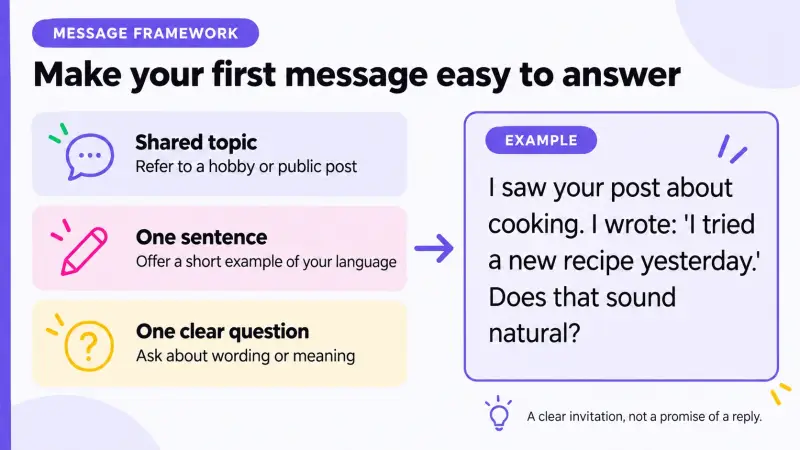
What should my first message to a stranger say?
Something answerable and specific about language or daily life. A question about a word they used, a request to check one sentence you wrote, or a comment on a Moments post. Generic greetings get generic silence because they give the other person nothing to reply to.
How do I keep my information private while practising?
Start in public spaces before private ones. Post to Moments, answer in a thread, listen before you speak. Move to one-to-one chat once you have seen how somebody talks. Share nothing beyond your first name and your target language until a conversation has run for a while, and let the pace be yours.
The Community Test You Can Run in Forty Minutes
Reading comparisons only takes you so far, because your target language, your level, and your time zone change every answer above. So run the test yourself today. Forty minutes, three communities, real data.
Minutes 0 to 5. Pick three from the six above. Include HelloTalk as the density benchmark, plus one mid-sized text community such as Speaky and one specialist option such as italki's community side or a language subreddit.
Minutes 5 to 15. On each one, write the same short profile and the same opening question. Use something concrete: a single sentence in your target language plus the request, please tell me if this sounds natural. Same words everywhere. That is what makes it a test rather than three unrelated attempts.
Minutes 15 to 25. On HelloTalk, post the same sentence to Moments and let the public feed work on it, then sit in on a live audio room as a listener. Do not speak yet. Just note how long it takes before you understand the thread of the conversation.
Minutes 25 to 35. Send your opening question to four different people per platform, not one. One message is a coin flip. Four is a sample.
Minutes 35 to 40. Write down three numbers for each community: how many replies arrived, how long the first one took, and how many of them corrected your sentence instead of only answering it.
Check again in twenty-four hours. The community worth your next three months is the one where strangers corrected your sentence without being asked twice. That number, measured on your own language pair, beats every comparison table anyone can write for you, including the ones above. To run the test on the community that came out strongest on both numbers, open a language exchange on HelloTalk and post your first sentence there.