The best language learning chat app in 2026: Stop answering questions, chat with real people
Imagine this:
We have been studying Japanese for eight months. We never miss a Duolingo streak, we have filled notebooks with vocabulary, we know hiragana and katakana, and we have worked through two textbooks. Then one day a Japanese tourist asks us, slowly, how to get to the subway station.
We know the words "subway," "left," and "walk," but they still do not come together fast enough. In the end, we just point at Google Maps and say nothing.
In that moment, eight months of study feels useless.

We may think that the problem lies in vocabulary or poor grammar. But most likely not. Many people have studied a language for a year or two and have a vocabulary of 2,000 or 3,000, but they get stuck when meeting real people.
The real problem is: What we learn is how to recognize the language, but what we fail to practice is actually using it.
Memorizing words trains us to recognize them. Grammar exercises train us to pick the right answer on a page. Conversation is different: we have to form a thought and say it in real time, before we can check a dictionary or draft a sentence.
This ability can only be developed through real conversations. Either answer more questions, memorize more words, or talk to real people.
Language learning chat apps exist to fill this gap.
What is the difference between practicing with AI and chatting with real people?
Many people have a feeling when using apps like Duolingo: I learned a lot today! But what exactly I learned was forgotten after a few days.
The reason is: the interaction between AI and a learner lacks the kind of thing that makes memories stay. There is no real emotional investment, no real drive to express clearly, and no slight pressure to "say something wrong and be seen".
Talking to a real person is completely different.
When we type a sentence in Japanese in the chat window and know that there is a real person on the other side waiting for our reply, we will really want to say the sentence correctly. When the other person replies with something we don't understand, we really want to figure out what he's talking about. When he corrects our grammar or pronunciation, we will really remember it - because it was a real person telling us, not a line of red words popping up on the screen.
There is also the cultural part. Duolingo can teach us "arigatou gozaimasu", but it can't tell us where Japanese people can say this without looking awkward. The native speakers at Moments will tell us.
This is the core value of chat learning applications: real people, real language, real culture, and real memories.
Major Language Learning Chat Apps of 2026
1. HelloTalk - It is difficult for people who have used it to switch to other ones.
HelloTalk is positioned as language exchange, language learning, and making friends from all over the world. These three things happen simultaneously on it, not as separate modules.
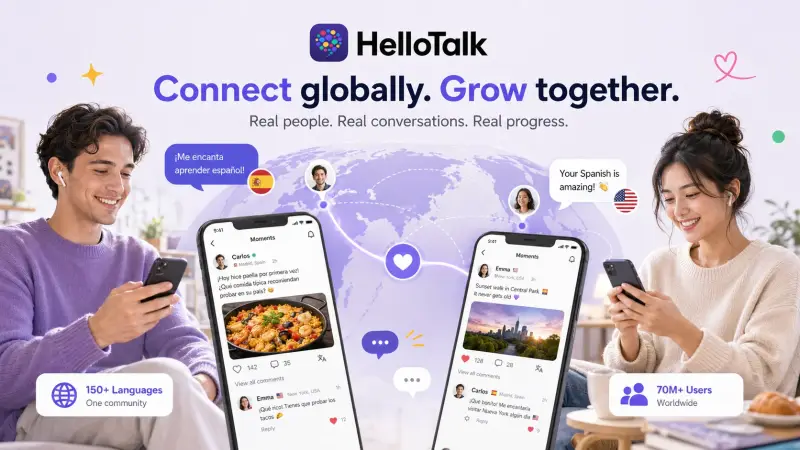
It has more than 70 million registered users worldwide and supports 260+ languages. It won the 2017 Google Play Best Social Application Award and was recommended on the global Google Play homepage in 2024. What these numbers actually mean is this: No matter what language we learn, we can almost always find native speakers, and we can find native speakers who like the same things.
The most indispensable thing after using it is its design that completely integrates learning tools and chat.
Chat-based Learning
This is the core function of HelloTalk. The design logic is very simple: all needs in the language learning process can be solved directly in the chat interface without switching any applications.
Specifically:
- The other party sent a message that we can't understand? Long press to translate immediately without any jump
- Got a word you don't know how to pronounce? Click to listen to the standard pronunciation
- Are there any grammatical problems with the sentences you wrote? The system will mark it out and tell us where we made the mistake, what the correct way of writing is, and why this is more accurate.
- Do you want to check the pronunciation of a word you don't know? The phonetic transcription function helps us spell out each word
For beginners, this design completely solves the problem of "fear of not understanding, fear of saying something wrong, so they dare not speak" - because there is support for every step, no one needs to bear it alone.
Moments (community updates)
If Chat-based Learning solves the problem of "one-to-one practice", Moments solves the problem of "I need more people to give me feedback."
Moments is a public community feed for language learners around the world. We can post on it:
- A sentence in the target language written by yourself and ask if there are any grammatical problems
- A recording asking native speakers to comment on our pronunciation
- A learning puzzle, see if anyone can explain it
- Segments of daily life, described in the target language, allowing native speakers to correct errors
Usually within a few minutes after it is sent out, native speakers from different countries will comment and correct mistakes. Unlike private messages to a language partner and other replies, Moments is broadcast to the entire community and receives a lot of feedback from many angles. Many corrections given by native speakers will be explained with reasons - "This is grammatically correct, but it sounds like a sentence in a textbook. In a real conversation, we would say..." This kind of feedback may not be obtained by paying a tutor.
In addition to posting your own content, it's also worth posting other people's Moments. The daily updates posted by native speakers - what they are eating, what dramas they have watched recently, and what fun things are happening in their lives - are the most direct way to experience the real cultural atmosphere. After scrolling for a while, natural phrasing starts to stick.
Livestreams & Voicerooms
For many people, the most difficult thing is not "learning" a language, but "speaking" it. There is too much pressure in one-to-one conversations. I am afraid of saying something wrong and being embarrassed. As a result, I still dare not speak even though I have been studying for a long time.
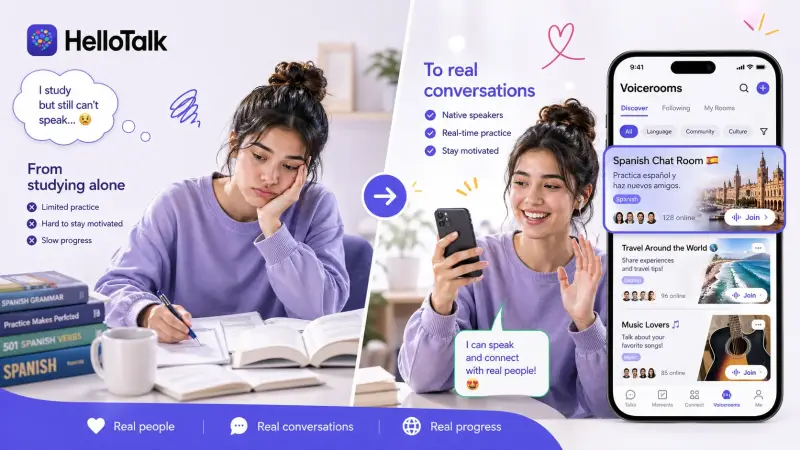
Voicerooms exists to solve this problem. There are multi-person voice chat rooms with different themes 24 hours a day - daily life, travel chat, exam sprint, workplace communication, and various topics. We can go in as listeners first, without speaking at all, just listen to how native speakers communicate with other learners, and feel the rhythm and intonation of the language. Wait until we are comfortable with it and feel confident before turning on the mic.
This low-pressure "listen first, talk later" environment is the starting point for many people to break through their fear of speaking. Many users said that after listening to Voicerooms for a week or two, one day they suddenly found that they could keep up with the rhythm of the conversation, and then turned on the microphone that time, and then they couldn't control it.
The positioning of Livestreams is slightly different, more like a moderated online class: a native speaker talks about pronunciation skills, authentic expressions, and cultural background, and we can ask questions and interact. Compared with paid courses, many Livestreams are completely free, and the time is flexible, so you can find them playing at any time.
AI Learning Tools
In addition to real-person interaction, HelloTalk also has a set of built-in AI tools to enhance areas that cannot be covered by real-person exercises.
AI pronunciation scoring: When we say a sentence, the system will give us a score and tell us which sound is not pronounced correctly and how to adjust it. This is particularly useful for learners of tonal languages - it is difficult to find problems by listening to your own recordings, and AI can give objective annotations.
AI grammar correction: works in real time during the chat process, no need to turn it on separately. Its advantage lies in its pertinence - not the broad grammar check of general translation tools, but precise annotation of common error patterns among language learners.
Picture translation: Take a photo, circle the text inside, and translate it immediately. This function is very convenient when traveling to a country where the target language is spoken and encountering menus or street signs that you cannot understand.
Interest tag matching
HelloTalk also has an often overlooked but actually important feature: a matching system based on interest tags.
We can mark our interests - animation, K-Pop, food, travel, fitness, workplace, exam preparation - and then the system will help us prioritize language partners with similar interests. This means that we find not just "a person who speaks Japanese" but "a person who likes the things we like and speaks Japanese."
If there are common topics, the conversation will continue naturally. Many people have met real friends on HelloTalk and are still in contact years later. This is the true meaning of learning a language.
2. Speaky - Simple, but a little thin
Speaky can match native speakers for language exchange. It is easy to operate and has no learning curve. It can be used by people who only need the most basic functions.
But after using it for a long time, you will find limitations:
- No interest tag matching, every time it is matched randomly, the probability of encountering someone you cannot chat with is very high
- There are no learning tools in the chat interface. There are no translations, phonetic symbols, or error corrections. If you encounter something you don't understand, you can only look it up yourself.
- No Moments, no Voicerooms, the only way to communicate is one-on-one private messages
It can be used as an alternative, but if we are serious about learning languages through chatting, the experience of Speaky will make us feel that something is missing the more we use it.
3. Busuu - The system course is good, but the core functions require payment
Busuu combines structured courses with community interaction, and has the function of native speakers correcting written exercises. Suitable for people who like systematic learning.
Several obvious shortcomings:
- Most of the valuable features are behind a paywall, and free users have very limited access
- Feedback from native speakers is not immediate, sometimes it takes several hours - I learned a grammar point, but by the time the feedback comes, I have long forgotten the question.
- There are few opportunities for oral practice, the focus is on written expression, and there is no such function as Voicerooms
If what we need is to spend a few hours a week using a structured course, Busuu is a reasonable payment option. But if we want to practice speaking frequently and maintain real interactions every day, the equivalent functions of HelloTalk are free.
4. Duolingo - useful for developing habits, but not for practicing speaking
Duolingo does one thing well: getting us to open language apps every day. Checking in every day, completing levels, and maintaining a winning streak - this mechanism can really help us turn language learning into a daily habit. Useful for beginners who need to establish a learning rhythm in the first few weeks.
But as a speaking practice tool, it's anything but:
- Full interaction with AI, no real person
- The training is listening and reading, and there is no output of speaking and writing.
- No language partner matching, no community, no Voicerooms
The most practical usage: Use Duolingo to help you establish the habit of opening language applications every day, and use HelloTalk for substantial speaking practice. The two are used together and complement each other.
Function comparison, see clearly at a glance
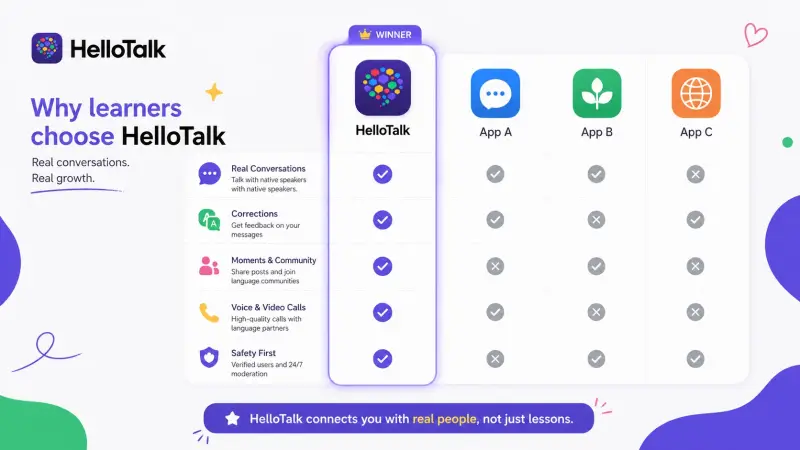
| Features | HelloTalk | Speaky | Busuu | Duolingo |
|---|---|---|---|---|
| Chat with real native speakers | Yes | Yes | Limited | No |
| Accurate matching of interest tags | Yes | No | No | No |
| Translation + error correction embedded dialogue | Yes | No | No | No |
| Moments community error correction | Yes | No | Paid | No |
| 24-hour Voicerooms | Yes | No | No | No |
| AI pronunciation rating | Yes | No | Paid | No |
| Core function free ratio | 90% | Yes | No | Yes |
What HelloTalk really solves are three very real problems.
"I can't find anyone to practice speaking"
This is the most common complaint and the most direct cause of stasis in spoken language. There are no native speakers around, I can't chat with random people I find online, and I don't know what to say if I find them.
HelloTalk's interest tag matching fundamentally solves this problem. If we mark "like anime", the system will give priority to matching native speakers of the target language who learn our mother tongue and also like anime. After we first said hello, the topic naturally came up. The size of 70 million+ users means that no matter what language we learn, there are people waiting to communicate with us online at almost any time.
"I have been studying for a while but I can't continue"
The root of this problem is usually not laziness but loneliness. A person works on the questions in silence without knowing whether he has made any progress. With no one paying attention and no one encouraging him, it is difficult to maintain motivation for a long time.
HelloTalk's solution is to turn language learning into a social thing. We posted a sentence in Moments, and someone came to like and correct it, which gave us a sense of participation; we made an appointment with our language partners to chat twice a week, which gave us a sense of responsibility; we met several learners at the same stage in the Voicerooms, and we felt a sense of belonging. These things combined make persistence something meaningful rather than just a matter of perseverance.
"I don't learn languages just to take exams, I want to really get to know friends from other countries"
Many people have a larger motivation behind learning a language: they want to broaden their world and establish real connections with people from different cultural backgrounds. However, traditional learning tools only solve the problem of "can you know it?" and do not solve the problem of "how to connect".
The design logic of HelloTalk has been from the beginning: language is a means, and cross-cultural communication is the purpose. The native speakers we meet on Moments can become long-term language exchange partners, local friends we contact when traveling to that country, and real friends. This is what makes language learning lastingly meaningful.
How to use language learning chat apps well? Some practical suggestions
Start by posting publicly, don't just rely on private messages
The feedback from Moments is much faster and richer than one-on-one private messages. Send out a practice sentence, and within a few minutes you may receive corrections from three or four native speakers at the same time from different perspectives. This kind of broadcast feedback is one of the most cost-effective practice methods in chat applications.
Listen first when entering Voicerooms, don't force yourself to speak immediately
The fear of speaking out is real, but if you insist on speaking, you will easily fall into a vicious cycle - you will be stumbling when speaking, let alone want to speak. A better way is to first enter Voicerooms as a listener, listen for a few days, get used to it, find the time when you want to interrupt, and join in naturally. Many people who used HelloTalk to break through their fear of speaking started this way.
Treat being corrected as a reward, not a punishment
Being corrected in Moments or conversations is one of the most valuable things about this type of platform. Each correction is a real native speaker using his or her own time to tell us how a native speaker would really say the sentence. Write it down and use it in your next conversation - it's the fastest way to learn.
Use interest tags to find people, don't just look at language proficiency
Having similar language proficiency is helpful, but long-term conversations rely on common topics. A language partner who likes our hobbies is more than twice as valuable as a language partner whose language level perfectly matches ours but has nothing to talk about.
Fixed time, even if it's only twenty minutes
The frequency of language practice is more important than the duration. Twenty minutes of real conversation a day will make progress much faster than two hours once a week. Fixing a time slot in your schedule is like making an appointment at the gym - it's hard to skip if it's fixed.
At last
Learning a language is, in the final analysis, very simple: speak to a real person, speak frequently, have someone correct you if you make a mistake, and then continue speaking.
After going full circle, the most effective tool is the one that can help us do this.
HelloTalk is currently the most complete in this matter - real-person chat, community error correction, Voicerooms, AI tools, interest matching, all in one place, 90% of the functions are free.
Download it, find your first language partner, send your first message.
That moment is more effective than studying the questions for another month.