
English for Software Project Handovers: Resources for Explaining Status, Risks, and Next Steps

You know exactly which parts of the project are finished, which parts are held together by a workaround, and which ticket has been blocked for three weeks. Then you have to say all of it in English to the person taking over, and it comes out as one long sentence. They write down "auth is done" when what you meant was "auth works in staging, but token refresh fails after the vendor's nightly maintenance and I restart it by hand."
One thing that helps is a structure that keeps three things apart in the listener's head, plus a place to rehearse it and ask a listener what they understood.
Compare English4IT, English for Software Engineers, and HelloTalk
Three named resources cover three different jobs here: workplace register, project conversation, and live use with a listener. None of them advertises a dedicated handover module on its public outline, so the useful question is what each one publicly lists and what you have to build on top. This sits inside the broader problem of building industry English through real conversations, narrowed to one task.
The table below is a quick sort before you spend time or money on anything. Read it by column three, "what you still have to build," because that column is where most handover practice actually lives. Course pages change, so check the current one before you commit.
| Resource | What its own pages list | What you still have to build | Role in a handover |
|---|---|---|---|
| English4IT Communication | Workplace emails, feedback, cross-cultural communication, meetings, demos and presentations, delivered through video, case studies, templates and speaking tasks. The advertised starting level is strong intermediate to upper-intermediate, and mentoring or live-group access varies by plan. | The handover drill itself. No dedicated software-handover module is listed, and not every plan includes mentor feedback or live classes. | Workplace register: how you open, structure and close a work update |
| English for Software Engineers: Boost Your Global Tech Career (Terry Mc Gonigle) | Project-specific questions, clarification, responsibilities, requirements, backlog discussion, plus dialogue and quiz sections, PDF slides and selected previews. | The receiver-side rehearsal and your own project script. Viewable previews do not mean the whole course is open, and no technical-correctness guarantee or professional certification is listed. | Project conversation: clarification and responsibility language |
| HelloTalk | HelloTalk offers text chat and voice messages with native speakers, Moments posts that other members can respond to, and Voicerooms you can join as a listener or a speaker. | Your own fictional project, your own script, and your own review questions. HelloTalk does not supply either course and does not promise you a software engineer as a partner. | Live use: does a real listener follow your handover, and where do they stop following |
Neither English4IT nor Terry Mc Gonigle's English for Software Engineers advertises a dedicated project-handover module on its public outline, so the handover drill is something you assemble from their workplace and project-clarification material. That is not a complaint about either course. It just means you should not buy one expecting a ready-made script, and you should plan the practice half yourself.
Use English4IT for Workplace Communication, Then Build Your Own Handover Task
English4IT's communication course lists the parts of work English that a handover borrows from: meetings, demos, presentations, written updates and giving or receiving feedback. That is the register layer. It teaches you how a work update sounds before you worry about what your specific sync job is doing.
Two practical notes before you start. The advertised entry level is strong intermediate to upper-intermediate, which means the material assumes you can already hold a work conversation and are trying to make it clearer. And what you get depends on the plan, since mentoring and live-group access are not identical across them.
A handover task you can build from the meeting and demo material
Here is an adaptation I would suggest, not an exercise the course provides. Take any demo or meeting structure you study there and rewrite it for a person who will own the project after you leave, then compare the two versions out loud.
A demo says "look what this does." A handover says "here is what you will be holding on Monday." Same project, different job, and the second one needs the unfinished parts in it.
Start with a sentence you would actually say, then split it. The version below is a rewrite that adds invented situational detail, so treat it as a demonstration; in a real handover you can only add facts you have confirmed. This is the kind of sentence that causes trouble:
"So the reporting page is basically finished, there's still the caching thing we never really solved, and I think someone should talk to the data team at some point."
Split into three:
"The reporting page is finished and deployed to production."
"Report pages load slowly for accounts with more than a year of history, because the caching fix was never finished."
"Someone needs to ask the data team whether they can pre-aggregate the yearly view. I have not contacted them yet."
The three rewritten sentences keep status, risk and next action apart, and the third one says plainly where that request stands. Notice also that "someone" is still vague. Naming the owner is the next improvement, and it is a language choice you can practise, not a project management rule.
Use Terry Mc Gonigle’s English for Software Engineers to Practice Project Clarification
The outline of English for Software Engineers: Boost Your Global Tech Career covers project-specific questions, clarification, responsibilities, requirements and backlog discussion, with dialogue and quiz sections attached. The clarification lesson is listed explicitly, along with PDF slides and selected previews.
Clarification language is often studied for asking better questions. For a handover, flip the direction. You are the one who will be asked, so the value of that material is that it shows you the shape of the questions coming at you, and you can prepare answers before you are on the call.
A simple drill: write your handover note, then write five questions you think a careful receiver would ask, then answer each one in two sentences. Five is just a workable number for one sitting; use three if the project is small.
Here is what one of those pairs can look like, written as my own example rather than course content:
Receiver: "When you say the sync job is mostly stable, how often does it fail?"
You: "It failed twice in the last month, both times right after the vendor's nightly maintenance window. I have not found the cause, so I restart it manually the next morning."
That answer replaces a vague adjective with a count, a pattern and an honest admission of what is unknown. "Mostly stable" told the receiver nothing they could plan around.
Make Current Status, Open Risks, and Next Actions Easy to Separate
Everything above feeds one structure, and this is it. A handover becomes usable when the receiver can tell, without asking, which of your sentences describe what is true now, which describe what might go wrong, and which describe what somebody has to do next. When those three blur together, the receiver may over-trust the finished parts or worry about the finished parts, and the structure of your sentences is one thing you can change.
The table below is a sorting tool for a draft you have already written. Take your handover note, label every sentence with one of the three buckets, and rewrite any sentence that needs two labels. The patterns in column three are ones that keep the buckets apart in practice, not the only grammatically correct way to say each thing.
| Bucket | Question it answers for the receiver | Sentence patterns that keep it in its own bucket | Example |
|---|---|---|---|
| Current status | What is true right now? | Present simple for how things run; present perfect for finished work that still matters today | "The import script runs nightly and has been stable since the September deploy." |
| Open risks | What could go wrong, and what do we not know? | if or when clauses, modal verbs, and an explicit "we do not know" | "If the vendor changes the endpoint again, the nightly import will fail silently. We do not know when their next change is planned." |
| Next actions | Who has to do what, and by when? | A named owner, a verb, and a time reference | "Emma needs to add an alert for failed imports before the next release." |
Saying the label out loud helps more than it should. "That was the current status. Now the two open risks." gives the listener a place to put the next thirty seconds, and it buys you a breath.

Give the Receiver Enough Context to Ask a Useful Question
Context is the part people cut when they are nervous in a second language, because it feels like padding. It is not padding. Enough context means the receiver can ask a question that changes your next sentence.
Four pieces are worth covering before any technical detail: who uses this thing, what breaks for them if it stops, who owns the decision when it breaks, and what deadline is already fixed. Thirty to forty seconds of that is a suggestion you can adjust, and it reframes what you say afterwards.
Compare the two openings. "This is the invoice service, it's Java, it talks to the billing API." tells a receiver almost nothing they can act on. "This is the invoice service. Finance uses it on the first working day of each month, so an outage on the 1st is visible to them within an hour. Priya in Finance decides whether we delay a run. The next run is 1 October." tells them when to worry and who to call.
From the second version, a receiver can ask something that matters: "What happens if the run fails on the morning of the 1st and Priya is unreachable?" That question improves the handover. If you want the general habit behind this, the guide on practicing effective communication in a foreign language covers the checking and confirming patterns this section leans on.
Practice With a HelloTalk Partner Using a Fictional Project
Do not rehearse with your employer's real system details. Build a fully fictional project: invent the product, the company and the vendor, and keep only the shape of the problem. Leave out your employer's non-public architecture, incident details, customers and data, and if you borrow anything from reality, use only what is already public or what you have clear permission to share, since renaming things does not by itself make them shareable. A fictional inventory sync with a flaky nightly job trains much of the same language, and it keeps the practice separate from anything you owe confidentiality on.
The drill has three rounds, in this order: a written handover note, a spoken retell, and the receiver's questions. Each round catches a different failure, so running all three is worth more than repeating the first one.
Round one is written. Post the note in a HelloTalk chat with a partner, or as a Moments post if you want to invite responses from more than one member. Ask one thing: after reading it, what do they think is already done and what is still broken?
Round two is spoken. Record the same handover as a voice message in HelloTalk, 60 to 90 seconds, without reading your note aloud. That length is a starting point, not a target. Voice messages let your partner replay the sentence where you lost the thread, which is hard to isolate in a live call.
Round three is questions. Invite your partner to send back two or three follow-up questions as a receiver rather than as a teacher, and accept that not everyone will have time to reply. HelloTalk also has Voicerooms if you want to try the same explanation with a group listening. Follow the host's rules and wait until you are invited to speak; joining as a listener first is a low-pressure way to hear how other people handle being interrupted mid-explanation.
Your opening message can be short and specific. Something like: "I'm practising a work handover in English. I'll send a 90-second voice message about a fictional project I'm passing to a colleague. Afterwards, could you tell me what you understood was finished and what was still a problem? You don't need any technical background." If you are still deciding where to run this kind of practice, the comparison of apps for practicing industry-specific English covers the wider set of options.
Check Language Clarity Separately From Technical Accuracy
These two reviews get confused constantly, and mixing them wastes both. A language partner can tell you whether your handover was understandable; only someone who knows the system can tell you whether it is technically correct. A partner may have relevant experience and offer a useful observation, but this task does not ask them to certify your caching diagnosis.
For the language pass, ask questions that produce evidence instead of praise. Which sentence did you have to replay? Can you tell me back, in your own words, what has to happen before the next release? Was there a point where you stopped being sure whether I was describing a problem or a plan? A retell is a useful one, because a retell that reverses cause and effect points you toward the sentence that carried the wrong signal, though you still have to check the context, their background knowledge and whether they heard you clearly.
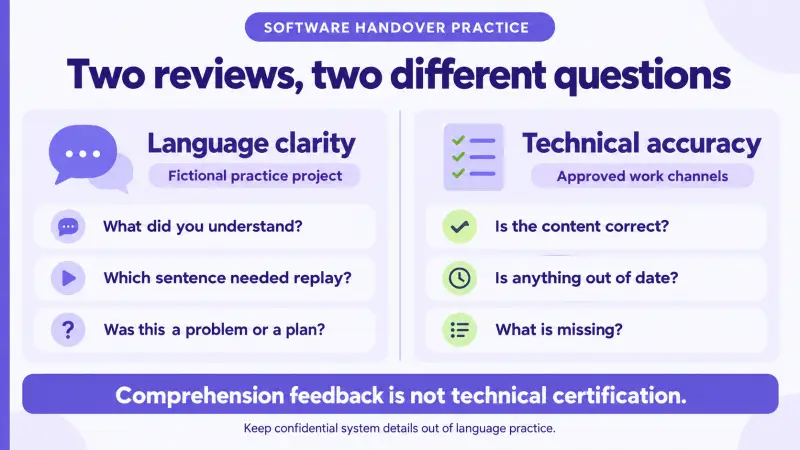
Be careful about reading too much into one moment. A pause might be someone thinking, and a follow-up question often means your partner is interested rather than lost. A repeated question about a fact you already stated, or a retell that lands on the opposite meaning, is worth looking into, though the cause could be your wording, missing background or audio they could not hear clearly.
For the technical pass, send the same note through your approved work channels to a teammate, a reviewer, or whoever inherits the project, and ask only about content: is anything here wrong, out of date, or missing. Keep that review separate from the fictional practice you send to a language partner, then merge the two rounds of feedback into one version. When you want a real listener for the language half while a colleague handles the technical half, HelloTalk lets you send the written note and the voice retell to native speakers, and the comprehension feedback you get there is about whether your English worked, which is the half this task asks them for.
Frequently Asked Questions About Software Handover English
Do I need a software-specific English course, or is general workplace English enough?
A handover uses both layers. The workplace layer, which English4IT's communication modules list, covers how you open, structure and close an update and how you handle feedback. The software layer, which the English for Software Engineers outline covers, gives you project questions, clarification and responsibility language. If your general work sentences already hold together and only project talk collapses, start with the software-focused one.
What level do I need for English4IT's communication course?
The course page advertises strong intermediate to upper-intermediate as the starting point, so it assumes you can already hold a work conversation and are trying to sharpen it. If you are below that starting point, check the provider's stated entry level and any sample material to see whether it fits you. What each plan includes differs, since mentoring and live-group access are not the same across plans, so check the current page.
Does either course give me a ready-made handover script?
Neither public outline lists a dedicated handover module. That does not mean handover language never comes up inside a lesson, but you should not choose either course expecting a finished script. The three-bucket structure in this article is my own practice format, not an exercise supplied by either provider.
How do I practise a handover without sharing confidential details?
Work from a fully fictional project. Invent the product, the company, the vendor and the people, and keep only the shape of the problem, such as a scheduled job that fails after a third party's maintenance window. Leave out your employer's non-public architecture, incident details, customers and data, since changing names does not by itself make that information shareable. Much of the language you need is the same, and a technical review of the real project belongs in an approved work channel.
If my partner asks a lot of questions, does that mean my English failed?
Not by itself. Questions often mean the person is following closely and wants detail, which is what a good handover invites. Signals worth looking into are a repeated question about a fact you already gave, or a retell that reverses what you meant, and the cause can be your wording, missing background or audio they could not hear clearly.
Can a language partner check whether my handover is technically right?
Judging that needs enough specific knowledge of the system and the relevant expertise, which a language partner may not have; some partners can share useful observations, but this task does not ask them to certify technical conclusions. Ask a partner whether the explanation was followable and where it broke down. Ask a teammate, reviewer or the actual receiver whether the content is accurate and current.
How long should a spoken handover be?
Short enough that the receiver can hold it and then ask. A 60 to 90 second first pass followed by questions works well as a practice size, and you can adjust it to the real project. Treat that range as a starting point rather than a standard.
Should I write the handover first or speak it first?
Writing first gives you time to separate status from risk and leaves the receiver something to reread. Speaking first exposes the places where you have no sentence ready and fall back on vague words like "basically" or "mostly." Doing both in one session, written note then voice retell, catches different problems, and HelloTalk lets you keep the text and the voice message in the same chat thread so your partner can compare them.