
A Word, a Collocation, or a Sentence Frame? Choosing What to Learn Together
You write a sentence where every single word is correct, and your partner rewrites it anyway. "I want to do a decision about the trip" comes back as "I want to make a decision about the trip." Nothing in that correction involves vocabulary you were missing or grammar you had never studied, so the real question is what to put in your notes: the word decision, the pair make a decision, or the whole sentence it arrived in.
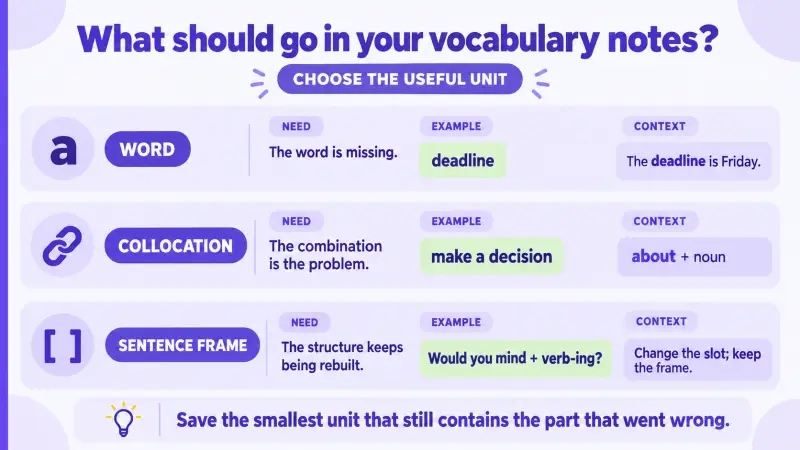
Short answer: save the smallest unit that still contains the part that went wrong. In that example, the word was already fine, so the unit is the pair. Below is how to run that decision quickly, what each unit looks like when it is stored well, and how to check your version against a real reaction before it becomes a habit.
Choose a Learning Unit Based on the Part You Keep Getting Wrong
Before you decide how to record something, look at what actually broke. Three failures show up over and over, and each one points to a different unit.
The first is a gap. You stopped mid-sentence because the item was not there at all, in any form. You wanted deadline and had nothing. That is a word problem.
The second is a bad combination. You had every word, the grammar was legal, and the result still was not what a fluent speaker says. "We had a strong rain yesterday" is understandable and wrong at the same time. That is a collocation problem.
The third is a rebuild. Every time you need a polite request, an opinion, or a comparison, you assemble it from scratch and get a different, slightly awkward result. "I want to know if it is possible that you send me the file" is a sentence built by hand where a ready-made structure exists. That is a frame problem.
The unit worth learning is the smallest piece that still contains the part you keep getting wrong, not the shortest piece and not the whole sentence.
Which of these three you hit most often also depends on what you are using the language for. A traveler collects different frames than someone handing off work to a remote team, and if you have not settled that yet, it helps to first choose a strategy around your actual goal.
The table below is a fast diagnosis, not a ranking. Read it by asking which column describes the thing you swap when the situation changes, since that is what tells you where the useful boundary of the unit sits.
| Learning unit | What stays fixed | What you swap | What shifts with context | Example worth storing |
|---|---|---|---|---|
| Single word | The word plus one sense | The whole sentence around it | Which sense is active, and how formal the word sounds | deadline, tagged with "the deadline is Friday" |
| Collocation | The core word pairing | Tense, subject, and the content that follows | Field and register, more than meaning | make a decision, with about + noun as one usable pattern |
| Sentence frame | The frame words that do the social work | The slot content | How direct or distant the frame sounds | Would you mind + verb-ing? |
Those three rows are the quick version. The next three sections are the full version of each one, in the order you usually meet them: you learn a word, then find out it prefers company, then find out that the company sits inside a repeatable structure.
Learn a Word With the Context That Distinguishes Its Meaning
A one-word translation gives you a label, not a usable sense. English charge covers charging a phone, charging a fee, and being in charge of a project. If your note says only "charge = ask for money", you will not recognize "Who is in charge here?" when it lands in a work chat, and you may produce something odd when you try to use it yourself.
Spanish quedar behaves the same way. Quedamos a las siete arranges a meeting, me queda bien says that a piece of clothing fits, and quedan dos says that two are left. These are not shades of one idea. They are different jobs held by the same word, and the only thing that separates them in your memory is the context you stored with it.
A word is stored well when it carries the smallest context that makes one sense unambiguous, usually a partner word, a preposition, or a two-word situation tag.
So a usable card is not "quedar = to stay". It is closer to this:
- Word: quedar, in the sense of arranging to meet
- Shape it takes: quedar con + person + time
- Your own line: Quedo con Emma a las siete.
- Easy to confuse with: quedarse, to stay somewhere
The British Council's advice for learners on picking up new words points the same way: meet and record words in context rather than as bare entries on a list. That is guidance about how to record, not a claim that single words are a beginner mistake. You cannot talk about a deadline without the noun, and plenty of high-frequency words are worth learning alone first and enriching later.
Keep a Collocation Together When the Words Form a Useful Combination
Some words travel in pairs, and splitting them costs you more than it saves. British Council teaching material for exam-age learners handles these as words that go together, practiced as combinations rather than as two separate items, which matches what corrections keep showing: the individual words were never the issue.
Here is the test that usually settles it. Take the combination, swap one half for a synonym, and check whether the meaning survives while the result stops being the combination speakers usually choose in that context.
- "Heavy rain" becomes "strong rain". The meaning survives, but "strong rain" is not what speakers usually reach for in this context.
- "Make a decision" becomes "do a decision". The meaning survives, and again the second version is not the usual combination here.
- "Take a photo" becomes "do a photo". Same result.
This is not an English quirk. Spanish says hacer una pregunta, closer to "make a question" than to "ask" one. German says eine Entscheidung treffen, closer to "meet a decision". Japanese says 風邪をひく, closer to "pull a cold" than to "catch" one. In every case the logical alternative is understandable and still not the combination usually chosen in that context.
When swapping one word for an accurate synonym keeps the meaning but moves you away from the combination usually used in that context, the combination is the unit, and it is worth storing together with the grammar that commonly holds it.
Store make a decision, with about + noun as one pattern it appears in, rather than the sentence "The team needs to make a decision about the trip." That sentence was one-time content. The pair, and the patterns it takes, will come back all week.
One honest limit: a swap sounding strange to one person is a signal, not proof of an absolute rule. Regional habits and professional registers differ. Before you record a pair as fixed, it is worth seeing the combination in more than one place, or hearing the same reaction from more than one person.
Use a Sentence Frame When Some Parts Stay Fixed and Others Change
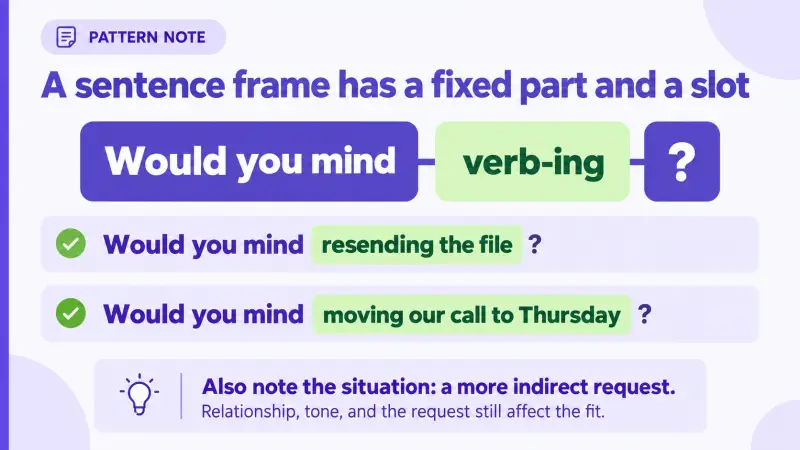
A sentence frame is a chunk where the fixed words carry the function and a slot carries the content. The fixed part softens a request, hedges an opinion, or opens a comparison. The slot changes every time.
Would you mind + verb-ing? is a frame. So is I'm not sure whether + clause. So is It depends on how + clause. What makes them worth storing as one unit is that the fixed half is exactly the half learners rebuild badly under time pressure.
Frames come with slot rules, and the rule belongs in your notes. Watch what happens with one of them:
- Would you mind resending the file? Works.
- Would you mind moving our call to Thursday? Works.
- Would you mind to resend the file? Breaks, because that slot takes an -ing form.
The same structure exists everywhere, with its own attachment rule. Spanish ¿Te importa si + present tense? gives you ¿Te importa si abro la ventana? Japanese 〜てもいいですか attaches to the te-form, so 座る becomes 座ってもいいですか. If you store the frame without its attachment rule, you will fill the slot with the dictionary form and produce something that no correction list warned you about.
Register belongs in the note too. Would you mind makes a request more indirect, which is useful with a new colleague, while a plain Can you is also natural with a close friend and simply sounds more direct. Register depends on the relationship, the tone, and what you are asking for, so this part of the note is about fit rather than error.
A frame is the right unit when the fixed part does the social work and the slot carries the content, which is why the slot rule and the register both belong in the same note as the frame itself.
If the jump from a workbook to a live conversation is where you stall, this pairs well with moving grammar exercises into conversation without hints.
Try Your Substitutions in a HelloTalk Conversation
Everything above is a decision made at your desk. The swap test only finishes when a person reacts, which is where HelloTalk fits into the sequence: not as a replacement for the course or dictionary that gave you the expression, but as the place where your version meets someone who did not write it.
The practical move is small. Take one unit you are unsure about, produce two versions, and put them where a reaction can happen. HelloTalk's text chat lets you send the uncertain version inside a real message rather than as a quiz, which is usually more informative, because you get to see whether the person answers your content or your wording.
Two short exchanges show the difference between a correction and a reaction.
You: Could you take a look at this when you get a chance?
Alex: Sure, send it over.
You: Could you see this when you're free?
Alex: You mean look at it? "See this" sounded like you were showing me a photo.
In the first exchange the reply was about the task, so nothing in the wording got in the way. The second drew a clarifying question, which shows how Alex read that wording at that moment; a short follow-up is what turns it into information about meaning rather than style. A person can react to your actual wording in a real situation; a synonym list cannot.
The table below matches each kind of substitution to a way of putting it in front of someone and to what the answer actually proves, so you do not read a polite "that's fine" as confirmation of something it never tested.
| What you are testing | How to put it in front of a person | What the reaction tells you |
|---|---|---|
| A synonym inside a collocation | Use it in a normal message about that topic | A different word coming back shows how that person would put it; ask directly or check more examples before storing the pair as fixed |
| A new fill in a frame | Send it as a real request, not a sample | An on-topic answer shows you were understood, not that every word sounded natural, so ask if you want the wording itself checked |
| A word sense you are unsure of | Use it with the situation attached | A clarifying question shows the sense did not land for that person, which can also come from missing background |
| A more or less formal version | Ask directly in chat which one they would say to a colleague | You get register information, which corrections often skip |
Other parts of the platform cover what chat cannot. HelloTalk's Moments lets you post two versions of the same sentence publicly, so more than one native speaker can react instead of one. HelloTalk's Voicerooms let you join as a listener and notice which frames keep appearing in unscripted talk, which is a cheap way to find out whether the structure you saved is common or bookish. HelloTalk's voice and video calls add the part text hides, including where someone hesitates before answering you.
This is also the point where stored material has to leave your notes and become something you produce under time pressure, a split covered in more depth in what input and output each build.
Save the Useful Pattern Without Memorizing Every Whole Sentence
After a conversation, most of what you wrote was one-time content. The file, the Thursday, the window: none of that repeats. What repeats is the shape around it.
A workable entry keeps five things and drops the rest: the unit, the slot and the form it requires, one or two fills that a person actually accepted, a short tag for when you would use it, and the version that failed with a one-line reason.
- Unit: frame, Would you mind + verb-ing?
- Accepted fills: resending the file / moving our call to Thursday
- Use when: polite request to someone you do not know well
- Failed: "Would you mind to resend", because the slot takes an -ing form
Review it by rebuilding rather than recognizing. Cover the fills, say the frame out loud with a new one you never wrote down, and see whether the fixed half comes out intact. Recognition tells you that the card looks familiar. Rebuilding tells you whether the unit is available when you need it.
Whole sentences are worth keeping when they work as fixed social lines, as context for how a pattern is used, or as a model for rhythm and pronunciation, while the piece you set out to memorize this time is usually the reusable pattern inside them.
Keeping the list short matters more than people expect, especially if you are running two languages at once, where the same hour has to cover twice as many patterns. That trade-off is handled separately in balancing study and conversation across two languages, and the unit question here sits inside the broader set of language learning strategies that decide where your practice time goes.
Frequently Asked Questions About Words, Collocations, and Sentence Frames
Does this mean single words are a waste of time?
No. You cannot build a sentence without nouns and verbs, and plenty of words are worth learning alone and enriching later. The point is narrower: when the correction you received was not about a missing word, a bigger unit is the one that fixes the problem.
How do I tell a real collocation from one of several acceptable options?
Swap one half for an accurate synonym and see whether the meaning survives while the result stops being the combination usually used in that context. If so, you probably have a strong pair, though a few other options can still be acceptable. Before recording it as fixed, check the combination in a second place or with a second person, since regional and professional habits vary.
How many fills should I keep for one frame?
Two or three confirmed fills is a reasonable starting suggestion rather than a proven number. The purpose of the fills is to show the slot rule in action, so once you can produce a new fill correctly without looking, extra examples add little.
My textbook gives whole sentences. What should I do with them?
Mark the parts that would change if the situation changed, and the parts that would not. The unchanged half is usually the frame worth keeping. The rest is example content, which can still be useful as context or as a model for rhythm, even if it is not the part you drill.
Does this work for languages with cases, particles, or different word order?
Yes, but the slot rule has to include the grammatical form required, not just the meaning. A Japanese frame needs the verb form it attaches to, and a German or Russian frame often needs the case the slot takes. A frame stored without that information produces confident, wrong sentences.
Should I save the correction I received or the pattern behind it?
Save the pattern, with the correction kept as one line showing what failed and why. The corrected sentence is tied to one conversation; the pattern is what shows up again next week.
Can I do all of this with a dictionary instead of a conversation partner?
A dictionary is good at separating senses and showing which grammar a word takes, so it belongs at the start. Dictionaries and courses can also describe register. What they cannot do is tell you how the person you are writing to right now reads your version, and that answer comes from use.
Is a sentence frame just a grammar rule in disguise?
Not quite. A frame is a usable chunk with a marked slot, and you can use it correctly before you can explain the rule that underlies it. Learning the rule afterwards makes the frame more flexible, but the chunk is what gets you through the conversation today.