Korean Pronunciation Resources for Beginners: Hearing More Than a Hangul Chart Shows
You can read 감사합니다 letter by letter off the page, but in a drama clip the same word lands as something closer to 감사함니다, and the chart you memorized says nothing about why. Then you say a word you were confident about, your partner repeats it back as a different word, and you still cannot tell which part slipped.
Closing that gap takes two kinds of resource used together: recorded material that gives you a clean model of the target sound, and a Korean speaker who tells you which word they actually heard. A Hangul chart tells you which letter to write; it does not tell you what a Korean listener heard when you said the word.
Compare Nuri-Sejong, KoreanClass101, and Human Listening Feedback
These three are not competing for the same job. The Nuri-Sejong practice catalog groups practice material by area, with Korean pronunciation as one of those areas, so you can work on sounds near the lesson content you are already studying. KoreanClass101 publishes a named pronunciation series, which suits the situation where one specific sound category keeps failing across many words. HelloTalk is where the sound leaves practice conditions and meets a listener who can say what came through.
If you finished Hangul and felt the material suddenly went quiet about how words behave in connected speech, the gap most Korean beginners hit right after the alphabet describes the same problem from the resource side.
Before picking one, it helps to see which question each option can answer and which one it hands back to you. Read the last two columns first, because they decide whether you still need a person in the loop.
| Resource | Sound demonstration | How you compare | Sentence-level context | Who judges the result | What it leaves open |
|---|---|---|---|---|---|
| Nuri-Sejong practice catalog | Pronunciation sits alongside other practice areas; open the exact item to see which sounds and words it demonstrates and at what level | Play the model, then record the same words and listen back to back, a routine you set up yourself | Whatever the selected item supplies; lining it up with your current lesson vocabulary is your decision | Check the selected item for what it reports back; otherwise you, or a listener you arrange separately | Whether a Korean listener would have understood your version |
| KoreanClass101 pronunciation series | A series organized by sound category, with recorded models; which lessons and extra supports open depends on your account | Repeat after the model, one contrast at a time | Example words and phrases from the series; your own sentences are up to you | You, comparing against the recording | How that sound behaves in an unrehearsed sentence you invent |
| HelloTalk | Voice messages from real partners and live speech in HelloTalk Voicerooms | Your voice message stays in the HelloTalk chat thread, so the same sentence can be replayed weeks later | Full sentences inside an actual conversation with a person | A listener who can report the word they heard | A standardized score or a tidy textbook explanation of every rule |
Recorded model audio and a real listener answer two different questions: what the sound is supposed to be, and what your version of it became. A lot of pronunciation frustration comes from trying to get the second answer out of the first kind of resource.
If you are still assembling your main study materials rather than fixing one stubborn sound, the broader comparison in this look at which Korean resources actually move you forward covers that decision. The rest of this article assumes you already have a course and a sound that keeps going wrong.
Nuri-Sejong: Use Pronunciation Practice Alongside Your Lessons
The mistake is treating pronunciation as a separate subject with its own word list. Practice material works harder when the words are the ones you are about to use anyway, which is why pairing pronunciation practice with your current lesson beats drilling random syllables.
Start by opening the specific item you plan to use, before you build a week around it. Check which level it targets, which sounds and words it actually demonstrates, and what, if anything, it gives back about your own audio. Coverage and format differ from item to item, and knowing that in advance saves you from planning a routine the material cannot support.
Here is a weekly routine you can run on top of whatever you found. This is a study loop suggested here, not a feature list of the catalog.
- Choose six to eight target words for the week, favoring the ones with final consonants or double final consonants, and keep to words you can actually find demonstrated in the material you opened.
- Play the model for each one, twice, before you say anything.
- Record yourself saying all of them in one take, so the takes stay comparable.
- Play the model and your recording back to back and sort the words into two piles.
Those two piles matter more than the drilling. Pile one is words where you can hear a difference between the model and yourself. Pile two is words where you honestly cannot tell. Pile two is the list you send to a person later, because self-checking has already run out of information there.
Beginner words worth putting through this are the ones where writing and speech separate: 값이 comes out as 갑씨, 읽어요 as 일거요, 앉아요 as 안자요, 없어요 as 업써요. The point of the recording step is to catch the moment your version drifts back toward the spelling. The listener check that follows is something you arrange yourself, and the next sections cover how to run it.
KoreanClass101: Use Its Pronunciation Series for Focused Sound Work
When the same error follows you across dozens of unrelated words, the problem is a sound category, not vocabulary. That is the case for a dedicated series rather than scattered listening. The published curriculum for KoreanClass101's pronunciation series lists five lessons, covering the consonants, the double and aspirated consonants, sound changes where consonants meet, the vowels, and final consonants.
Two practical notes before you plan around it. Which lessons and supporting materials open for you depends on your account, so confirm that rather than assuming the whole series is available. And a series of models is still input; repeating along with a recording can feel productive long after it has stopped telling you anything new.
Pick one contrast per cycle and freeze a six-word target list so recordings stay comparable. Two contrasts that cause trouble early:
- The plain, aspirated and tense series: 불 (fire) / 풀 (grass) / 뿔 (horn), and 달 (moon) / 탈 (mask) / 딸 (daughter). Listen to the model for how much breath escapes at the very start, how quickly the voice begins after it, and how the vowel right after sounds. Do not try to line all three up on one scale from soft to hard, because no single descriptor separates them reliably, and speakers describe them in different ways.
- The 어 and 오 vowels: 거기 (there) / 고기 (meat), 벌 (bee) / 볼 (cheek), 손 (hand) / 선 (line). Test these in a sentence too, since "고기 좋아해요?" and "거기 좋아해요?" are both things a person might say to you.
Keep that list for the whole cycle. If your target words change every day, each new recording gets compared against nothing, and you lose the one thing that would have shown a change.
Move From an Isolated Sound to a Word and a Short Sentence
A sound that is clean on its own can still collapse the moment it has neighbors. Korean makes this obvious: 한국어 is generally heard as 한구거, 못해요 as 모태요, 좋아요 as 조아요. 맛있어요 is commonly heard as 마시써요, and 마디써요 exists as well, so treat both as things you may hear rather than one correct version and one mistake. Nothing in the letters changed, but the joins did.
So build the target at three levels. Level one is a short syllable contrast, level two is one full word, level three is that word inside a short question you would really ask. Work through them with the model audio, and when a listener is available, use them to check whichever level you are currently on. You do not need a verdict before you try the next level; the listener check is a verification step, not a gate.

The table below is a diagnostic checklist for those three levels, not a set of results you should expect to reproduce.
| Level | What you say | What to listen for | Where it commonly slips |
|---|---|---|---|
| 1. Short syllable | 사 / 싸 | The start of the syllable, including how the voice begins | You hear the contrast in the model but not in your own recording |
| 2. Single word | 사요 / 싸요 | Whether the contrast survives once an ending is attached | The second syllable pulls the first one loose |
| 3. Short sentence | 이거 사요? / 이거 싸요? | The contrast under question intonation and normal speed | The target word flattens as the sentence speeds up |
Beginner pronunciation problems that survive isolated drilling often live at the joins between syllables rather than inside the letters themselves. That is also why reading aloud helps at level three: a page of text gives you sentences you did not write, so you cannot quietly avoid the shapes you find hard. Pick that material by vocabulary and sentence patterns you can handle, whether that turns out to be a short graded reader or a textbook dialogue you have already studied. If you want candidates, short first readers for the stretch right after Hangul covers how to judge one.
Ask a HelloTalk Partner What They Heard Before Asking for a Correction
Here is the move that changes the whole loop. "Is my pronunciation okay?" is a yes/no question, and a friendly partner has little reason to pull apart a sentence you asked them to approve, so "Yes, very good!" is a perfectly reasonable answer to it. Ask instead what word arrived.
The most useful question to send a Korean-speaking partner is not "was that correct" but "which word did you hear." Send a voice message in your HelloTalk chat with two takes of the same sentence, then ask which one is which, and ask them not to correct anything until they have answered.
A realistic exchange:
You (voice message): 이거 싸요?
Partner: I heard 이거 사요. Like you were asking if I am buying it.
You: I meant "is this cheap". What made it sound like 사요?
Partner: The beginning sounded soft and a little long to me. Mine feels tighter and starts faster. (sends a voice message: 이거 싸요?)
You (voice message, second take): 이거 싸요?
Partner: That one I heard as 싸요.
Notice what the partner supplied: not a rule, but a report of what reached them and what changed their interpretation. Their description of the difference is one listener's wording, and another partner might describe the same gap in completely different terms. What travels across listeners is the word they heard, so that is the part worth collecting.
Three other uses fit different parts of the job. HelloTalk Voicerooms let you hear the same everyday words from several speakers instead of one studio recording, and you can join to listen first, though whether a particular room invites you to speak is up to whoever is hosting it. A short written question posted as a HelloTalk Moment lets you invite replies from several readers at once when you want to know which of two phrasings people would actually say in a shop. And the same HelloTalk chat is where the word finally gets used for real, in a conversation about the weekend or a price or a recipe, which is a harder test than any drill because your attention is on the meaning instead of the consonant.
Compare Your Next Recording With the Model and the Listener’s Feedback
The loop only pays off if the pieces stay together. A comparison needs three audio items plus one sentence of human description: the model from your course or the pronunciation series, your first take, your second take after the feedback, and the listener's own words about what they heard the first time.
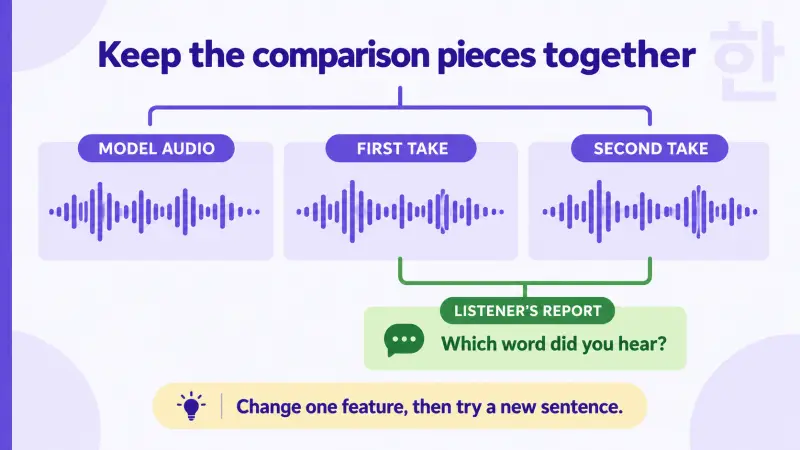
A review pass you can run once a week:
- Replay the model for your target word, then your oldest recording of it, then your newest. Listen for one feature only, not general quality.
- Reread the listener's report. If they said "it sounded like 사요", check whether your newest take still invites that reading.
- Record the word inside a new sentence you have never practiced, so you test transfer rather than memory of one rehearsed line.
- Send that new sentence to the same partner with the same question about which word they heard.
- Log one line: date, target contrast, the sentence, what the listener heard, and the single change you made.
Progress shows up as a change in what listeners report back, not as a feeling that the word got easier to say. Comfort can arrive early and mean very little; the shift from "I heard 사요" to "that one was 싸요" is the signal worth tracking.
Your ear leads your mouth in this loop, so it is worth feeding the input side at the same time with material at a level you can follow, and a comparison of beginner Korean listening resources covers that choice separately. For the review itself, the practical question is where the model audio, both of your takes and the listener's exact wording end up sitting; one workable answer is to keep a running thread on HelloTalk with one patient partner, since the voice messages and their written report stay in the same conversation and you can scroll back to the take from three weeks ago.
Frequently Asked Questions About Korean Pronunciation Resources
Do I need a tool that scores my pronunciation?
A score answers a narrower question than the one you have. What you need to know is which word a Korean listener heard, and that comes from a person who can tell you the word plus what made them choose it. Recorded models give you the target; a listener gives you the verdict.
Is the Nuri-Sejong practice catalog enough on its own?
It gives you practice material with pronunciation among its areas, which you can line up with the lesson content you are studying. Open the specific item first and check its level, which words it demonstrates, and what feedback it offers on your own audio. The recording and sorting routine in this article is a study loop you run yourself, and the listener check is something you arrange separately.
Is KoreanClass101's pronunciation series free?
Some material is openly available and other lessons or supporting features depend on the account you hold, so confirm what actually opens for you before you build a study cycle around a particular lesson. Treat the series as a source of clean models for one sound category at a time rather than a full pronunciation course with feedback.
How long should I spend on one sound contrast?
There is no fixed answer, and anyone promising one is guessing. A workable plan is one contrast per cycle with a fixed six-word list, judged by what listeners report rather than by how natural it feels in your own mouth.
My partner says my pronunciation is good, but people still mishear me. What should I ask instead?
Give them a forced choice. Send two takes and ask which one is 싸요 and which is 사요, or ask them to write down the word they heard before offering any correction. Then ask them to say your version back in their own voice, so you can hear your error from outside.
Should I learn the sound-change rules or just imitate the audio?
Imitate first so your ear has the target, then name the pattern so you can predict it in new words. Once you know why 감사합니다 is heard as 감사함니다, the same shape shows up in 입니다 as 임니다, and you stop rediscovering it word by word.
What if I cannot hear the difference between the two words at all?
Work on recognition before production. Ask a partner to record the two words in random order without telling you which is which, then guess and check. Drilling stalls in a specific way here: if you cannot hear the contrast, you have no way to check your own output, so more repetition just locks in whatever you are already doing.