
Japanese Dictionaries for Beginners: Finding the Right Word for a Real Message

You want to send one sentence to a language partner you already chat with: you would like to invite them over on Saturday. You type "invite" into a Japanese dictionary, get 招く (まねく, maneku), and then stop, because the same entry also lists something about causing a result, and you cannot tell whether this word belongs in a casual message at all. The half written sentence sits there while you scroll the entry again.
Here is what actually moves that message forward. A dictionary narrows your candidates and shows you how a word behaves grammatically. The example sentences show you the kind of situation the word turns up in. And the reply you get shows you how your sentence read to the person you sent it to. A dictionary handles the first two well; the third one needs somebody to read what you actually wrote.
Quick Comparison: Takoboto, JapanDict, and Nihongo Master
To keep this comparison honest, the same single lookup was run in all three: the verb 招く. Nothing below ranks translation accuracy, because one shared lookup cannot establish that. Read the table by the column that matters most for what you are doing right now, which for a message you are about to send is usually the last two.
| Dictionary | What the 招く entry showed | Readings and grammar labels | Example sentences | What it does not settle |
|---|---|---|---|---|
| Takoboto | Several distinct senses on one entry, including inviting a person and bringing about an outcome | Kana and romaji reading, transitive godan verb classification, conjugation forms | Sentence examples shown on the entry | Which sense belongs in your message; one entry does not prove every word has examples |
| JapanDict | Meaning groups for the same headword, with grammar tags | Readings, grammar tags, conjugations | Example sentences, with the site's own help noting that imported Tatoeba and Tanaka Corpus material varies in quality | Whether a given example is a model worth copying; the entry audio is described in its help as computer-generated |
| Nihongo Master | Multiple senses on the word page, covering both invitation and caused consequences | Kana and romaji, part of speech, conjugations | Japanese and English contextual examples on the entry | Whether the wider learning platform is open; no accuracy advantage over the other two was established |
All three sample entries were publicly readable when checked, without creating an account. Takoboto asks you to sign in for personal vocabulary lists and private translations, and an open dictionary page on Nihongo Master says nothing about how its separate learning course works. Entries also get edited over time, so treat the table as a description of what these pages show you rather than a permanent guarantee.
A dictionary entry tells you what a word can mean and how it conjugates; whether that meaning fits the message you are about to send is a separate question the entry cannot answer. If you are still assembling your beginner setup and want to see where a dictionary sits next to textbooks, audio and reading material, the overview of the most effective online resources for beginner Japanese covers that layer. For how a dictionary differs in purpose from a flashcard deck or a textbook chapter, Japanese learning tools compared across apps, textbooks and SRS sorts those roles out.
Takoboto: Check the Reading and Meaning Before Choosing a Word
The habit worth building is reading the entry from the top down instead of jumping to the first English word that matches what you had in mind. On the 招く entry, the top of the page gives you the reading in kana and romaji, まねく and maneku. That comes first for a practical reason: a word you cannot say is a word you cannot use in a voice message or recognize when someone says it back to you.
Next comes the grammar label: transitive godan verb. Transitive tells you this kind of use takes an object, and in the full sentences below the を marks either the person being invited or the result being brought about. That is not a rule that every Japanese sentence must spell out its object, since Japanese often leaves it unsaid when the context already makes it obvious. What the label gives you is a pairing to check: which noun is going with this verb in your sentence. Godan tells you which conjugations you get, so 招きます for the polite form, 招いた for the past, and 招いて for the te-form. If you were unsure whether it was 招いて or 招きて, the conjugation section settles it.
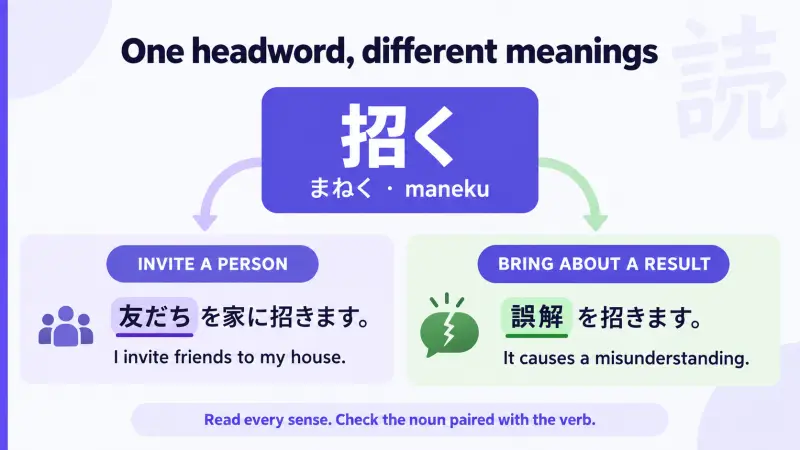
Then read every numbered sense, not just the first. The 招く entry separates inviting a person from bringing about a result, and the two senses pair with very different nouns. The examples below are written for this article to show that contrast, not copied from any entry:
- 友だちを家に招きます。(Tomodachi o ie ni manekimasu.) I invite friends to my house.
- 誤解を招きます。(Gokai o manekimasu.) It causes a misunderstanding.
English does something comparable when it says invite criticism or invite trouble, so the second sense is not as strange as a one-word gloss makes it look. What you are actually reading for is the collocation: one sense goes with a person you are hosting, the other with nouns like 誤解.
Reading all of a Japanese entry's numbered senses is what stops you from building a sentence on a meaning you did not intend, because one headword like 招く covers both inviting a guest and bringing about a result.
JapanDict: Compare the Entries That Match Your Search
Reading one entry carefully solves half the problem. The other half appears when several different Japanese words come back glossed as the same English word, which is exactly what happens with "invite."
So open more than one candidate and compare instead of accepting the first result. On the JapanDict page for 招く, the parts worth comparing are the meaning groups and the grammar tags, since those are what differ between candidates. Two other entries on the same site are worth putting beside it. The entry for 誘う (さそう, sasou) includes senses about inviting or asking someone to do something or come along. The entry for 招待 (しょうたい, shoutai) lists it as a noun that also works as a する verb, with the meaning of invitation or inviting.
That gives you three candidates rather than one. It does not give you a fixed ladder from casual to formal, and nothing in these entries establishes that 招待する is automatically the politer choice. The useful comparison is more concrete: what sentence pattern does each one want, who is involved, and what kind of occasion are you describing. Which one your friend would actually type on a Saturday afternoon is still open at this stage.
Two limits on this site are worth knowing because the site states them itself. Its help describes the entry audio as computer-generated rather than a native human recording, which is a distinction to keep rather than a reason to ignore it: the audio still gives you the reading, and a human voice adds how the word sits inside the rhythm of a particular sentence. Its example-sentence help also warns that imported Tatoeba and Tanaka Corpus sentences vary in quality. A detailed entry narrows your candidates and shows the patterns a word appears in, but it does not confirm how your particular sentence reads to the person you are writing to.
Nihongo Master: Read Examples Before Copying a Translation
Comparing candidate entries narrows the field. Examples are what let you choose between the survivors, because an example sentence carries a situation, and the situation is usually the part you were missing.
The Nihongo Master word page for 招く carries kana and romaji, part of speech, multiple senses, conjugations, and contextual examples in Japanese with English. The same entry covers both the invitation sense and the caused-consequence sense, which makes it a convenient place to run a small self-test.
Try it this way. Read the Japanese example first with the English covered, and ask one question: what is happening here, and who is doing it to whom? Then uncover the English. If your reconstruction and the translation disagree, you have found the gap before it reaches your message instead of after. Then ask the more important question: does any example here describe a situation like mine? If the examples sit in event-hosting or consequence territory and your situation is a short message to a friend about dinner, that is a signal to keep comparing.
One boundary to keep in mind: these dictionary pages being openly readable tells you nothing about how the separate learning course on the same site works. Judge the dictionary as a dictionary.
Compare the Sentence Around the Word, Not Just Its Translation
Everything above converges on one idea. You are not choosing a word, you are choosing a sentence, and the sentence includes particles, the noun that habitually pairs with the verb, the politeness level, and who is doing what to whom. A word that looks correct in isolation can still land oddly once those four things are attached.
This is also why reading and hearing full sentences outside a dictionary pays off. Graded readers give you the same vocabulary embedded in stories where the situation is already supplied, and the comparison of Japanese graded readers for beginners covers where to find that kind of input. Hearing a word spoken by a person with the text in front of you lets you follow that speaker's rhythm and intonation across a full sentence in a specific situation, and beginner Japanese audio resources with text is the companion piece for that.
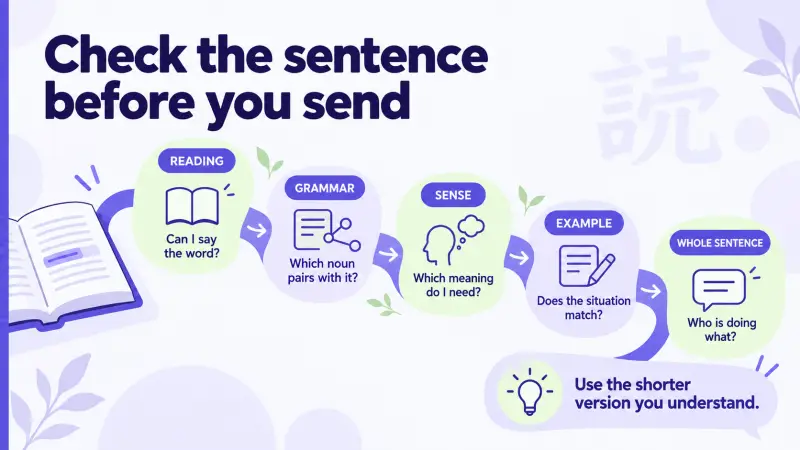
Here is a check you can run on a word before it goes into a message. The left column is what you look at, the middle is the question you ask, and the right shows the check applied to 招く so you can see what a pass or a fail looks like.
| What you look at | Question to ask | Applied to 招く |
|---|---|---|
| Reading | Can I say this out loud right now? | まねく, maneku; the te-form in my sentence is 招いて, maneite |
| Grammar label | Which noun is pairing with this verb in my sentence? | Transitive use, so the person or the result takes を: 友だちを招く, 誤解を招く |
| Sense number | Which numbered sense am I actually using? | The inviting-a-person sense, not the causing-a-result sense |
| Example situation | Does any example describe a situation like mine? | If every example is a formal event and mine is a Saturday message, keep comparing |
| Whole sentence | Can I say what this sentence means and who is doing what in it? | If not, use the shorter version whose meaning I can state |
If you cannot say what your sentence means and who is doing what in it, send the shorter version you can state in your own words; you do not need to explain every particle to use a chunk whose meaning you understand.
Use the Word in a HelloTalk Message and Check What Was Understood
The last step puts the word into a real message and shows you how it reads to somebody else. The exchange below is written as a practice model for this article, not taken from a real conversation, and it assumes a friend you already chat with regularly. A home invitation is not a good opening line with someone you have just met.
You: 土曜日の夜、うちに友だちを招きます。よかったら来ませんか。 (Doyoubi no yoru, uchi ni tomodachi o manekimasu. Yokattara kimasen ka.)
A reply like 行きたいです!何時からですか。(Ikitai desu! Nanji kara desu ka.) is easy to read. The invitation landed and they are asking for the time.
A reply like 誰を招くんですか?(Dare o maneku n desu ka?) is not. That line has more than one reasonable reading: they may be asking who else is coming before deciding, or they may be checking whether they are included, or they may just be curious. It is not evidence on its own that 招く was the wrong word. Resist the urge to diagnose it, and confirm instead:
You: 来てほしいと思って書きました。ほかに友だちが二人来ます。 (Kite hoshii to omotte kakimashita. Hoka ni tomodachi ga futari kimasu.)
Once the meaning is settled, you can ask about the wording separately, which is the part a dictionary genuinely cannot supply: 「招く」はこの場面で自然ですか。ふつうは何と言いますか。(Is 招く natural in this situation? What would you normally say?) That question is short and specific, so it is easy to answer in one line.
An answer like 自然ですよ。でも友だちには「うちに来ない?」のほうが多いかな。tells you how one person reads that situation. That is worth collecting, and it is also one person's preference rather than a rule, so treat several answers over time as more informative than any single one. If you would rather keep it simple while you are still checking, 土曜日、うちでごはんを食べませんか。(Doyoubi, uchi de gohan o tabemasen ka.) says the same thing with vocabulary you already control.
The rest of what you can do on HelloTalk fits around this same loop rather than replacing the dictionary step: a HelloTalk voice message lets you hear 招いて inside a full sentence spoken by a person, a HelloTalk Moments post puts one sentence in front of several native speakers instead of one, and sitting in a HelloTalk Voiceroom as a listener lets you hear how people phrase invitations to each other before you write your next one. A reply shows you how your sentence read to one person in one moment, which is information a dictionary entry cannot produce, even though individual preferences differ.
Frequently Asked Questions About Japanese Dictionaries for Beginners
Which of these three should a beginner use first?
This comparison does not establish a winner. All three showed the same headword with readings, grammar labels, senses, conjugations and examples. Pick the one whose layout you can scan quickly, and keep a second one open when a word has several candidate translations, since the value comes from comparing entries rather than from one site.
Is a dictionary enough to write a message in Japanese?
A dictionary gets you a long way: it gives you the reading, the conjugations, the separate senses and example sentences that show what situations a word appears in. What it cannot do is confirm how your specific sentence reads to your specific reader on that day. The practical way to close that gap is to send a short version and read the reply.
Why does one Japanese word have such different meanings?
Because entries list separate senses under the same headword. The 招く entry covers both inviting a person and bringing about a result, which is why 友だちを招く and 誤解を招く come out so differently in English, though English has its own version of the same stretch in phrases like invite criticism. Read all the numbered senses and note which nouns each one pairs with.
Can I copy dictionary example sentences into my own messages?
Treat them as evidence of what situation a word appears in, then adapt the pattern. JapanDict's own help notes that its imported Tatoeba and Tanaka Corpus examples vary in quality, so pasting a sentence whose context you cannot see is riskier than rebuilding a short version around your own situation.
Should I trust the pronunciation audio on a dictionary entry?
Use it for the reading, which is what it is there for. JapanDict's help describes its audio as computer-generated rather than a native human recording, so when rhythm or intonation matters, such as a phrase you plan to say out loud, listen to a person saying it in a full sentence as well, for example by exchanging a voice message on HelloTalk.
Do I need an account to use these dictionaries?
The sample entries checked on all three were publicly readable without signing in. Takoboto asks you to sign in for personal vocabulary lists and private translations, and an open dictionary page on Nihongo Master says nothing about access to its separate learning course. Check the specific feature you want rather than assuming everything is open.
Two entries both say "invite." How do I choose?
Compare three things: the grammar tags, the numbered senses, and the situations in the example sentences. The JapanDict entries for 誘う and 招待 show that these words describe different sentence patterns and participants, not a fixed ladder from casual to formal. If two still look interchangeable to you, send the simplest version of your message and ask the person which one they would have used; their answer takes one line and tells you how that word landed with one reader.