Beginner Japanese Audio Resources With Text: Podcasts and Lesson Dialogues Compared

You find a beginner Japanese podcast that sounds slow and friendly, then go looking for the script and there is no transcript sitting next to that episode. The next resource does have text, but once you open it you realize it is a course lesson with printed material rather than a show you can follow on a commute. Both are usable. The difference is where the text lives and whether your current access actually includes it.
So the task before you press play is small: work out which of the two formats you are looking at, then confirm the text support for the exact lesson or episode you plan to use. That takes a couple of minutes and saves you from building a study week around a script you cannot open. If you want the wider map of where audio sits among other beginner options, the complete guide to effective online resources for beginner Japanese covers the rest of the stack.
Quick Comparison: Irodori, JapanesePod101, and Japanese With Shun
Before comparing content, it helps to compare shape, because the shape of a resource decides how you study it. The table below sorts the three named resources by format, by what kind of text comes with the audio, by how that text is attached to a specific recording, and by what is worth confirming in your own account. The last column exists because none of these recordings can react to what you say, so each one leaves something open. Where this check did not confirm a detail for a specific episode or account level, the cell says so instead of filling the gap with a guess.
| Resource | Format and beginner fit | Text type | How the text lines up with the audio | Access to confirm | Follow-up task it leaves to you |
|---|---|---|---|---|---|
| Irodori Starter (The Japan Foundation) | Official course material with lesson audio, organized by everyday topic; a course you listen to rather than a show you subscribe to | Lesson PDF, plus a version of the PDF with embedded audio | Audio carries the same lesson number as the printed material; the Lesson 5 playback page lists listening, vocabulary and speaking tracks separately | The lesson index and MP3 playback pages opened without an account in this check; the PDF with embedded audio needs the desktop reader setup the site describes | Turn the lesson topic into a sentence about your own food and find out whether a person understands it |
| JapanesePod101 | Lesson-based audio library with accompanying study material | Lesson notes and transcripts are listed at the Basic level | Line-by-line audio and complete lesson translations are listed at Premium, which is separate from having the transcript | Open the exact lesson you plan to use and check what your own account level shows beside it | Find out whether the phrasing you practiced sounds natural coming from you |
| Japanese with Shun | Independent podcast; the creator's Patreon introduction describes it as intended for beginner Japanese learners | Transcript is linked as its own destination on the creator's official link page (Patreon) | Not checked episode by episode here; membership levels and locked posts exist, so match the episode title to the transcript entry yourself | Check the specific episode you want at your own membership level | Ask a person when the phrase you heard would actually get used |
| HelloTalk (real-person extension) | HelloTalk's official site describes text chat, voice and video calls, Moments posts and Voicerooms | Your own typed messages and what a partner writes back | Voice messages and typed text sit in the same HelloTalk chat thread and can be replayed; a live HelloTalk call is unscripted | Check which features your own HelloTalk account shows | Ask which part of your sentence came through, then ask your own question; whether a partner replies, and in how much detail, varies |
A beginner podcast and a course dialogue keep their text in different places: course material publishes the script inside the lesson package, while an independent show may host its transcript on a page separate from the audio feed. That single difference is what sends people hunting for a script that was never attached to the episode in the first place.
Irodori: Short Course Dialogues With Learning Materials
Irodori is published by The Japan Foundation as course material, so the audio exists to serve a lesson rather than to stand alone as a show. That is useful when you are starting out, because the recording and the printed page belong to the same numbered lesson. It is less useful when you want something to half-listen to while cooking.
On the Irodori Starter lesson index, the same lesson is published as a PDF, a PDF with embedded audio, a separate MP3 download and an MP3 playback page, and the Lesson 5 playback page lists listening, vocabulary and speaking tracks under matching lesson numbering. Starter Lesson 5, "I like udon," sits under the My Favorite Foods topic, which gives you a concrete entry point rather than a vague "beginner listening" folder.
One detail worth reading carefully: the site's note about playback limits in browsers and on phones applies to the PDFs with embedded audio, which need the desktop reader setup it describes. The separate MP3 playback pages are a different thing. If embedded audio refuses to play on your phone, switching to the plain MP3 page usually solves it.
Here is a way to use that structure, written as this article's own practice suggestion rather than an instruction from the course. Play the listening track once with the material closed. Pick one line from the part you could not follow. Open the lesson materials and find the section that matches the track you just played, using the lesson number and track order to locate it, since matching numbering tells you which material belongs to which recording rather than guaranteeing a word-for-word script for every track. Then play the vocabulary track and say each item out loud before you check the speaking track.
Food is a good topic to start on because it is easy to adapt into your own sentences without needing new grammar, which matters for the follow-up step later in this article.
JapanesePod101: Check Which Text Support Your Access Includes
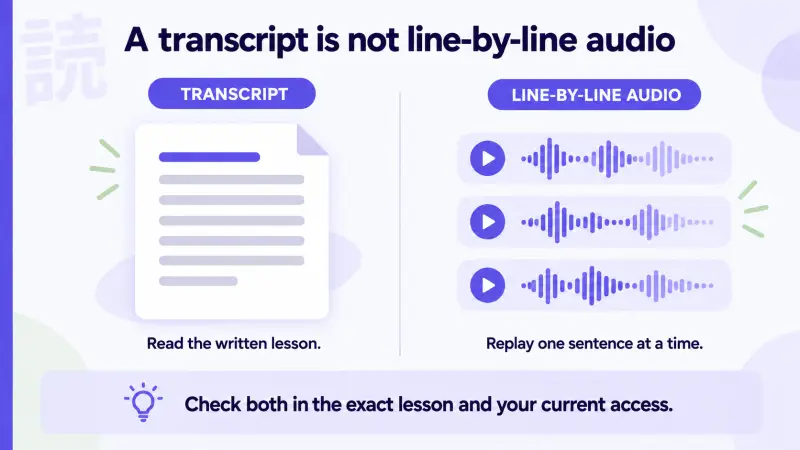
The reason this resource needs its own check is that "has transcripts" and "has line-by-line audio" get collapsed into one feature in most recommendation lists, and they are not the same thing.
JapanesePod101's own feature page lists lesson notes and transcripts at the Basic level, while line-by-line audio and complete lesson translations are listed at Premium, so reading the script and replaying one sentence at a time are two separate entitlements. That distinction matters for beginners specifically. The hard part of early listening is usually not a whole passage but one sentence delivered at full speed, and line-by-line replay is the tool built for exactly that problem.
A free sign-up does not settle the question in either direction. Before you plan a routine around a particular support, open the lesson you actually intend to use and look at which tools appear next to it in your own account. Checking one lesson tells you what that lesson includes; other lessons and other levels can be set up differently, so it is worth repeating the check when you move to a new series.
If the transcript is available to you but line-by-line playback is not, a manual version still does the job: replay the same thirty seconds two or three times, read the transcript line, then replay once more. The comparison of Japanese apps, textbooks and spaced repetition tools covers how to slot lesson audio next to review software so the same sentences come back to you later in the week.
Japanese With Shun: Check the Episode and Transcript Before You Commit
This one is a genuine podcast, which is why the transcript question is worth asking per episode instead of once for the whole show.
Japanese with Shun's official link page points to the podcast and to a transcript page on the creator's Patreon as two separate destinations, so the transcript for the episode you want is worth locating by name before you plan a text-supported session. The creator's Patreon introduction describes the podcast as intended for beginner Japanese learners, and membership levels with locked posts exist there. This check did not open a matched episode and transcript pair, so nothing here should be read as a rule about what every episode includes.
The routine takes about a minute. Write down the exact episode title and number you want, open the creator's transcript destination, and search for that episode by name. If you find it and it is available to you, plan a session with the text. If you cannot confirm it, treat that episode as listening practice without text: play it once for the general topic, write down the two or three words you kept hearing, and look those up rather than trying to rebuild a full script from memory. A dictionary that shows several senses for one word is the right tool there, and the guide to beginner Japanese dictionaries for real messages explains how to pick the sense that matches what you actually heard.
Listen First, Use the Text for Gaps, and Listen Again Without the Text
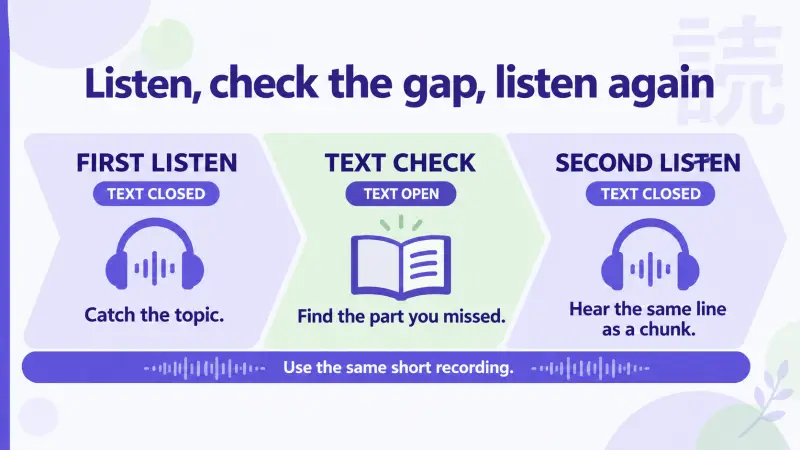
Whether your text is a lesson PDF, a transcript page or nothing at all, the same question comes up as soon as you press play: when do you open it? Reading along from the first second is a legitimate exercise, and it does build reading speed with audio support. It is simply a different exercise from working out what you can catch by ear, and the two get mixed up when the script is sitting open by default.
Deciding before you press play which of those two exercises this session is for keeps the text from silently replacing your listening. The routine below is this article's suggested self-test rather than a measured result. Each stage uses the same short recording; what changes is whether the text is open and what you are paying attention to.
| Stage | Text open? | What you do | What you are listening for |
|---|---|---|---|
| First listen | No | Play the clip straight through once, then write in your own language what you think it was about | Whether you caught the topic, the speaker's mood, and roughly where each sentence ended |
| Text check | Yes | Read only the parts you could not follow, then pick one word and one full sentence to keep | Why the sound you heard did not match the word you expected |
| Second listen | No | Replay the same clip and say your marked sentence out loud along with the speaker | Whether that sentence now arrives as one chunk instead of separate syllables |
Two to four minutes of audio is enough material for this, and the whole loop fits in about ten minutes. If the first listen gives you nothing at all, not even the topic, that is a signal about the material rather than about you: shorten the clip, drop to easier audio, or preview five or six words before playing it. Adding more volume with a fresh episode each day is a different trade-off, not a mistake.
Here is what closing a gap can look like. You hear うどんが すきです (udon ga suki desu) and all you catch is that someone likes something. The text check shows が marking うどん as the thing being liked in this sentence, which is why the word order did not land the way you expected. On the second listen, すきです stops being a blur and becomes one usable chunk for saying you like something.
If you want reading input at a controlled level that reinforces the same vocabulary between listening sessions, the comparison of Japanese graded readers for beginners covers that side of the stack.
Take the Topic Into a HelloTalk Voice Exchange
A recording plays the same way every time. It cannot hear the sentence you just produced, so it cannot tell you whether the sentence landed, and that is the one thing a person can do for you after a listening session.
The exchange below is written for this article as an example of how that step can go, not a transcript of a real chat. You record a voice message: わたしは うどんが すきです (Watashi wa udon ga suki desu), "I like udon." One possible reply is いいですね。どんな うどんが すきですか (Ii desu ne. Donna udon ga suki desu ka), "Nice. What kind of udon do you like?" Another partner might simply agree, mention their own preference, or ask about something else entirely. If you lose the thread, ゆっくり おねがいします (Yukkuri onegaishimasu), "slowly, please," is a normal thing to say and usually keeps the conversation moving.
Asking for something specific gets you more than asking "was that correct?" Try asking which part of your sentence came through clearly, or whether your phrasing sounded like something the other person would say themselves, then ask your own question about the topic. Replies vary in speed and depth depending on who you are talking to, so treat useful feedback as something you invite rather than something guaranteed by a recording or a script.
HelloTalk's voice and video calls give you the unscripted version of the topic, and HelloTalk's Voicerooms let you join as a listener first if speaking on day one feels like too much. In HelloTalk's text chat, a voice message and the written version of the same sentence sit in one thread, so the corrected wording stays next to the audio you recorded. HelloTalk's Moments feed suits the leftover question: post the single sentence you marked during your second listen and ask whether a native speaker would phrase it that way.
The reaction is where the new information is. If a partner repeats a word back with a different pitch, or answers a question you did not quite mean to ask, you have learned something the transcript did not contain. Running that step on HelloTalk soon after a listening session is what connects the lesson topic, the text and a conversation where you had to think on the spot.
Frequently Asked Questions About Beginner Japanese Audio and Text
Is a transcript the same as line-by-line audio?
No. A transcript is the written script of the lesson, while line-by-line audio lets you replay one sentence at a time. JapanesePod101's feature page lists lesson notes and transcripts at Basic and lists line-by-line audio plus complete lesson translations at Premium, so check each one separately for the lesson you want.
Should a complete beginner start with a course dialogue or a podcast?
Course material such as Irodori Starter keeps the audio, the printed material and the vocabulary under one lesson number, which is easier when you have almost no vocabulary yet. A beginner podcast suits you better once you can follow the general topic without a script and want more listening volume.
Is Irodori a podcast?
No. Irodori is course material published by The Japan Foundation, and its recordings belong to numbered lessons with accompanying PDFs. Treat it as a course you listen to rather than a show you subscribe to.
How do I check whether a podcast episode's transcript is available before I commit time to it?
Write down the exact episode title, open the creator's official transcript destination, and look for that episode by name. For Japanese with Shun, the official link page points to the podcast and to a transcript page on the creator's Patreon separately, so confirm the specific episode at your own membership level rather than assuming anything about the whole catalogue.
Why does the audio in an Irodori PDF not play on my phone?
The site's playback limitation applies to the PDFs with embedded audio, which need the desktop reader setup it describes. Each lesson also has a separate MP3 download and an MP3 playback page, so switching to those usually fixes it.
Is reading the transcript while you listen a waste of time?
No, it is a different exercise. Reading along with audio support builds reading speed and shows you how written words map onto sounds. It just does not test what you can catch by ear, so decide before you press play which of the two you are doing in that session.
How long should the clip be, and how many times should I replay it?
Two to four minutes is enough for the listen, text check, listen again loop described above, which usually means playing the clip twice with a reading stage in between. That is a suggested routine rather than a measured result, so adjust the clip length first before adding more repetitions.
What do I actually say to a language partner about something I listened to?
Bring one sentence rather than a summary. Say your marked line out loud, ask which part of it came through, then ask a question the recording left open, such as どんな うどんが すきですか (Donna udon ga suki desu ka). Whatever comes back is input that no transcript could have given you.