
English for Hotel Guest Requests: Resources for Clarifying Needs and Changes

A guest walks up to the desk and says she would like to change rooms. You have that sentence covered, so you offer something on the fourth floor. Then she adds that she needs to be moved before a two o'clock meeting, and that the new room has to have a bathtub, and the reply you rehearsed is already two conditions behind.
The fix is not a longer phrase list. It is the habit of asking two or three questions before you propose anything, plus practice with someone who can add a condition you did not plan for.
The hardest part of a hotel guest request in English is rarely the opening sentence; it is the conditions the guest has not mentioned yet.
Three named resources cover different parts of that problem: EnglishClub's hotel pages for staff-side wording, Pearson's English for International Tourism for structured course work, and role-play on HelloTalk for the moment when a request shifts mid conversation.
Quick Comparison: EnglishClub, English for International Tourism, and HelloTalk
These three get grouped together under "hotel English," but they sit at different points in the same job. Read the table by the column that matches your current gap: staff wording, structured study, or a request that changes while you are still speaking.
| Resource | Staff perspective | Dialogue input | Clarifying and changes | How you practice | Access |
|---|---|---|---|---|---|
| EnglishClub, English for Hotel Staff | Written for hotel employees, covering taking reservations and serving guests rather than booking your own trip | Hotel vocabulary, a vocabulary quiz, a full reservation dialogue and a check-in and check-out page, each with comprehension questions | The reservation example moves from a fully booked weekend to different dates, then to bed type and guest numbers; the check-out example covers a late departure, pool hours and unexpected items on a bill | Read the dialogues, copy the front desk lines that ask for information, then test yourself with the quizzes | The index and those dialogue pages are readable without logging in |
| Pearson, English for International Tourism | Aimed at people working in tourism and at students of tourism | Coursebook units on tourism topics, each ending with a case study task; the coursebook DVD-ROM carries tourism films with exercises | The official description lists handling enquiries, negotiating and addressing groups among the skills taught; which scenes appear in a given unit depends on level and edition | Structured study across levels, usually with a teacher or class, supported by workbook and audio components | A published course in three levels, with components and packs listed by level; you can look for it through a course, a library or a bookseller |
| HelloTalk role-play | Whatever staff role you write into the brief you send your partner | Live text or voice exchanges with another person, with no fixed script | A partner can hold back a condition, then revise one detail halfway through, and tell you what they understood | You set a scene, run it for a few minutes, then ask what came across | HelloTalk is free to use with an optional paid plan |
None of these replaces the others. The first two give you reliable input, and the third is where you find out whether that input survives contact with a request that moves. If you are still deciding which tools belong in your weekly routine at all, this broader comparison of apps for practicing industry-specific English covers the selection step before you get to the hotel-specific work below.
EnglishClub: Start With Hotel Staff Language and Short Exchanges
Start here if your problem is wording. EnglishClub's hotel pages are written for staff, listing front desk expressions separately from guest expressions, which is what makes them usable behind the desk rather than at the booking stage.
The hotel index links to vocabulary, a vocabulary quiz, a reservation dialogue and a page on checking guests in and out. The reservation page runs a full telephone booking. What makes it worth reading closely is that the first request does not survive intact: the weekend the caller wants is fully booked, the caller asks about the following weekend, and the front desk confirms the exact dates. The conversation then goes on to bed type, number of people and the possibility of someone else joining. That is the shape of most real requests, where the opening line is only the first layer.
The check-in and check-out page splits into two sections with expressions for each side, plus a check-out example and comprehension questions. In that example a guest leaves later than expected, the pool hours are not what the guest assumed, and there are items on the bill that need explaining. Among the front desk expressions you will find lines for confirming the name on the reservation, confirming the number of nights, and asking whether the guest would like to speak with the manager on duty.
Two cautions when you mine these pages. Any amount, fee or deposit inside a sample dialogue belongs to that sample, not to your property. The same goes for outcomes: if the example guest is allowed to leave late, that tells you how to phrase the exchange, not what your hotel permits.
A reading task for one sitting
This is a suggestion, not an exercise supplied by the site, and you can shrink or extend it.
- Read the reservation dialogue once for meaning, then read it again and underline only the lines where the front desk asks for missing information.
- Write those lines out as questions of your own, swapping in the room types and services your hotel actually has.
- Do the same with the check-out page, and keep one line for the moment you need to check something before answering.
The index marks some entries with an audio icon. The written dialogues are the part you can count on reading in full, so build your plan around the text and treat any recording you find on the page as extra.
English for International Tourism: Practice Requests Within a Broader Course
Phrase lists run short as soon as a guest adds a condition the list does not cover. A published course is the usual next step, because it sequences vocabulary, listening and task work instead of leaving you to assemble them.
English for International Tourism is a three-level published course covering CEFR A2 to B2, so the level you choose matters more than the series name. The publisher lists Pre-intermediate, Intermediate and Upper-intermediate, which means none of the three is a from-zero starting point. The official description covers professional language skills including handling enquiries, negotiating and speaking to groups, and each unit finishes with a case study task built on a tourism topic. The coursebook DVD-ROM contains tourism films with accompanying exercises.
The publisher lists different components and packs by level: a coursebook and DVD-ROM pack, a workbook and audio pack with or without the answer key, and a class CD for teachers. Check the level, edition and pack before you assume a particular disc, licence or audio file is included with the copy you are holding, especially with second-hand books.
One honest limit on planning: the publisher's overview describes the course at series level, so which exact scenes appear in a hotel-related unit depends on the book in your hands. Look at the contents page before you build a study plan around a specific scenario. On the publisher's Nordic site, the sample button leads to a request form for teachers in that region, with samples provided at Pearson's discretion, so an instant download is not something to count on; a course, a library or a local bookseller are channels worth considering instead.
Where this pairs well with the rest: the case study tasks give you a prepared situation, and you still need someone to react to it in real time.
Clarify the Request Before Offering an Option
Here is the habit that fixes the scene at the top of this article. Ask what the problem is, what must stay the same, and when it needs to happen, before you name a room, a time or a solution.
Compare two versions of the same thirty seconds. First, the version that offers too early:
Guest: We'd like to change rooms.
You: Certainly, I can move you to a room on the fourth floor.
Guest: Oh, but we need to stay on the same floor as our colleague, and we're leaving very early tomorrow.
Now you have to withdraw an offer, which is harder in a second language than making one. The clarifying version keeps you on stable ground:
Guest: We'd like to change rooms.
You: Of course. Could you tell me what isn't working in the room at the moment?
Guest: It faces the main road, and we can hear the traffic at night.
You: Understood. Is a quieter room the main thing, or do you also need to keep the same bed setup?
Guest: Same setup, two beds. And we'd like to move before dinner if possible.
Two questions, and now you have three pieces of information: the problem, the fixed condition, and the timing the guest added herself. If a guest does not volunteer a time, that is the next question to ask before you offer anything.
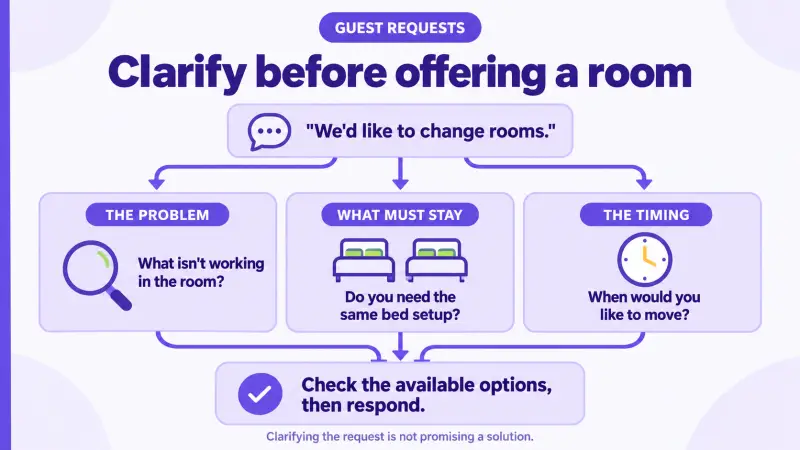
Clarifying questions come more easily when you can see what the guest's first sentence leaves out. The table below takes openings you will hear often and separates what has been said from what you still need.
| What the guest says | What is still unknown | A question that finds it |
|---|---|---|
| "We'd like to change rooms." | The reason, the timing, what must stay the same | "Of course. Could you tell me what isn't working in the room at the moment?" |
| "Can we have a late check-out?" | How late, and whether it applies to the whole booking | "How late would you like to stay, and is that for both rooms?" |
| "We need a quiet room." | Whether the noise is outside or inside, and whether floor or bed type matters | "Is the noise coming from the street, or from inside the hotel?" |
| "Could you keep our bags?" | How many, until when, whether they return to the room first | "How many bags will there be, and what time are you planning to collect them?" |
Notice that none of these questions promises anything. They buy you the information you need and they buy you a few seconds of thinking time, which is a fair trade in any language. The same repair-and-check moves show up outside hotels too, and this guide to practicing clear communication in a foreign language covers the general versions if you want to drill them away from work vocabulary.
Use HelloTalk Role-Play for a Guest Who Changes One Detail
A dialogue on a page always ends the same way. To rehearse a request that moves, you need someone who can revise it while you are mid answer, whether that is a classmate, a teacher, or a language partner in an app.
That is the specific job HelloTalk does in this sequence. On HelloTalk, you can run the exchange as text chat when you want time to compose, switch to a voice call when you want the pressure of answering out loud, and use Moments to post a short written confirmation message for native speakers to react to. HelloTalk also hosts Voicerooms, which are worth joining as a listener first if hearing several speakers at once is part of what throws you at the desk.
Send the brief before you start, so your partner knows what to withhold:
"Hi Sarah, I work at a hotel front desk and I'm practicing English for guest requests. Could you play a guest for about ten minutes? You'd like to change rooms. Please don't give me all your reasons at once, and partway through, change one thing about what you asked for."
A run might go like this, with an entirely invented guest:
Partner, as the guest: Hi, is it possible to move to a different room?
You: Of course. Could you tell me what isn't working in your current room?
Partner: The air conditioning is very loud at night.
You: I see. Would a room on a higher floor be all right, or do you need to stay on this floor?
Partner: Higher is fine. Actually, one more thing, we're now checking out on Friday morning instead of Saturday.
You: Thank you for telling me. So that is a quieter room on a higher floor, and check-out now on Friday morning rather than Saturday. Let me check the room and the new departure date before I confirm either of them.
That last line from the guest is the whole point of the exercise, and your reply to it is the part worth practicing. Ten minutes is a starting size, not a target; cut it to five if the change lands too late for you to answer it.
Then run the review step. Ask directly: "Before we stop, can you tell me in your own words what you asked for, what I said I would do, and what I still have to check?" What comes back is useful feedback from one person in one conversation, not a ruling on your English. If your partner asks you to repeat a line, that can mean the line was unclear, and it can equally mean they were checking a detail. Watch for the same word causing trouble across several sessions before you treat it as a pronunciation problem.
Two boundaries to keep. Use invented guest details only, never a real booking, name or room number. And your partner is playing a guest and reporting what they understood, not certifying your hospitality English or your hotel's procedures; HelloTalk connects you with other language learners and speakers, and does not promise a hospitality specialist. For the wider argument about why job-specific English needs practice in conversations like this, the parent guide on building industry English through real conversations works through the full input-to-use cycle.
Confirm What Has Been Agreed Without Inventing Hotel Policy
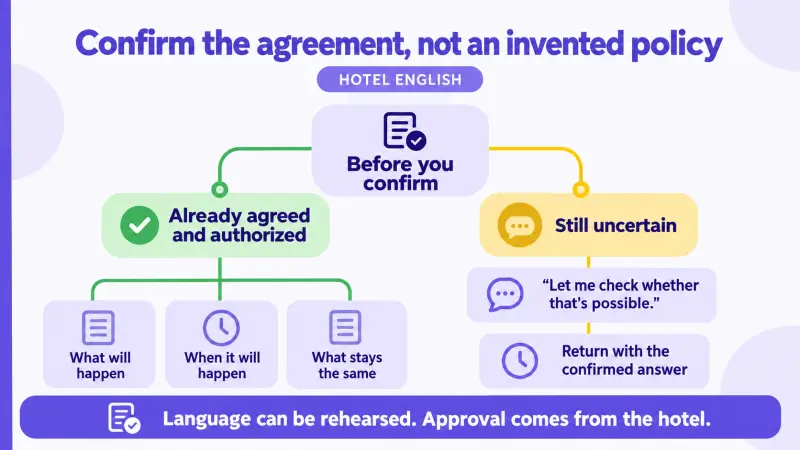
The last move is short, and repeating an agreement back is how you find out whether you and the guest understood it the same way. Repeat three things back: what you will do, when it will happen, and what stays the same.
"So I'll move you to a room on the eighth floor, same two beds, and I'll have the key ready by four o'clock. Does that work for you?"
The risky moment is different. It is when a guest asks for something you are not sure about, and the temptation in a second language is to say whatever sentence you can produce fastest. Both "Yes, of course" and "No, that's not allowed" are dangerous when you do not actually know. The safe pattern buys time:
Guest: Could we keep the room until six tomorrow evening?
You: Let me check whether that's possible for tomorrow. Can I confirm with you in ten minutes?
Confirming an agreement is a language skill you can rehearse anywhere; the authority behind that agreement is not, and it stays with your employer. This is also why the sample dialogues are worth reading for shape rather than for rules. In the EnglishClub check-out example, a guest leaves later than planned and asks about items on the bill. Useful wording, and no indication of what your own hotel actually allows in that situation. Late departures, upgrades, facility hours and waived items in this article are practice-card settings, nothing more.
Keep one escalation line ready in whatever form your workplace uses, since the check-in and check-out page includes exactly that function among the front desk expressions: offering to bring in the manager on duty. Knowing how to hand something over politely is part of the English, and it removes the pressure to invent a policy on the spot.
Frequently Asked Questions About English for Hotel Guest Requests
Are free hotel English pages enough, or do I need a full course?
It depends on the gap. If you can follow guests but reach for wording, the EnglishClub hotel dialogues and expression lists may cover you for a while, and they are readable without an account. If you lose the thread once a conversation runs past a few turns, a sequenced course such as English for International Tourism gives you listening, vocabulary and task work in a planned order. Either way, add live practice for the part where requests change.
What English level do I need before practicing guest requests?
For the published course, the publisher's overall range is CEFR A2 to B2 across Pre-intermediate, Intermediate and Upper-intermediate, so pick the level rather than the series. The EnglishClub hotel page read here does not state a level of its own, so judge it directly: read the reservation dialogue and see whether you follow it without translating every line.
How do I practice a guest who changes their mind if I study alone?
You cannot get that from a fixed recording, because it will always say the same thing. Ask a person to supply the change: a classmate, a teacher, or a language partner in a role-play. On HelloTalk you can set the scene in the brief, asking your partner to withhold one condition at the start and revise one detail partway through.
Should I memorize scripts?
Memorize functions, not scripts. It is worth having automatic versions of four moves: asking what the problem is, checking what must stay the same, asking when it needs to happen, and confirming back. Fixed whole dialogues break the moment a guest answers off-script, which is most of the time.
Does English for International Tourism come with audio?
The publisher lists media components separately by level, including a coursebook and DVD-ROM pack with tourism films and exercises, a workbook and audio pack, and a class CD for teachers. Check which components come with the level and edition you are buying, since a print or second-hand copy does not automatically carry a usable audio licence, and you cannot assume that free online audio is available for the whole course.
Is it safe to use real guest situations when I practice?
No. Build practice cards from invented guests, invented room numbers and invented dates. A role-play partner only needs a situation, not real booking data, and inventing the details also lets you rehearse the awkward cases your shift has not produced yet.
What should I say when a guest asks for something I cannot approve?
Separate the language from the decision. Say that you will check and give a time for coming back, or offer to bring in the person who can decide, in whatever form your workplace uses. The English you practice is the checking and the confirming; the permission itself always comes from your hotel's own policy.