
How to Join a Spanish Group Conversation Without Interrupting Everyone

The group is talking about something you actually know well. You start building a sentence in your head, check the verb ending, and by the time it is ready three people have moved on to a different city, a different job and somebody's weekend. A minute later another opening appears, and the same thing happens again.
This article is about that specific timing problem: you are following the point well enough to have something to say, but the moment for saying it keeps closing. What changes things is preparing a short entry line that hooks onto the point already on the table instead of a finished sentence of your own.
Follow the Current Point Before Preparing Your Own
Here is why the rehearsed sentence keeps arriving late. While you are assembling it, you stop tracking the conversation, so you lose the thing your sentence was supposed to attach to. The sentence comes out correct and unattached at the same time.
In a Spanish group conversation, the line that gets you in is usually one that attaches to the point already on the table rather than one that opens a new subject. That gives your listening a specific target instead of a vague hope of catching everything.
While others speak, hold three things only:
- Who is holding the floor right now, and their name if you caught it.
- The keyword of their point, one or two words, not the whole sentence.
- Whether the group is agreeing, adding examples, or pushing back.
If the group is talking about working from home, your mental note is not a translated paragraph. It is something like ruido, horario, ahorro. One of those words is what your entry line will grab.
Watch how little you actually need to catch:
Emma: "Yo trabajo mejor en casa, pero mis vecinos llevan un mes de obras y hay un ruido horrible toda la mañana."
David: "A mí me pasa igual. Con ese ruido no puedo ni hacer llamadas."
Keyword caught: ruido. Both speakers said it out loud, and David repeated it, so even if obras is new to you, the word carrying the complaint is right there in what you heard. That is enough to build an entry on.
The same handful of moments comes back in almost every group conversation, so it helps to see the cue and the phrase side by side. Read the middle column first, because noticing the moment is what decides whether the line lands. The Spanish lines are starting points to adapt, not a code of manners that works identically in every country, family or work call.
| Moment | What you can notice | One line you can say | Sense in English |
|---|---|---|---|
| Someone is still developing a point | The idea is not closed yet and nobody is waiting on you | "Claro, claro." | "Right, right." Shows you are following. It does not reserve the next turn |
| Connecting to the last speaker | Someone finished a complete point and nobody has started | "Sobre eso que dijo Emma, a mí me pasó lo mismo." | "About what Emma said, the same thing happened to me." |
| You missed something small | You lost one word or one name, not the whole idea | "Solo una palabra: ¿qué significa 'chamba'?" | "Just one word: what does 'chamba' mean?" |
| You get talked over | Two of you started at once and the other kept going | "Sigue, sigue, luego termino yo." | "Go on, I will finish after." |
| The topic already moved | Your point still connects, but the subject changed | "Volviendo un segundo a lo del trabajo..." | "Going back for a second to the work thing..." |
Forms of address change across regions and groups: tú, vos and usted, plus ustedes or vosotros in the plural. Copy what the room is already using rather than applying one form everywhere.
Enter With a Short Connection to What Someone Just Said
A group turn has a shape that a one-to-one turn does not need. In a two-person chat, anything you say is obviously addressed to the other person. In a group, your sentence has to announce what it is answering, or half the room will not know whether you are replying to Emma, to David or to nobody.
The working pattern has three parts: connector, reference, content.
- Connector: Sobre eso / Justo sobre eso / Siguiendo con lo que decías / A mí me pasa algo parecido
- Reference: the keyword you caught, or the person's name
- Content: your short point
Compare the two versions:
Weak entry: "Yo compré auriculares con cancelación de ruido el año pasado porque en mi edificio hay mucho movimiento por la mañana y..." The group hears a new monologue starting and cannot tell where it came from.
Stronger entry: "Justo sobre eso del ruido: yo me compré unos auriculares y cambió todo."
Same content, but the first clause does the social work. A connector plus the keyword you just heard tells the group what you are answering, which is work your content sentence cannot do on its own. Keep that opening short and put the detail after it.
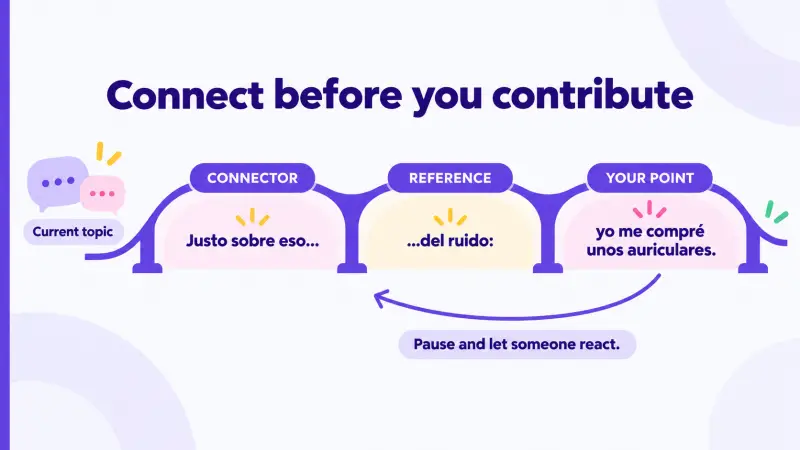
Then stop and let someone react. If they do, you have the floor for the detail and your nerves have already dropped, because you are no longer starting cold.
If the point you want to make is a disagreement rather than an addition, the entry line has to do extra work and the wording changes. That softening is covered in the piece on giving opinions and disagreeing politely in Spanish.
Signal That You Want a Turn Without Taking Over
Waiting for a full silence is a reliable way to never speak. In lively group talk, long silences often do not arrive, because the next speaker starts as soon as the current one lands a point. What does arrive is a short gap at the end of that point, and a small signal placed there is what gets you into it.
How you signal depends on the setting. In a moderated call, class or hosted room, the expected move is usually a raised hand, the chat box, or waiting for whoever is running it to bring you in. In casual talk among friends, a short spoken signal at a pause is normal. In neither case does talking over the current speaker work in your favour.
Ways to flag that you want a turn
- "Una cosa rápida." (Quick thing.)
- "¿Puedo agregar algo?" (Can I add something? Añadir is more common in Spain, and both are understood.)
- "Cuando termines, te quiero preguntar algo." (When you finish, I want to ask you something.)
- "Después les cuento lo mío." (I will tell you mine after. In Spain: "Luego os cuento lo mío.")
The last two are worth practising because they ask for a later turn instead of the current one, which takes the pressure off finding the exact millisecond to jump in. Say them at a pause rather than across someone, and expect the result to depend on the group and on whoever is running the conversation.
On video, unmuting, leaning in or a small hand raise does the same job before you say anything. In audio-only conversations you need the words, so keep two of these lines ready, and follow the room's own procedure where there is one.
How to hand the turn back
Taking over usually looks like one of two things: opening a new topic nobody asked about, or holding the floor for a long monologue while the group waits. One habit prevents both. Say two or three sentences, then pass the turn with a question:
"...y desde entonces trabajo con la puerta cerrada. ¿A ustedes les pasa lo mismo?"
Handing back is what keeps you in the conversation instead of ending it. Whoever answers often names you in their reply, which gives you an easier second turn.
Ask for Clarification Without Restarting the Whole Discussion
When you lose the thread, the instinct is "no entiendo, ¿pueden repetir?" That is a legitimate thing to say. It simply rewinds the group to a point they have already passed, and most of the time a narrower question gets you the missing piece faster.
A clarification question that names one word, one name or one detail keeps the discussion moving, while a broad request to repeat everything resets it.
Narrow versions to keep ready:
- "Perdón, ¿dijiste el jueves o el martes?" (Sorry, did you say Thursday or Tuesday?)
- "¿A quién te referías?" (Who were you referring to?)
- "Solo una palabra: ¿qué significa 'chamba'?" (Chamba is a regional word for work, common in some countries and not in others, which is exactly the kind of item worth asking about.)
- "Me perdí en la última parte, ¿quién decidió eso?" (I got lost in the last part, who decided that?)
There is a second move that is often faster than any question: say what you understood and let the group correct the gap.
"Entendí que van a cambiar la hora de la reunión, ¿es así?"
Descriptions of spoken interaction from Instituto Cervantes treat conversation as speakers alternating between listening and speaking while working out meaning together, and this kind of check is that process made visible. You are not stopping the talk, you are pointing at the exact spot that needs one sentence of repair.
If the problem is bigger than one word, asking for something broader is the right call, not a failure of technique. "¿Me lo resumes en una frase?" or "¿Pueden ir un poquito más despacio?" are ordinary requests, and people in a language exchange context are generally there precisely to be asked. If a room is consistently too fast in every direction, a smaller group or a one-to-one conversation is a better place to build up to it than forcing entries on half-caught keywords.
One more decision to make in real time: if what you missed does not change the point, let it go and keep listening. Not every gap needs a question.
Try One Participation Goal in a HelloTalk Voiceroom
Reading entry lines is not the same as saying one while several people are talking. The difference is timing, and timing trains in rooms with more than one live speaker. That is where a multi-participant voice space fits into the cycle: you study some Spanish input, you use it live, then you review what came out of your mouth.
For the live part, HelloTalk runs Voicerooms, voice spaces with several participants where you can join and listen before saying anything. One prerequisite to know before you plan a goal: HelloTalk's own Voiceroom help describes requesting to speak by taking an open seat or raising your hand, with the host or an admin approving before your microphone opens. So the sequence is join, listen, request to speak under the room's rules, and practise your line once you are on. Nobody is assigned to you and no particular room or partner is guaranteed, so treat each session as practice ground rather than a scheduled lesson.
Go in with one goal rather than a general plan to speak more. These are suggestions to pick from, not a graded sequence:
- Say one backchannel out loud during the session: "Claro" or "Sí, sí."
- Use one connector entry: "Sobre eso que dijiste..."
- Ask one narrow clarification question.
- Hand a turn back with a question to the room.
A live room moves fast, so it helps to have your phrases ready before you go in and to write down what you actually said soon after, while you can still recall the wording. This small plan links the three stages around those two tasks.
| Stage | What you do | How you check it afterwards |
|---|---|---|
| Input | Take three phrases from whatever Spanish material you already study this week and write them where you can see them | Read them aloud once before you enter the room |
| Use | Join a Voiceroom, listen for a few minutes, request to speak, then use one phrase when the keyword you were waiting for appears | Note the exact sentence you said, in Spanish, right after |
| Review | Send that sentence to someone you chat with and ask whether it sounded natural in a group | Keep the version they give you and reuse it in the next room |
For that review step, the text and voice chat on HelloTalk is a practical place to send the line you actually said and ask what a native speaker would have said instead. HelloTalk Moments works for the same question in public, where several people can reply with the version used in their country. Replies arrive on other people's schedules, so post it and carry on rather than waiting.
If you cannot get into a live room this week, prepare the same lines solo first. The routines in practising Spanish speaking when you have nobody to talk to cover how to rehearse turns before you use them with real speakers, and the wider sequence from first messages to comfortable conversation sits in the main guide on how to talk in Spanish.
Rejoin After an Interruption or a Change of Topic
Losing your turn is not a sign that your Spanish failed. Overlap and interruption are ordinary features of multi-speaker talk in many settings, and they happen to fluent speakers constantly. Re-entry is a separate skill from starting to speak, and it is worth rehearsing on its own rather than assuming it will follow from a good opening line.
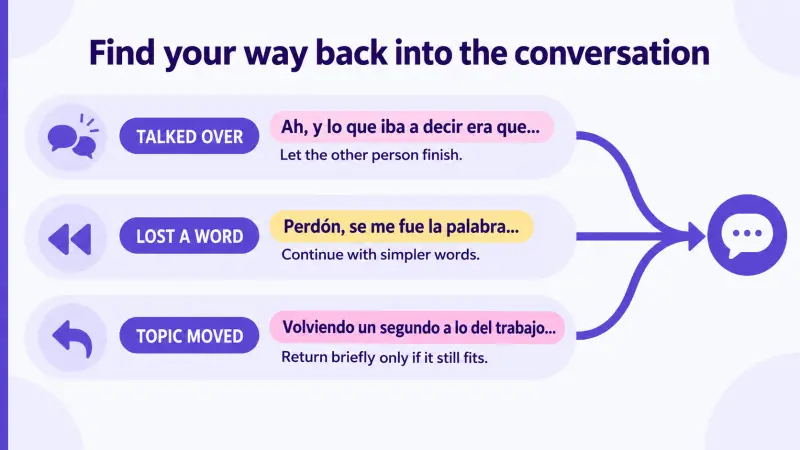
You got talked over
Let the other person finish. Fighting for the floor is loud and rarely works. When they land, use the memory of your own half-sentence as the connector:
"Ah, y lo que iba a decir era que en mi ciudad pasa lo mismo."
You froze in the middle of your own sentence
Name it and continue with simpler words. Spanish has a ready phrase for exactly this:
"Perdón, se me fue la palabra... bueno, la cosa es que ahora trabajo menos horas."
Restarting in easier vocabulary is not a retreat. It keeps your turn, which is the point.
The topic already changed
Make a quick decision. If your point still adds something, reopen it briefly:
"Volviendo un segundo a lo del trabajo, ¿al final conseguiste el horario nuevo?"
If it no longer fits, drop it. Attaching to the new topic is usually faster than reopening the old one. When a group conversation shifts into arranging something together, which happens often once people warm up, the language moves to invitations, times and changes of plan, and the phrases for that turn are in the article on making plans in Spanish and handling changes.
You came back after leaving or losing audio
"Perdón, se me cortó. ¿En qué quedaron?" (Sorry, I got cut off. What did you all settle on?) One short question puts you back inside the current point instead of guessing for the next ten minutes.
Frequently Asked Questions About Spanish Group Conversations
What is the simplest phrase for joining a Spanish group conversation?
"Sobre eso que dijo [name], ..." works in most casual group settings because it names what you are answering before you say anything new. Add your own point in one short sentence, then let someone respond.
Is interrupting rude in Spanish conversations?
Overlapping speech is common in many Spanish-speaking groups and often signals interest rather than rudeness, but it varies a lot by country, group and context, and a work meeting is not a dinner with friends. Watch what the people in that specific room do and follow it instead of applying one rule everywhere.
How do I ask someone to repeat without stopping the whole discussion?
Ask about one item rather than the whole idea: "¿Dijiste el jueves o el martes?" or "Solo una palabra: ¿qué significa eso?" You can also state what you understood and let the group correct it: "Entendí que van a cambiar la hora, ¿es así?"
How long should my turn be in a group?
Two or three sentences is a good starting habit, then hand the turn back with a question such as "¿A ustedes les pasa lo mismo?" Short turns plus a question tend to get you brought back in, while long turns often close the exchange.
Should I use tú, vos, usted, ustedes or vosotros in a group?
Follow the form the group is already using with each other, since it changes by region and by how formal the setting is. If you genuinely cannot tell, asking directly is normal: "¿Nos tuteamos?"
Can I practise group turn-taking on my own?
Partly. You can rehearse connectors, clarification questions and re-entry lines alone until they come out without thinking, but entering a live gap needs several speakers, which is why a multi-participant voice space such as a HelloTalk Voiceroom is a useful place to try one prepared line per session, once the host has approved your request to speak.
What if I only understand half of what the group says?
Track names and keywords rather than full sentences, and enter on a keyword you clearly caught. Half a conversation is enough to take part in it. If you are losing the thread over and over, say so and ask for a summary or slower speech, or move to a smaller group where you can follow more of what is said.