English for Research Conference Q&A: Resources for Understanding and Answering Follow-Up Questions
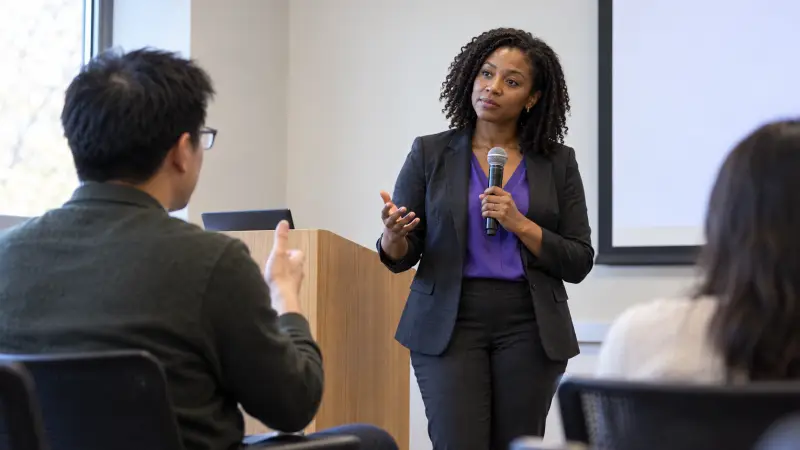
The talk itself goes fine. You rehearsed the slides, the timing worked, and then someone in the third row says, "Could you say a bit more about how you selected your samples?" You know your method in detail, but you cannot tell whether they want the recruitment channel, the exclusion criteria, or the reason you did not randomize. Those few seconds of guessing, not the presentation, are usually the hardest part of the session.
Three resources cover different pieces of that problem, and no one of these three covers the reading, the preparing and the live questioning together. The University of Tokyo's English Academia has a Q&A teaching page you can read. Cambridge's Presentation Skills for Scientists is a published guide whose chapters include handling questions. HelloTalk is where you can hand a public or fictional abstract to a real listener and hear the unscripted follow-up you could not predict on your own.
Compare English Academia, Presentation Skills for Scientists, and HelloTalk
Before picking one, it helps to see what each resource actually puts in front of you, because they fail in different places. A page can show you a pattern but cannot react to your study. A book can help you prepare but cannot interrupt you mid-sentence. A live partner can do both of those things, but that person's feedback is about what they understood, not a check on whether your statistics are sound. Read the table below by asking which gap you are trying to close this week rather than which resource is strongest overall.
| Resource | What you actually get | Follow-up task it supports | Who responds to you | Checks your science? |
|---|---|---|---|---|
| English Academia, Module 5, "How to Survive a Q&A session? (2)" (University of Tokyo) | A teaching page on Q&A sessions that discusses explaining a method on the spot, data you do not have, and off-topic questions | Seeing how a question can be restated before it is answered, and how an unavailable answer can be acknowledged | A fixed page, so it cannot respond to your abstract or your wording | No |
| Presentation Skills for Scientists, second edition, Edward Zanders and Lindsay MacLeod (Cambridge) | A published guide whose publisher-listed chapters cover the audience, planning, science and the English language, and handling questions | Preparation done before you ever stand up | A book, so there is no live reply | No |
| HelloTalk practice with ordinary listeners | Your own public or fictional abstract plus real questions from a partner in text or voice | Live rephrasing, interruption, and follow-ups you did not rehearse | A real person in HelloTalk chat, a voice call, Moments comments or a Voiceroom | No, this practice asks listeners for comprehension feedback, not scientific review |
Two honest notes on access. The English Academia Q&A page was publicly readable when it was checked in late September 2026, which says nothing about enrollment, completion or certificates for the wider course. The Cambridge book sits behind publisher access controls, so check which edition your library or institution currently gives you access to.
No one of these three resources covers research Q&A end to end, because reading about a pattern, preparing in advance and being questioned live are three different skills. If you are still choosing practice tools in general, the wider comparison in the best apps for practicing industry-specific English handles that decision; this article stays on the narrow task of answering questions about your own research.
English Academia: Observe How a Conference Question Is Handled
Start here if you want a worked example rather than advice. English Academia is a set of academic English materials from the University of Tokyo, and Module 5 includes a page titled "How to Survive a Q&A session? (2)." The situations it discusses are the ones that actually go wrong at a podium: being asked to explain a method immediately, being asked about data you do not have, and getting a question that drifts off your topic.
Two recommendations on that page are worth carrying into your own session. The first is to restate the question so that both you and the questioner agree on what is being asked. The second is to be open when an answer cannot be supplied yet, rather than manufacturing one.
That second point has a boundary that is easy to blur. Being open about a gap does not mean inventing supporting evidence, and it does not mean promising a future study just because "we plan to test that next" sounds more confident than "I don't know." Only say that if it is genuinely planned.
The limit of this resource is structural, not editorial. It is a fixed page, so it cannot listen to your abstract, cannot ask you the awkward second question, and cannot tell you that the word you chose for your control group confused a listener. Use it to learn the shape of a good answer, then get the shape tested somewhere live.
Presentation Skills for Scientists: Prepare Beyond the Slide Script
Once you know what a handled question looks like, the next gap is everything you should have decided before the session starts. Presentation Skills for Scientists, second edition, by Edward Zanders and Lindsay MacLeod, is a Cambridge title aimed at that stage. Its publisher-listed contents include chapters on the audience, on planning, on science and the English language, and on handling questions, and the publisher describes it as a practical guide that includes advice for presenters who are not native English speakers.
Those chapter headings tell you something useful even before you open the book: the publisher treats audience, language and questions as separate preparation problems rather than as one lump called "presenting."
Because the full text was not read for this article, nothing below is quoted or summarized from it. The following preparation checklist is this article's own suggestion, sized as an example you can shrink or expand:
- Write the one-sentence version of your method that you would say if someone stopped you in a corridor.
- List the three questions a skeptical colleague in your own lab would ask, and draft answers in English out loud, not on paper.
- Write down, in one line each, what your data does not cover. This becomes your honest boundary later.
- Note the two or three English terms in your field that outsiders in the room may not share, and prepare a plain substitute for each.
Preparation is where a book earns its place. What it cannot do is rephrase your answer back to you incorrectly, which is something a live audience may well do.
Clarify the Question Before Explaining Your Method
This is the move that saves the guessing seconds described at the start. Restating the question does two things at once: it buys you thinking time, and it turns a vague request into something you can actually answer.
A small warning before the scripts. A follow-up question can mean the questioner is interested, or that something in your explanation was not clear to them. One follow-up question does not tell you which of those it is, so treat it as a request for information rather than a verdict on your talk.
The table below maps vague questions to the narrower thing they might mean, and to a restatement that makes the questioner choose. These are original examples, adjustable to your own field.
| What you hear | What it might be asking | Restatement that narrows it |
|---|---|---|
| "How did you choose your samples?" | Recruitment channel, exclusion criteria, or sample size | "Do you mean how the participants were recruited, or how we decided who to exclude?" |
| "Did you control for age?" | Whether age was measured at all, or whether it was in the model | "Are you asking whether age was in the model, or whether we measured it in the first place?" |
| "Why didn't you use method B?" | A practical constraint, or a theoretical objection | "Are you asking why method A was practical for us, or whether method B would change the result?" |
| "Is this generalizable?" | Other sites, other populations, or other time periods | "Generalizable to other hospitals, or to a different age group? They have different answers." |
In speech, the pattern is short. Repeat the core of the question, offer the two readings, stop talking, and let the questioner pick.
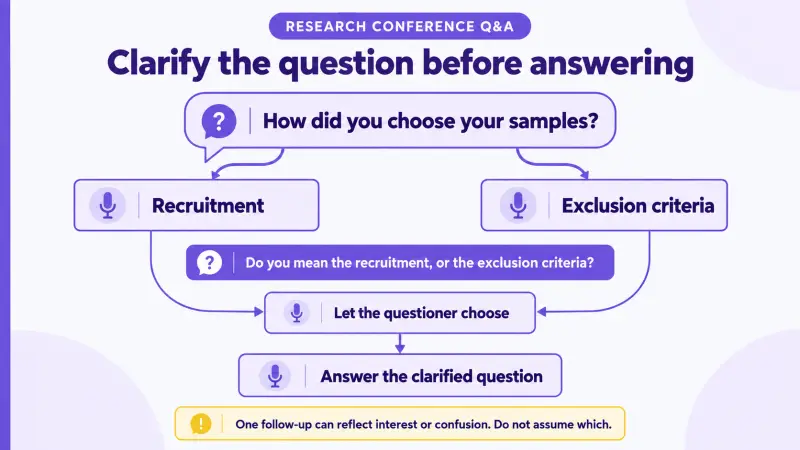
You: "So the question is about sample selection. Do you mean the recruitment, or the exclusion criteria?"
Questioner: "The exclusion criteria."
You: "Right. We excluded anyone who had already taken the training in the previous year, because we could not separate that effect from ours."
Restating a question in your own words before answering helps you avoid answering a question nobody asked. It also works when you simply did not hear: "Sorry, I caught the part about the control group but not the rest. Could you repeat the second half?" is more precise, and more useful to the questioner, than a general "Pardon?" The broader habit behind this is covered in this practical guide to communicating in a foreign language.
Use HelloTalk for Audience Questions About a Public or Fictional Abstract
Reading and preparing both stop at the same wall: you cannot predict how a real person will rephrase your work back at you. That is the gap HelloTalk fills in this sequence, and the safe way to fill it is to practice on material you can share.
Practicing with a public or fictional abstract lets you rehearse live questions without exposing unpublished results. Take an abstract that is already public, or invent a plausible fictional study in your area, and rewrite it in about ninety words of plain English. That length is a starting suggestion, not a rule; shorten it if your partner keeps losing the thread.
Then pick the format that matches what you want tested:
HelloTalk Moments works for written questions. Post the plain-language abstract and add one line such as, "This is a practice abstract. What would you ask me about it?" Posting is an invitation rather than a guarantee that someone will reply, and any comments that do arrive are in writing, which gives you time to draft a restatement carefully.
HelloTalk text chat works for slow follow-ups. You can trade three or four turns with one partner and see which word they keep returning to.
A HelloTalk voice call works for the part that actually mimics a conference, once a partner has agreed to this kind of practice: they interrupt, rephrase and ask again while you are mid-sentence.
HelloTalk Voicerooms work as a listening exercise. Joining one as a listener first lets you hear how people ask for clarification in a group; whether you can run a Q&A of your own depends on the room's topic and what its host has arranged.
Here is an invented example of how that can go. You post a fictional abstract about a workplace training study. David comments: "What does attrition mean here? Did people quit the study, or quit the job?" That is one word worth a second look in your spoken version, not proof that the whole abstract was unclear. Later, on a voice call, you read it aloud and Emma stops you: "Wait, the second group got the training first, or after?" That is a cue to check whether your sequencing sentence needs an explicit time marker, not proof that this sentence is the only unclear part.
Be clear about what you are asking your partner for. The request is comprehension feedback, not scientific verification, so invite Emma to say back what she understood: which order she thought the events happened in, which terms she was unsure about, and which sentence she would have asked about. Checking whether the science itself holds up belongs with your supervisor, collaborators or formal reviewers. That kind of comprehension feedback is the reason this practice sits inside a larger routine of building industry English through real conversations rather than replacing a course, a supervisor or a departmental practice talk.
Explain the Limits of an Answer Without Pretending to Know More
The English Academia page mentioned earlier names two of the situations that push people into inventing answers: a question about data you do not have, and a question that is off your topic. Both have clean English solutions, and both work better when you say what your study does cover before you say what it does not.
Stating that your data cannot answer a question is a complete answer, as long as you also state what your data does cover. Compare these two versions:
Weak: "Um, that's a good question, we would need more research on that."
Bounded: "Our data covers the first six months after the training, so I can't speak to the one-year effect. Within those six months, the difference held for both groups."
The second version gives the room something usable. The first leaves the limits of your data unstated.
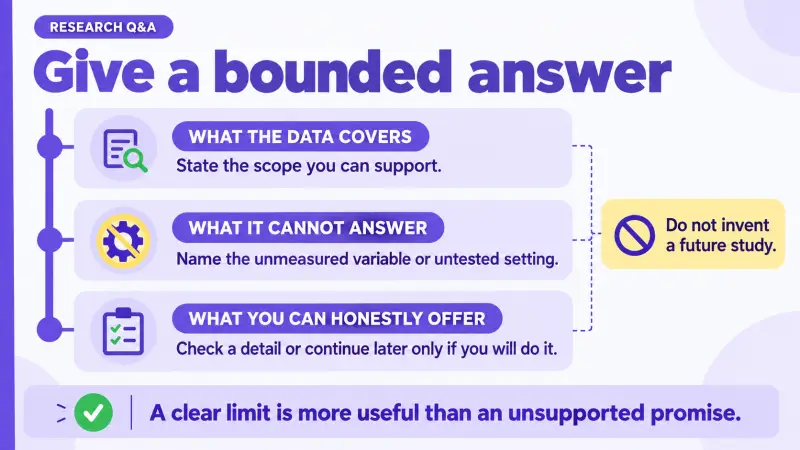
Three more scripts you can adapt, with what each one actually commits you to:
"We didn't measure that variable, so I don't have an answer from this dataset." This commits you to nothing beyond a factual statement about your design.
"That's outside what this study tested, but I'd be glad to talk about it after the session." This is a fair response to an off-topic question and it keeps the room moving. Only offer it if you will actually stay and talk.
"I'm not certain, and I'd rather check my notes than guess. Can I email you the exact figure?" This commits you to sending the email. Ask for the address before you leave.
The one thing to avoid is padding a gap with an invented promise. Saying "we're planning to test that next" when nothing is planned buys you three comfortable seconds and costs you credibility with the one person in the room most likely to remember it.
Frequently Asked Questions About Research Conference Q&A in English
Is it rude to ask a questioner to repeat or rephrase?
No. Asking for a repeat is normal at academic sessions in English, and it is more efficient than answering the wrong question. Naming the part you did catch, such as "I caught the part about the control group but not the rest," helps the questioner repeat only what you missed.
How can I practice Q&A when my results are not published yet?
Use a public abstract from your field or write a fictional study. Keep unpublished methods, data and identifiable details out of the practice material entirely rather than only changing names, and you still get the practice in restating questions, sequencing your explanation and marking limits.
Can a language partner tell me whether my research answer is correct?
No. An ordinary partner on any language exchange app is a listener, not a peer reviewer. Ask them to say back what they understood and which wording was unclear, and treat that as comprehension feedback rather than a check on your science. Scientific accuracy stays with your supervisor, co-authors and reviewers.
What does English Academia actually cover about Q&A sessions?
The Module 5 page checked for this article, "How to Survive a Q&A session? (2)," discusses explaining a method on the spot, questions about data you do not have, and off-topic questions. It recommends restating the question to confirm what is being asked and being open when an answer cannot be supplied yet. Other modules were not reviewed here.
Do I need the Cambridge book if I already read free materials online?
Not necessarily. Presentation Skills for Scientists, second edition, by Edward Zanders and Lindsay MacLeod, is a published guide whose listed chapters cover the audience, planning, science and the English language, and handling questions, and it sits behind publisher access controls. It is most useful for structured preparation. If your gap is live reaction rather than preparation, practice with a real listener first.
How long should an answer at a conference be?
There is no fixed rule, and norms vary by field and session format. As a working suggestion, aim for a restatement plus two or three sentences, then stop and check whether that answered the question. Adjust if your session chair or your field expects something different.
What should I do if a question turns into a long comment?
Wait for a pause, then restate whatever question is hidden inside it: "So if I understand, you're asking whether the effect would hold in a larger sample?" If there is no question, thank them for the observation and offer to continue after the session.
Which part of this should I practice first?
Clarification. Restating a question before answering solves the specific moment described at the start of this article, and you can rehearse just that step on HelloTalk this week using the public or fictional abstract you prepared.