Best Ways to Practice Speaking Spanish When You Have No One to Talk To
"I have no one to practice with" is the most common reason people give for not speaking Spanish. It is also the most solvable. You do not need a live human every single session to train the physical and mental machinery of speaking, and pretending you do is just another way of postponing.
This is a support article in our beginner-speaking cluster. The mindset behind it lives in the hub on how to start speaking Spanish before you feel ready. Here we solve the specific problem of practicing with zero partner.
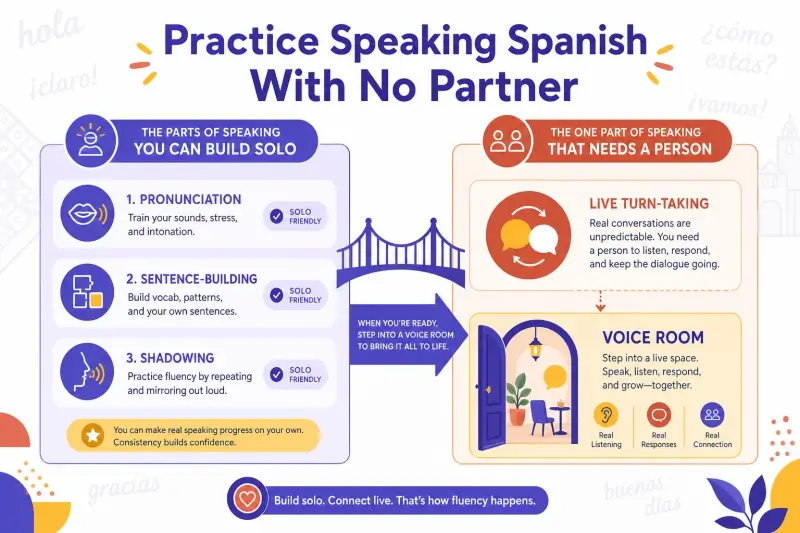
You can train most of the speaking skill alone, because pronunciation, retrieval speed, and phrase automaticity are muscles you can drill solo, and only the improvisation layer strictly needs another person. Understanding that split is what unlocks solo practice.
Which parts of speaking actually need a partner
Speaking is not one skill. It is a stack, and only the top layer truly requires someone else in the room.
| Speaking sub-skill | Needs a partner? | How to train it solo |
|---|---|---|
| Pronunciation and rhythm | No | Shadowing + AI pronunciation scoring |
| Vocabulary retrieval speed | No | Timed self-talk, describe your day aloud |
| Phrase automaticity | No | Repeat reaction phrases until reflexive |
| Listening comprehension | No | Podcasts, voice rooms as a listener |
| Real-time improvisation | Partly | Voice rooms, then real chats |
Look at the column. Four of the five sub-skills are trainable with no one else present. That is most of the work, done before you ever face a partner.
The solo drills that actually build speaking
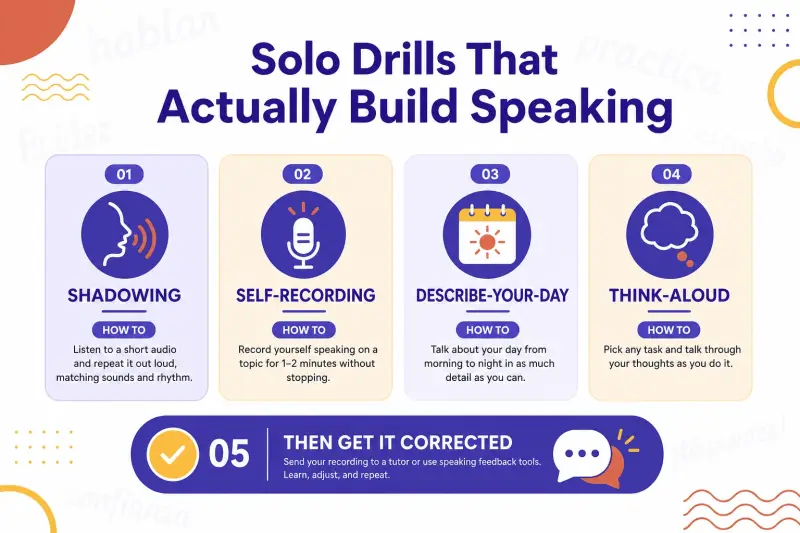
Here are the methods that move the needle when you are on your own, roughly in order of impact per minute.
Shadowing is the highest-yield solo speaking drill, because repeating audio a beat behind a native speaker trains rhythm, sound, and chunking at the same time. Play a short clip, speak over it a half-second behind, and match the melody, not just the words.
-
Self-talk narration: describe what you are doing, out loud, in Spanish. Making coffee? "Estoy haciendo café. Necesito azúcar." This trains retrieval under mild pressure with no audience.
-
Record and compare: record a 60-second monologue, listen back, note where you froze or fumbled, then redo it. Your own recording is a brutally honest coach.
-
AI pronunciation feedback: this is where solo practice got much better. HelloTalk's AI pronunciation scoring points to the specific sound you missed and its grammar correction explains the fix in real time, so you get targeted feedback without a human present.
For a structured weekly plan that folds these drills together, use our daily Spanish practice routine that actually works, and to keep it going past the motivation dip, the guide on building a Spanish habit that lasts.
From solo to soft-launch: the voice room bridge
There is a middle step between talking to yourself and talking to a partner, and most learners skip it.
A voice room lets you practice live speaking with the pressure dialed down, because you can enter as a silent listener and unmute only when you are ready. It is the gentlest bridge from solo drills to real conversation.
HelloTalk runs 24-hour multi-person Voicerooms plus interactive Livestream mini-lessons. You slide in as a listener, absorb real rhythm and filler use, then speak one line when it feels safe. Its Moments feed also lets you post a short voice clip and get corrected by several native speakers at once, which is solo-friendly because it is not a live call.
And when you do want a real partner, the reach is there fast: HelloTalk keeps 90% of core features free, connects 70M+ registered users across 260+ languages in 200+ countries, and carries over 1 billion messages daily. It was a 2017 Google Play Best Social App and got a global Google Play homepage feature in 2024. That scale matters because Spanish has around 485 million native speakers, so a partner is never actually far away once you want one.
Mistakes that waste solo practice
-
Only reading silently and calling it practice. If your mouth does not move, your speaking does not improve. More on this in input vs output in language learning.
-
Shadowing content way above your level. Pick clips you almost understand, not ones you cannot follow.
-
Never recording yourself. Without playback, you cannot hear your own errors.
-
Treating solo practice as a permanent replacement for people. It is the on-ramp. The destination is real conversation, covered in your first Spanish conversation today and the language-exchange pillar guide.
This Spanish speaking cluster is meant to be used together: how to start speaking Spanish, phrases that show up in real chats, solo speaking practice with no partner, and making the first conversation happen. Pair any of them with the daily Spanish routine hub and the language exchange method guide.
Frequently Asked Questions
Can I really learn to speak Spanish without a partner? You can train most of it solo: pronunciation, retrieval, and phrase automaticity all improve alone. Only live improvisation needs another person, and voice rooms bridge that gap gently.
What is the single best solo drill for speaking? Shadowing. Repeating native audio a beat behind trains sound, rhythm, and chunking together, which no flashcard can do.
How do I get pronunciation feedback with no teacher? Use AI pronunciation scoring that flags the exact sound you missed, then record and compare yourself against native audio.
Is talking to myself in Spanish actually useful? Yes. Narrating your day out loud builds retrieval speed under mild pressure, and it is available any time, free, with no partner.
How do I move from solo practice to real conversation? Use voice rooms as a listener first, then unmute for one line, then move to one-on-one chats. It is a ramp, not a leap. See the phrases that keep a chat going.
How long should a solo speaking session be? Even 10-15 focused minutes daily beats an occasional long one. Consistency wins, which is why a repeatable routine helps more than willpower.
Solo Practice That Still Gets Corrected
No partner is not a real excuse anymore. Shadow a clip, narrate your morning, get AI feedback, then slip into a voice room as a listener. The speaking muscle grows regardless.
Download HelloTalk at hellotalk.com to practice solo with AI feedback and step into a voice room when you're ready. Mostly free, always real.