
The Best Chinese Language Exchange Apps in 2026 (And How to Find a Real Partner)

You have been studying Mandarin for eight months. You know a few hundred characters, you can read the pinyin off a flashcard, and your app tells you your streak is 214 days. Then a delivery driver asks you a simple question on the street in Chengdu, and your mouth just stops. The tones you drilled in isolation collapse the second you have to string a real sentence together. He repeats himself, slower, and you catch maybe a third of it.
That gap is the whole reason Chinese language exchange apps exist. Solo study builds a vocabulary you can recognize but cannot deploy. What you are missing is the one thing no course can fake: a real person who speaks Mandarin natively, who will correct your fourth tone before it becomes a habit, and who actually wants to talk to you every day. This guide walks through the apps that connect you with that person, how tone feedback works when it comes from a human instead of a machine, and how to spot a partner who will still be around in three months.
Why Mandarin Is Harder to Self-Study Than Almost Any Other Language
Before comparing apps, it helps to be honest about what makes Mandarin different. Three problems trip up nearly every learner, and none of them get solved by an app that talks at you instead of with you.
The first is tone. Mandarin has four tones plus a neutral one, and the same syllable means completely different things depending on pitch contour. "Mā" is mother, "mǎ" is horse, "mà" is to scold. In isolation you can produce each tone fine after a few weeks. The trouble starts when tones combine inside a fast sentence, where they shift, compress, and blend. You cannot hear your own errors, because to your ear the wrong tone sounds perfectly reasonable. Only a native listener catches the moment your "I want to buy" turns into something that means "I want to sell."
The second is the gap between reading and speaking. Chinese characters do not tell you how to pronounce them, so it is entirely possible to read a paragraph and still have no idea how to say it aloud with the right rhythm. Learners who study through characters and apps often build a passive skill that never converts into speech.
The third is register and pace. Textbook Mandarin is clean and slow. Real Mandarin is full of sentence-final particles (ne, ba, ma, la), regional filler words, and a speed that feels impossible at first. You only get comfortable with it by hearing it constantly from people who are not performing for a classroom.
A language exchange partner fixes all three at once, because you are producing real speech and getting real feedback on it in the same conversation. If you want the bigger picture on why this two-way practice beats passive input, our overview of how language exchange actually works breaks down the mechanics.
What to Look for in a Chinese Language Exchange App
Not every app that promises "conversation practice" gives you what a Mandarin learner needs. Judge each one against these five things.
-
A large pool of native Mandarin speakers. Mandarin has more native speakers than any language on earth, but that only helps if the app has actually recruited them. A partner supply problem is the number one reason exchanges die. You want enough people online that you can find someone at your level and in your time zone within minutes, not days.
-
In-line text correction. When you type a message with the wrong character or a clunky word order, your partner should be able to fix it right inside the chat and hand it back to you, so you can see the corrected version next to your original.
-
Voice tools built for tone work. Text alone cannot fix your pronunciation. You need voice messages you can replay, and ideally live audio, so your partner can hear the tones and model the correct ones back.
-
A translation and pinyin layer. When a message stumps you, being able to tap for a translation and pinyin keeps the conversation flowing instead of sending you off to a dictionary for ten minutes.
-
A reason for the partner to stay. The best apps are built around a community, not a one-off match. If your partner is also learning your language, the exchange is genuinely mutual and far more likely to last.
The Best Chinese Language Exchange Apps in 2026
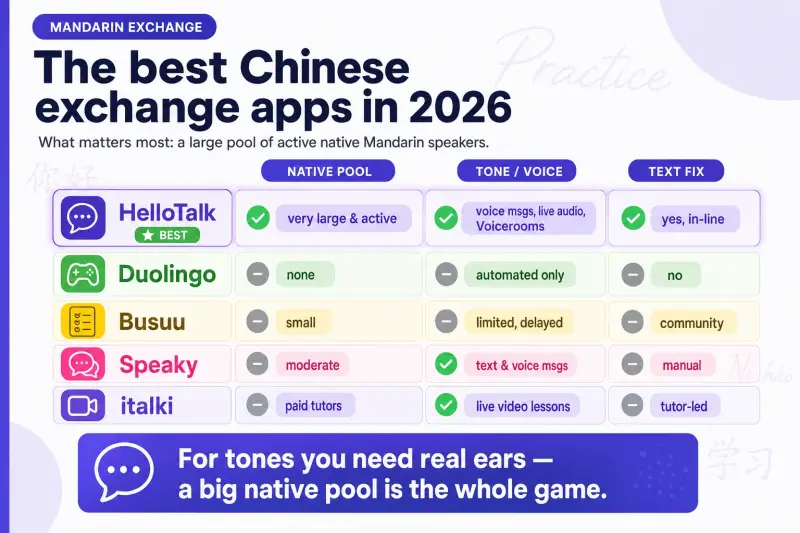
Here is how the main options compare specifically for Mandarin learners, not for language study in general.
| App | Native Mandarin pool | Tone / voice practice | Text correction | Best for |
|---|---|---|---|---|
| HelloTalk | Very large, active community | Voice messages, live audio, Voicerooms | Yes, in-line | Daily two-way exchange and tone feedback |
| Duolingo | None (no exchange feature) | Automated only | No | Early vocabulary and characters |
| Busuu | Small community feedback pool | Limited voice, delayed feedback | Community corrections | Structured course with occasional review |
| Speaky | Moderate | Text and voice messages | Manual | Casual text-first chatting |
| italki | Paid tutors, not free exchange | Live video lessons | Tutor-led | Structured paid lessons |
A few things stand out for Mandarin specifically. Duolingo and Busuu are fine for building your first few hundred characters and some grammar scaffolding, but neither gives you a live human who will correct a tone the moment you slip. italki is excellent if you want a paid tutor and a structured lesson plan, but it is not a free reciprocal exchange, so the pressure to perform is different and the cost adds up fast.
HelloTalk sits in a different category because it was built around the exchange itself. With 70M+ registered users across 200+ countries and support for 260+ languages, the Mandarin-learning community is one of its largest and most active. That scale matters more for Chinese than for almost any other language, because it means the partner supply problem mostly disappears. You can find someone learning English (or your native language) who natively speaks Mandarin, and now you both have a reason to show up. If you are weighing your options more broadly, our guide on how to choose an English speaking app uses the same evaluation logic in reverse, and it is worth a read when you are picking any exchange platform.
How Tone Correction Actually Works With a Human Partner
This is the part that makes Chinese exchange different from, say, Spanish or French exchange. Your partner is not just checking your grammar. They are your tone monitor.
Here is a workflow that works. Record a short voice message, thirty seconds is plenty, describing your day in Mandarin. Send it. Your partner listens and does two things: they type back a corrected version of your sentence, and they record the same sentence themselves so you can hear the target tones. Now you have a text correction and an audio model of the exact words you just tried to say. You replay their voice message five times, then re-record your own version and send it back. Within a week of doing this daily, you will start catching your own third-tone errors before your partner does.
The reason this beats an app that scores your pronunciation with a machine is that a human hears intent. When you say something with the wrong tone, a native speaker knows what you meant and can tell you both what you said and what you should have said. A pitch-detection algorithm just flags "wrong" without the context that helps you fix the pattern. For a fuller look at this difference, our comparison of AI conversation versus real human language practice goes deep on where each one helps.
Dropping into a Voiceroom is the low-pressure version of this. You can join a room where people are chatting in Mandarin, keep your microphone off, and just let the rhythm and tone patterns of real conversation land in your ear while you cook dinner. Ten minutes a day of passive listening like this tunes your ear faster than any drill. When you feel ready, you unmute and say one sentence. Nobody is grading you.
A Simple Weekly Chinese Exchange Routine
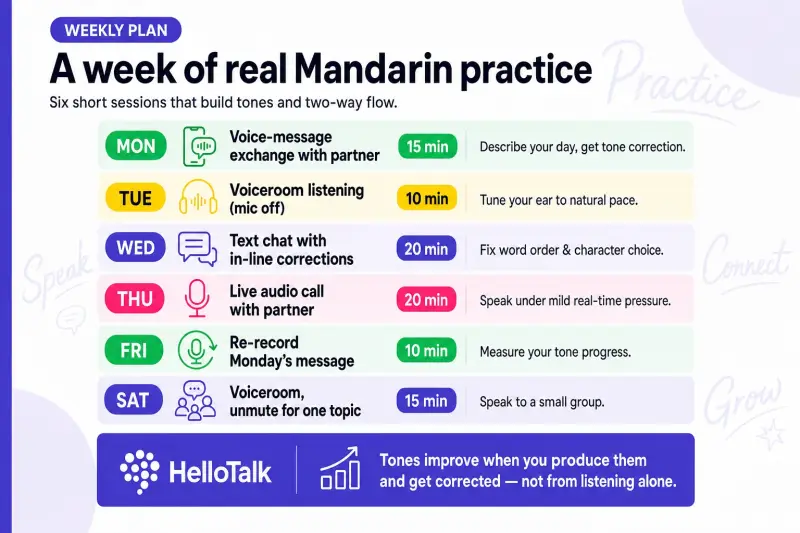
Structure keeps an exchange alive. Here is a week that balances speaking, listening, and correction without burning you out. Adjust the times to fit your schedule.
| Day | Activity | Time | Goal |
|---|---|---|---|
| Monday | Voice message exchange with partner | 15 min | Describe your day, get tone correction |
| Tuesday | Voiceroom listening (mic off) | 10 min | Tune your ear to natural pace |
| Wednesday | Text chat with in-line corrections | 20 min | Fix word order and character choice |
| Thursday | Live audio call with partner | 20 min | Real-time speaking under mild pressure |
| Friday | Re-record Monday's message | 10 min | Measure your tone progress |
| Saturday | Voiceroom, unmute for one topic | 15 min | Speak to a small group |
| Sunday | Rest or light review | 0-10 min | Let it settle |
The key move is Friday. Re-recording the same message you made on Monday gives you a concrete before-and-after. You will hear your own improvement, and that feedback loop is what keeps people going past the three-month mark where most learners quit.
How to Find a Partner Who Will Actually Stick Around
The apps get you matched. Keeping a partner is a separate skill. Most exchanges fizzle in the first two weeks, not because the people are unpleasant, but because the exchange was one-sided or unstructured.
Look for these green flags. A good partner is learning your language at roughly the same seriousness you are learning theirs, so the trade is fair. They correct you without being asked, which means they take the exchange seriously. They respond within a day or two, not once a week. And they are willing to do voice, not just text, because that is where Mandarin actually improves.
Watch for these red flags. Someone who only ever wants you to teach them English while never speaking Mandarin back is not an exchange partner, they are a free tutor arrangement that will exhaust you. Someone who only texts and refuses voice will not help your tones. And someone whose messages are all small talk with no correction is pleasant but not useful for progress.
When you first connect, set the terms out loud. Something as simple as "Let us do fifteen minutes in Mandarin and fifteen minutes in English each session, and please correct my tones" turns a vague chat into a real exchange. People appreciate the clarity, and it filters out the ones who were never serious.
If your goal is broader than one partner, remember that the community itself is a resource. Livestreams let you watch native speakers talk about topics you care about, and the comment sections are full of learners you can connect with. The Mandarin community on a large platform is big enough that if one partner drifts away, you can find another the same afternoon.
Common Problems and How to Fix Them
Every Chinese exchange hits the same few snags. Here is how to handle them.
"My partner speaks too fast and I understand nothing." Ask them, in Mandarin, to slow down: "Qǐng shuō màn yīdiǎn." Most partners happily oblige. If someone refuses to adjust, they are not a good match for your level yet, and that is fine. Find someone closer to your ability.
"We just make small talk and I am not improving." Bring a topic. Pick one thing to discuss each session, ordering food, describing your city, talking about a movie, and push yourself to use new vocabulary. Structure beats drift every time.
"I get corrected so much I feel discouraged." Reframe it. Every correction is a tone or a word you will now get right forever. Ask your partner to correct only your three biggest errors per message instead of everything, so it feels manageable.
"I can read but I freeze when I have to speak." This is the character-versus-speech gap. The fix is volume of speaking, not more reading. Send more voice messages, join more Voicerooms, and accept that the first two weeks feel clumsy. It gets smoother fast.
If English speaking is also on your radar, the same freeze problem shows up there, and our guide to an English speaking practice app covers the same "read but cannot speak" fix from the other direction.
Frequently Asked Questions
Are Chinese language exchange apps free? Many are. HelloTalk, Speaky, and Busuu's community features have free tiers that let you find partners and chat. Paid tiers usually add translation, extra correction tools, or remove ads. italki is different, since it charges per lesson because you are booking a tutor, not doing a reciprocal exchange.
How fast can I get conversational in Mandarin using an exchange? With daily practice of twenty to thirty minutes, most learners reach comfortable basic conversation in six to nine months. Tone accuracy improves fastest, usually within the first month of daily voice exchange, because you finally get feedback on it. Reading and formal writing take longer.
Do I need to know characters before starting an exchange? No. You can start with pinyin and voice messages from day one. A translation and pinyin layer inside the app lets you read your partner's messages even before you know many characters. Speaking practice does not have to wait for your reading to catch up.
What if I am shy about speaking? Start with voice messages instead of live calls, since you can re-record until you are happy. Then use Voicerooms with your microphone off to build listening confidence. Move to live audio only when you feel ready. There is no rush, and every fluent speaker started out clumsy.
Can I practice a specific dialect like Cantonese? Most exchange apps focus on Mandarin, which is the standard national language, but a large community will also have speakers of other regional varieties. Search the community, mention the variety you want in your profile, and you will find people. For most learners, though, Mandarin is the practical starting point.
How do I keep a partner interested long-term? Make the exchange genuinely mutual, show up consistently, and take an interest in their learning too. The exchanges that last are friendships built on a shared goal, not transactions. When both people improve, both people stay.
Start Talking, Not Just Studying
The fastest way to close the gap between the Mandarin you can read and the Mandarin you can say is to find one native speaker and talk to them every day. You can find that partner, get your tones corrected in real time, and drop into Voicerooms to tune your ear at HelloTalk.