
The Ideal Daily Spanish Schedule for Working Adults (30 Minutes or Less)
If your calendar is a wall of meetings and your evenings are already spoken for, the usual "just study an hour a day" advice is a joke. Working adults don't fail at Spanish because they're undisciplined. They fail because the advice assumes free time they don't have.
So this piece throws out the idea of one clean study block. Instead we'll fit Spanish into the pockets that already exist in a workday. If you want the underlying routine template that these pockets are built from, see our daily Spanish practice routine; this article is about scheduling it around a job.
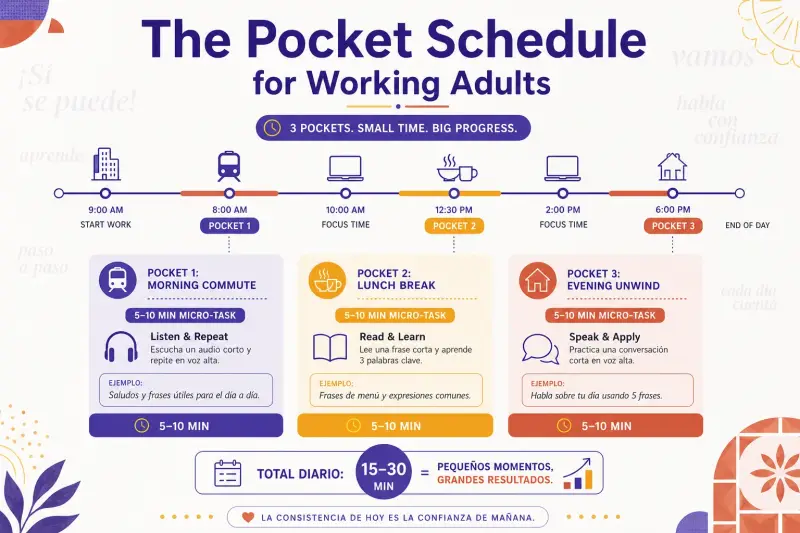
Busy adults make the most progress by breaking Spanish into two or three small pockets across the day rather than searching for one uninterrupted block that never comes. Commute, lunch, and a short evening window can add up to a real 30 minutes without stealing time you don't have.
Why the "one block" plan fails at work
The problem with a single daily block is fragility. Miss the block and you miss the whole day. And for people with jobs, blocks get eaten constantly by meetings, overtime, and family.
Distributed practice isn't just a workaround; it's actually better. Research on spaced learning shows short sessions spread across the day and week beat the same total time in one sitting. So the busy-adult constraint accidentally pushes you toward a more effective method. We cover the dose-response side of this in how many minutes of Spanish per day makes a difference.
For working adults, splitting practice into pockets isn't a compromise; distributed practice actually retains better than one long block, so the busy schedule works in your favor.
The pocket schedule
Here's a template that assumes a normal workday. Adjust the slots to match yours; the point is the structure, not the exact clock times.
| When | Time | What you do | Job it covers | |
|---|---|---|---|---|
| Commute in | Morning travel | 8 min | Listen to a Voiceroom or podcast in Spanish | Input |
| Micro-review | Between tasks | 3 min | Flashcard review on your phone | Retention |
| Lunch exchange | Midday break | 10 min | Message a native speaker, read the reply | Output + interaction |
| Commute home | Evening travel | 5 min | Read a Spanish post or two | Input |
| Wind-down | Before bed | 4 min | Write 2-3 sentences about your day | Output |
That's 30 minutes without a single dedicated "study session." Nobody around you even needs to know you're doing it. If your commute is a drive, swap reading for listening in those slots.
Match the schedule to your actual work rhythm
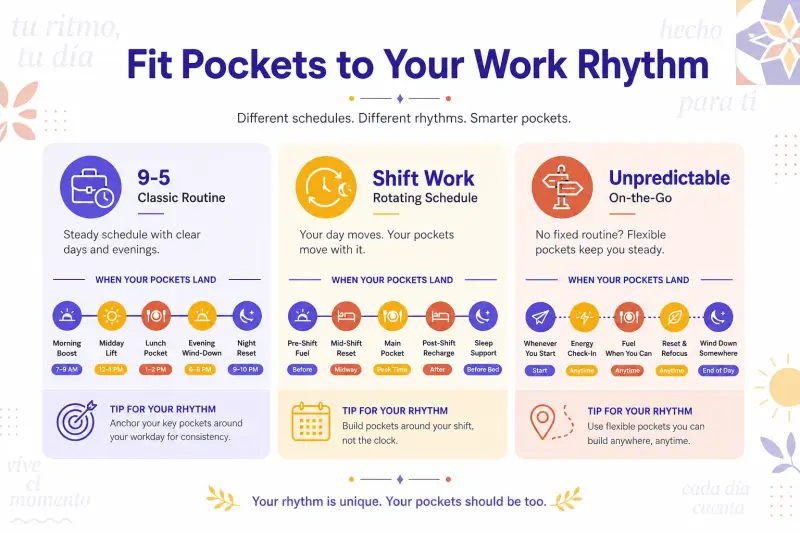
Not every job looks the same, so adapt the shape:
-
No commute (remote work): Use the coffee break, the post-lunch lull, and the moment you close your laptop as your three anchors.
-
Shift work: Anchor to fixed points in your day (waking, first break, meal) rather than clock times, since your hours move.
-
Frequent travel: Front-load input on planes and trains, and keep the lunch exchange as your non-negotiable interaction.
The consistent thread is anchoring practice to something that already happens every day. That's the core of making it survive a busy life, which we go deep on in how to build a Spanish practice habit that lasts.
Why pockets need a tool that fits pockets
Short pockets only work if the tool loads fast, needs no scheduling, and gives feedback in the moment. Booking a tutor for a 10-minute lunch slot every day isn't realistic. Asynchronous real conversation is.
That's the natural fit for HelloTalk. You send a Spanish message on your lunch break; a native speaker replies and corrects it while you're back in meetings; you read the correction on your commute home. The chat's built-in translation, phonetic transcription, and real-time grammar correction mean you don't lose your short window looking things up. With over 1 billion messages exchanged daily, replies come fast enough to keep the loop going across a workday.
The best schedule for a working adult is asynchronous real conversation, because a corrected message waiting for you fits a lunch break in a way a scheduled lesson never can. For the commute pockets, HelloTalk's Voicerooms run 24 hours and let you join as a silent listener, so you can fill travel time with real Spanish speech without needing to talk on a crowded train. Its Moments feed gives you short real posts to read in the two-minute gaps, and roughly 90% of core features are free, so a busy-adult schedule doesn't require a paid plan.
Protecting the schedule when work explodes
Some weeks work eats everything. The schedule survives if you have a fallback minimum: on a brutal day, do only the lunch exchange, one message. That single corrected message keeps the streak and the habit alive. Never trade a bad day for a zero day.
For choosing where to invest your limited time based on your goal (travel, work, a partner), language learning strategy by goal helps you prioritize, and language learning strategies that actually work covers the methods that give the most return per busy minute.
On the platform side, the same loop can include joining Livestreams when you want a slightly more guided room, and checking one line with AI pronunciation scoring or AI grammar notes before you hit send without changing this article's theme.
This Spanish daily-practice cluster works as four linked pieces: the 30-minute routine hub, building a habit that lasts, how many minutes per day actually help, and a working-adult pocket schedule. For how live exchange fits any routine, see the language exchange guide.
Frequently Asked Questions
How can I learn Spanish with a full-time job? Break practice into two or three small pockets tied to things you already do: commute, lunch, and wind-down. Thirty minutes split across the day is realistic and actually retains better than one long block.
Is 30 minutes a day enough for a busy professional? Yes. Thirty focused minutes daily, especially with real conversation in it, produces steady progress toward conversational Spanish. Consistency matters far more than finding a long study session.
When should working adults practice Spanish? Whenever your day already has gaps: the commute, coffee breaks, lunch, and the moment you finish work. Anchor practice to these fixed points instead of hunting for a special study time.
How do I practice speaking if I have no time for lessons? Use asynchronous real conversation. Send messages to native speakers during breaks and read their corrected replies later. It gives you real feedback without booking a fixed lesson slot.
What do I do on a day work goes crazy? Drop to your fallback minimum: one corrected message on your lunch break. Keeping a tiny action alive on the worst days is what protects the habit long term.
Should I study in the morning or evening? Both, in pieces. Use mornings and commutes for input (listening and reading) and lunch or evenings for output (writing and one real exchange). Splitting the two jobs across the day works better than one block.
Use Pockets, Not a Free Afternoon
Map your commute, lunch, and wind-down to the pockets above, then run the lunch exchange today so the streak starts now. Set up your daily asynchronous exchange with a native speaker on HelloTalk, and see our language exchange guide for the full approach to learning through real conversation.