
How to Build a Spanish Practice Habit That Lasts More Than 3 Weeks

You've done this before. Week one, you're on fire. Week two, still going. Week three, life happens, you miss a day, then two, and the app icon starts to feel like a small accusation. By week four it's over.
The problem was never motivation. Motivation always fades. The problem is that most of us try to run on willpower when we should be building a system that survives low-motivation days. This piece is about that system. If you don't yet have a routine to make automatic, start with our daily Spanish practice routine first, then come back here to make it stick.
A Spanish habit lasts when the daily action is small enough to do on your worst day, anchored to something you already do, and rewarding enough that you want to come back. Skip any of those three and week three will get you.
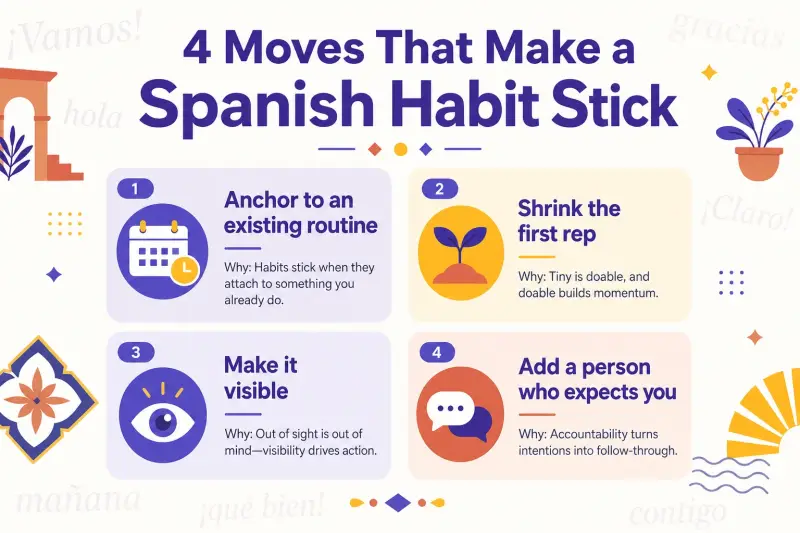
Why habits take longer than you think
Here's the number worth knowing. A well-cited study from University College London tracked people forming new habits and found it took a median of 66 days for a behavior to feel automatic, with a range from 18 to 254 days depending on the person and the habit.
The "3 weeks to a habit" idea is a myth; real habit formation averages around two months, which is exactly why so many people quit in week three. They expect autopilot before it can possibly arrive, feel like it's "not working," and stop. Knowing the real timeline changes how you treat the rough patch: it's not failure, it's the middle.
| Week | What it actually feels like | What most people do | What works instead |
|---|---|---|---|
| 1 | Exciting, easy | Overcommit | Keep it small on purpose |
| 2-3 | Novelty gone, effort felt | Miss a day, then quit | Protect the streak, shrink the task |
| 4-8 | Slowly getting easier | Already stopped | Keep showing up; automaticity is forming |
| 9+ | Feels normal | N/A | Add difficulty, not more willpower |
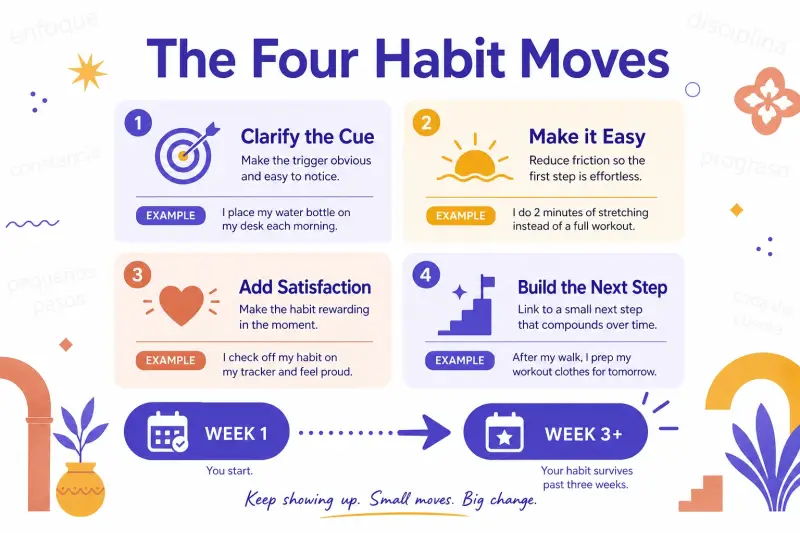
The four moves that make it stick
1. Make the minimum absurdly small
Your daily commitment should be so small it feels silly to skip. Not "study 30 minutes." Instead: "send one Spanish message." On good days you'll do far more, but the promise you keep is the tiny one. This is what keeps the streak alive on the day you're exhausted.
2. Stack it on an existing habit
Attach Spanish to something you already do without thinking. After I pour my morning coffee, I open my chat with a native speaker. After I sit on the train, I read one Spanish post. The existing habit becomes the trigger, so you don't have to remember or decide.
3. Build in the reward loop fast
Habits need a payoff you feel now, not fluency in two years. A reply from a real person is a fast, satisfying reward. This is where real interaction beats solo drilling for habit-building: a corrected message from a native speaker feels social and alive, which pulls you back tomorrow.
4. Protect the streak, but forgive one miss
Streaks are motivating because you don't want to break the chain. But make the rule "never miss twice." One miss is life; two is a new habit forming (the wrong one).
Why real interaction is a better habit than solo drilling
Solo apps are easy to abandon because nothing waits for you. A conversation is different. When someone replies in Spanish, there's a light, human pull to answer.
On HelloTalk, that pull is built in. The chat comes with inline translation, phonetic transcription, and real-time grammar correction, so a beginner can hold a conversation without stalling, and the correction turns every message into a mini lesson. With over 1 billion messages exchanged daily across its community, there's always someone to reply, which keeps the reward loop firing.
The most durable Spanish habit is a daily two-way conversation, because a reply from a real person is a reward your brain actually feels, unlike a solo streak counter. HelloTalk's Moments feed helps too: you post a sentence, several native speakers correct it, and that quick social feedback makes daily practice feel worth returning to. Its AI grammar correction also flags mistakes in real time with short explanations, so the low-motivation days still teach you something.
Design your habit in five minutes
Fill in these blanks right now:
-
My minimum daily action is: __________ (make it tiny)
-
I will do it right after I: __________ (an existing habit)
-
My reward is: __________ (ideally a reply from a real person)
-
My rule is: never miss twice.
That's the whole system. It's not exciting, which is the point; exciting is what fades.
When the habit is stable, then optimize
Once showing up is automatic, you can start caring about efficiency. That's the moment to think about the right daily dose, which we cover in how many minutes of Spanish per day makes a difference, and about matching your method to your goal in language learning strategy by goal. For the underlying methods worth building the habit around, language learning strategies that actually work is a solid map.
If your obstacle is a packed calendar rather than motivation, the fix is scheduling, not habit psychology. See the ideal daily Spanish schedule for working adults.
Common reasons Spanish habits die
-
Too big to sustain. Shrink the minimum.
-
No trigger. Stack it on coffee, commute, or lunch.
-
No feedback or reward. Add real interaction.
-
Perfectionism. A missed day is not a failed habit. Restart tomorrow.
On the platform side, the same loop can include dropping into Voicerooms as a listener first, and joining Livestreams when you want a slightly more guided room without changing this article's theme.
This Spanish daily-practice cluster works as four linked pieces: the 30-minute routine hub, building a habit that lasts, how many minutes per day actually help, and a working-adult pocket schedule. For how live exchange fits any routine, see the language exchange guide.
Frequently Asked Questions
How long does it really take to build a Spanish habit? Research suggests around 66 days on average for a behavior to feel automatic, with wide variation. Expect roughly two months of conscious effort before daily Spanish feels normal rather than forced.
Why do I keep quitting in week three? Because the novelty is gone but the habit isn't automatic yet. Week three is the hardest stretch, not proof it's failing. Shrink the task and protect the streak through it.
How small should my daily practice be? Small enough to do on your worst day. "Send one Spanish message" or "read one post" is a great minimum. You'll usually do more, but the tiny promise is what survives bad days.
Do streaks actually help? Yes, for most people. Not wanting to break a chain is a real motivator. Just set the rule as "never miss twice" so one off day doesn't spiral into quitting.
Is it better to practice alone or with people? For habit durability, with people. A reply from a real person is a faster, more satisfying reward than a solo streak counter, so it pulls you back the next day.
What if I've already broken the habit several times? Normal. Most people rebuild a habit several times before it holds. Restart with a smaller minimum and a clearer trigger, and treat past attempts as reps, not failures.
Make Showing Up the Hardest Part to Skip
Write your four blanks, then do the tiny version once today so the streak is real. The fastest way to build the reward loop is a daily reply from a native speaker, so set that up on HelloTalk. For the bigger picture on making real conversation your engine, see our language exchange guide.