How to Start Speaking Spanish (Before You Think You're Ready)
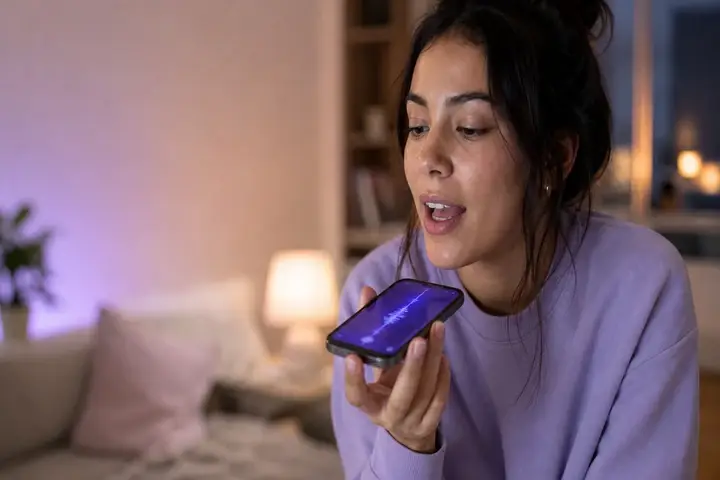
Most of us wait too long to open our mouths. We tell ourselves we'll speak once we've finished the grammar book, once we know 1,000 words, once we stop making mistakes. That day never quite arrives, and the speaking never quite starts.
Here is the honest version of how this works, and it is the whole reason this guide exists.
The fastest way to start speaking Spanish is to speak badly on purpose, early, in short real exchanges, instead of waiting until you feel ready. Readiness is not a stage you reach through more study. It shows up after you have already spoken, not before.
This is the hub article for our beginner-speaking cluster. If you want the deeper pieces, we link to them throughout: the actual phrases that come up in real Spanish conversations, how to practice speaking Spanish when you have no one to talk to, and a walk-through for having your first Spanish conversation today.
Why "wait until you're ready" quietly fails
Speaking is a separate skill from understanding. You can recognize hundreds of words on a page and still freeze when someone asks you a question out loud, because reading and listening never trained your mouth to retrieve and produce under time pressure.
There is a scale question underneath this too. Spanish has roughly 485 million native speakers, making it the second-most-spoken native language in the world after Mandarin, and it is used across around 20 countries. That means the moment you can string together a few phrases, there is an enormous pool of people who will actually understand your imperfect attempts. You are not practicing for some distant exam. You are practicing for a conversation that could happen this week.
Beginners who speak in their first two weeks build usable fluency faster than beginners who study silently for months first, because early speaking forces retrieval and exposes the exact gaps worth fixing. Silent study hides your gaps. Speaking surfaces them.
How much speaking actually gets you somewhere
Let's ground the timeline. The US Foreign Service Institute classifies Spanish as a Category I language, one of the easiest for English speakers, and estimates roughly 600-750 class hours to reach professional working proficiency. That is the full professional bar, not the "can hold a friendly chat" bar, which comes much sooner.
The practical takeaway is that conversational comfort is a fraction of that number, and every minute you spend actually talking counts far more than a minute spent reading rules. If you want a structured way to spread those minutes across a week, we built a separate daily Spanish practice routine that actually moves the needle, and a piece on building a Spanish habit that lasts more than three weeks.
Your first 30 days: a speaking-first plan
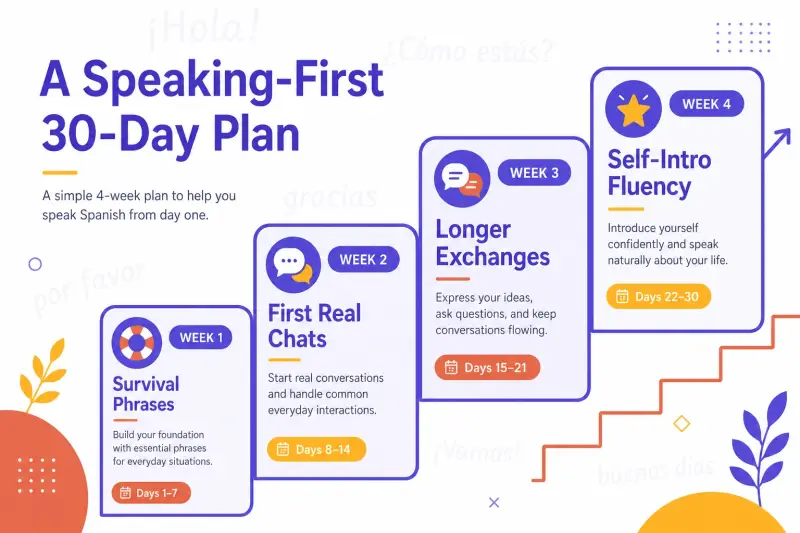
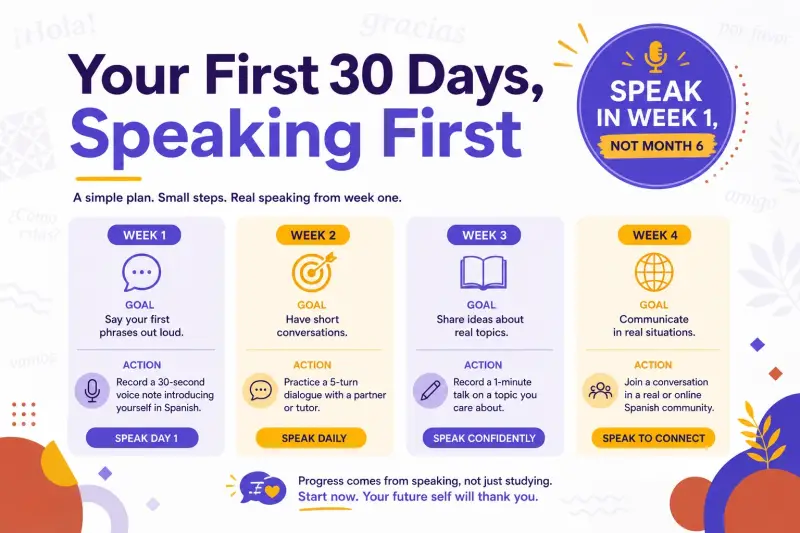
Here is a plan built around output, not consumption. Notice that talking starts on day one, not day thirty.
| Phase | Days | Daily focus | What you actually do | Output goal |
|---|---|---|---|---|
| Warm mouth | 1-5 | Survival phrases | Read 10 phrases aloud, record yourself | Send one voice message |
| First contact | 6-12 | Greetings + self-intro | Introduce yourself to a native speaker | One real 3-line exchange |
| Stretch | 13-21 | Questions + reactions | Ask and answer, react in real time | A 5-minute chat |
| Recover | 22-30 | Fix repeated mistakes | Get corrections, redo the same topic | Retell one story cleanly |
The point of the table is not perfection. It is that "speak" appears in week one and never leaves.
The four things that make early speaking survivable
Speaking badly is only bearable if you have a soft place to do it. This is where the right tool matters, and it is why we lean on a real-people app rather than a solo drill app for this stage.
A beginner speaks sooner when translation, pronunciation feedback, and a native speaker all live in the same place, because switching between apps kills momentum mid-sentence. On HelloTalk, that integration sits inside one chat: built-in translation, transcription, text-to-speech readouts, and real-time grammar correction, so you can understand a reply and fire back without leaving the conversation.
Four features carry most of the beginner-speaking load:
-
Chat-based learning: message a native speaker, tap for translation, hear the word read aloud, and get corrections inline. It removes the "what did that mean" panic that usually ends a chat.
-
Moments: post a short sentence or voice clip to the public feed and get it corrected by several native speakers at once. It is low-stakes reps without a live call.
-
Voicerooms and Livestreams: 24-hour multi-person voice rooms you can enter as a silent listener first, then speak when ready, plus interactive livestream mini-lessons.
-
AI learning tools: AI pronunciation scoring that points to the specific sound you missed, plus real-time grammar correction with explanations, for the days you want to rehearse before facing a human.
HelloTalk keeps 90% of its core features free, spans 260+ languages across 200+ countries with 70M+ registered users, and moves over 1 billion messages daily, so finding a Spanish speaker at your level is genuinely fast. It was named a Google Play Best Social App in 2017 and featured on the global Google Play homepage in 2024.
Common beginner mistakes that delay speaking
-
Treating a course finish line as the permission slip to speak. It is not.
-
Rehearsing full sentences in your head instead of sending imperfect ones. Send the imperfect one.
-
Avoiding native speakers because you fear judgment. Most are delighted you are trying their language.
-
Only doing input. If you never produce, you never train production. We go deeper on this trade-off in input vs output in language learning and in language-learning strategies that actually work.
If you want the fuller picture of practicing with real people over time, the pillar guide on language exchange covers where and how to do it safely.
This Spanish speaking cluster is meant to be used together: how to start speaking Spanish, phrases that show up in real chats, solo speaking practice with no partner, and making the first conversation happen. Pair any of them with the daily Spanish routine hub and the language exchange method guide.
Frequently Asked Questions
How soon can a beginner start speaking Spanish? On day one. You can send a voice message with a memorized greeting before you understand any grammar. The skill you are building is retrieval under pressure, and that only develops by doing it.
Do I need to know grammar before I speak? No. You need enough survival phrases to be understood. Grammar accuracy improves through correction after you speak, not through study before you speak.
Is it embarrassing to speak Spanish badly to a native speaker? Far less than you expect. Most native speakers on a language-exchange app are learning your language too, so the exchange is mutual and forgiving.
How much daily speaking is enough at the start? Even 10-15 focused minutes of actual output beats an hour of silent reading. Consistency matters more than length, which is why a repeatable routine helps.
What if I have literally no one to practice with? You still have options, from AI pronunciation tools to shadowing to voice rooms. We cover all of them in our guide to practicing Spanish with no partner.
How long until I can hold a real conversation? Sooner than the 600-750 FSI hours for full proficiency. Basic back-and-forth chats are reachable in weeks if you speak daily. Start with your first conversation today.
Speak This Week, Not Next Year
You do not need to feel ready. You need one native speaker, one memorized greeting, and the willingness to be a beginner out loud. The readiness follows.
Download HelloTalk at hellotalk.com and send your first Spanish message today. Real speakers, real corrections, mostly free.