Your First Spanish Conversation: How to Make It Happen Today
You have read the guides. You know you should speak early. And yet the first conversation keeps getting pushed to "next week, when I'm a bit better." Let's kill that pattern right now, in the next hour, with a plan you can actually finish today.
This is the action article in our beginner-speaking cluster. The reasoning behind speaking early sits in the hub on how to start speaking Spanish before you feel ready. This piece is not about why. It is about doing it before you go to bed.
The reason a first Spanish conversation keeps getting delayed is that we treat it as a milestone to earn instead of a task to schedule, and tasks get done while milestones drift. Turn it into a 40-minute task and it happens today.
Why "today" fails, and how to beat it
"I'll speak when I'm ready" fails because readiness has no finish line. There is always one more chapter. The fix is to shrink the goal until it is impossible to justify skipping: not "have a great conversation," just "send three real messages to one real person and get one reply."
A first conversation only needs to be three exchanges long to count as a win, because the goal today is to break the seal on speaking, not to hold a deep chat. Lower the bar until you clear it, then raise it tomorrow.
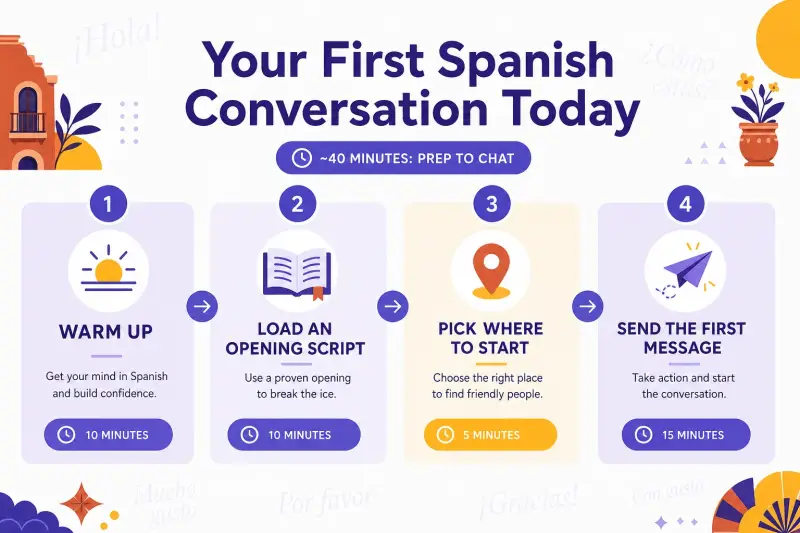
Your today action plan (about 40 minutes)
Do not read ahead and plan. Do the steps in order. The whole thing fits in a single sitting.
| Step | Time | Action | Output |
|---|---|---|---|
| 1 | 5 min | Install a language-exchange app, set Spanish as target | Profile live |
| 2 | 10 min | Memorize a 3-line self-intro (below) | Intro ready |
| 3 | 5 min | Find one Spanish native at beginner-friendly level | Partner found |
| 4 | 10 min | Send the intro, ask one question | First message sent |
| 5 | 10 min | React to their reply using filler phrases | Real exchange done |
That is it. Five steps, one sitting, first conversation logged.
The opening script that always works
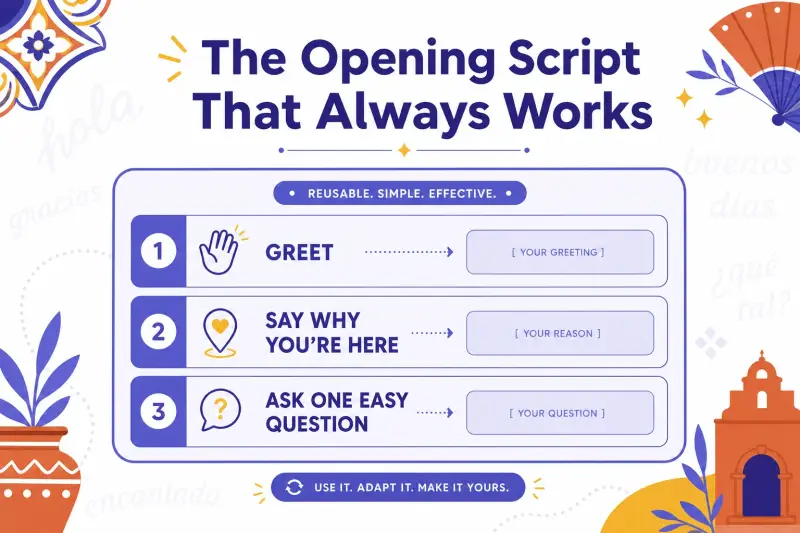
You do not improvise your first message. You use a template. Here is one that lands well because it is warm, honest, and invites an easy reply.
"¡Hola! Me llamo Alex. Estoy aprendiendo español y soy principiante. ¿De dónde eres?" (Hi! My name is Alex. I'm learning Spanish and I'm a beginner. Where are you from?)
Announcing that you are a beginner is a feature, not a weakness. It sets expectations and native speakers respond with patience. When they reply, reach for the reaction phrases from our guide to the phrases that come up in real conversations: "¿En serio?", "¡Qué bien!", "¿Y tú?". Those keep the rally alive.
Where to actually have it today
You need a place with real Spanish speakers online right now, low pressure, and tools that stop you from freezing mid-sentence. That combination is the whole reason we point beginners to a real-people app for this.
A first conversation goes better in a chat where translation, read-aloud, and correction are built in, because a beginner needs help mid-message without abandoning the thread to open another app. On HelloTalk, all of that sits inside one chat window.
Here is how the four features carry your first attempt:
-
Chat-based learning: send your intro, tap any confusing reply for instant translation, hear it read aloud, and get gentle inline correction. You never leave the conversation to look something up.
-
Moments: not ready to message one-on-one? Post your intro line to the public feed and get several native speakers correcting and replying, a soft first contact.
-
Voicerooms and Livestreams: enter a 24-hour voice room as a listener today, then say one line. That counts as a first spoken conversation too.
-
AI learning tools: rehearse your intro against AI pronunciation scoring first, so your very first "¿De dónde eres?" comes out clear.
The odds are in your favor: HelloTalk connects 70M+ registered users across 200+ countries and 260+ languages, moves over 1 billion messages daily, and keeps 90% of core features free, so a Spanish speaker is available the minute you sign up. Spanish having roughly 485 million native speakers means your beginner intro will find a friendly reader fast.
Mistakes that sink a first conversation
-
Waiting for a "better" day. There is no better day. Do it now.
-
Writing a paragraph. Three short lines beat one anxious essay.
-
Going silent after their reply. Have your reaction phrases ready before you send.
-
Aiming for perfect. The win today is completion, not correctness. To make this stick beyond today, set up a routine that lasts and see language-learning strategies that actually work. If you truly have no one available this minute, our no-partner practice guide and the language-exchange pillar give you the interim moves.
This Spanish speaking cluster is meant to be used together: how to start speaking Spanish, phrases that show up in real chats, solo speaking practice with no partner, and making the first conversation happen. Pair any of them with the daily Spanish routine hub and the language exchange method guide.
Frequently Asked Questions
How do I start my very first Spanish conversation? Send a three-line self-intro that says you are a beginner, then ask one simple question like "¿De dónde eres?" Keep it short and let them reply.
What if I don't understand their reply? Use "¿Cómo?" or "Más despacio, por favor," or tap for translation inside the chat. Not understanding is normal and easy to recover from.
Should my first conversation be text or voice? Text is fine and lower pressure. Voice rooms as a listener also count. Do whichever gets you to send today rather than tomorrow.
How long should a first conversation be? Three exchanges is a complete win. The goal is breaking the seal, not depth. Depth comes with repetition.
What do I say after "hello"? Ask one question about them, then react to their answer with a filler phrase and bounce it back with "¿Y tú?" See the full reaction phrase set.
Is it really okay to speak so early as a beginner? Yes, and it is the point. Early speaking is what builds fluency fastest, as the hub guide explains.
Have the First Exchange Before Bed
Set a 40-minute timer, work the five steps, and send that intro before you sleep. Tomorrow you will not be someone who is "about to start speaking Spanish." You will be someone who already has.
Download HelloTalk at hellotalk.com, memorize your three lines, and have your first Spanish conversation today. Real speakers, real replies, mostly free.