The Best App to Learn English Speaking Fluently in 2026

Fluency is not a bigger vocabulary. It is the ability to say what you mean in real time, without translating in your head first, and to keep going when the other person says something you did not expect. Plenty of learners have thousands of words memorized and still stall in a real conversation, because they built knowledge instead of a reflex.
That is the lens for this guide. The best app to learn English speaking fluently is not the one with the most lessons. It is the one that gets you doing the specific thing fluency is made of, which is speaking in real time, often, with feedback. Here is how the popular apps measure up against that standard.
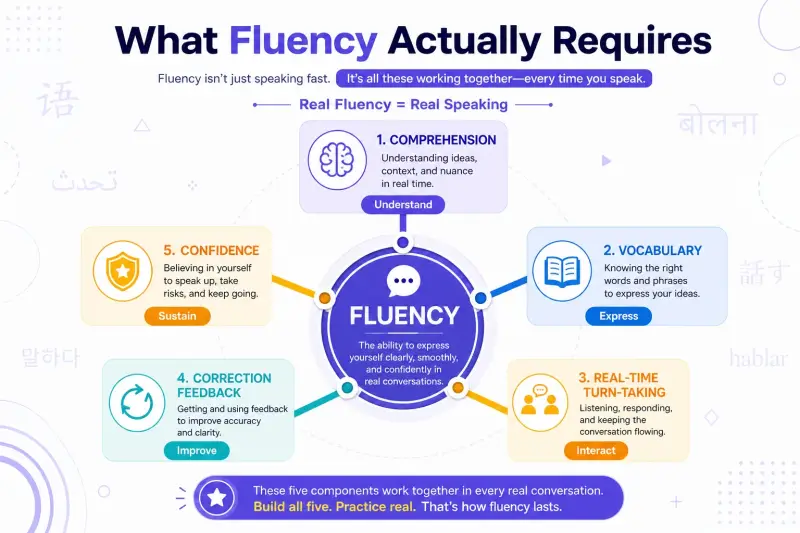
What Fluency Actually Requires
Before comparing apps, it helps to name what you are actually training. Spoken fluency comes from a handful of ingredients, and an app is only as good as how many of them it delivers.
-
Real-time production. You have to form sentences under time pressure, not compose them slowly. This trains automatic retrieval.
-
Unpredictable input. Real people say unscripted things, which forces you to comprehend and respond on the fly.
-
Feedback that lands. Corrections have to reach you in context, right after you make the mistake, or they do not stick.
-
Volume and consistency. Fluency is a frequency game. A little every day beats a lot occasionally.
An app that nails all four builds fluency. An app that only drills vocabulary trains recognition, which is useful but not the same thing. Our guide on the difference between input and output in language learning explains why output is the piece most learners skip.
The Best Apps for English Speaking Fluency, Compared
| App | Real-time speaking | Unpredictable input | Feedback quality | Fluency fit |
|---|---|---|---|---|
| HelloTalk | High: live chat, voice, Voicerooms | High: real native speakers | In-context corrections from natives | Strong for real fluency |
| Cambly | High: live video tutors | Medium: guided by tutor | Tutor feedback, real-time | Strong, at a cost per hour |
| italki | High: scheduled lessons | Medium: teacher-led | Structured teacher feedback | Strong for guided fluency |
| Speak | Medium: AI partner | Low: scripted AI | Instant AI feedback | Good for warm-up reps |
| ELSA | Low: pronunciation only | Low | Precise pronunciation scoring | Narrow: accent, not full fluency |
| Babbel | Low: in-lesson speech | Low | Speech recognition | Foundation, not fluency |
| Duolingo | Low: short prompts | Low | Automated | Habit and basics, not fluency |
The pattern repeats. The apps that score high for fluency are the ones that put you in real, unpredictable conversation. Tutor apps do this with paid teachers. A language exchange app does it with a community of native speakers. AI and drill apps are valuable supports, but on their own they train pieces of fluency rather than the whole reflex. For the trade-offs by budget and style, see our guide on how to choose an English speaking app.
Why HelloTalk Fits the Fluency Definition
HelloTalk hits all four fluency ingredients because the platform is a network of real people rather than a course. You are matched with native English speakers among 70M+ registered users across 200+ countries, so real-time, unpredictable conversation is always available.
Picture a fluency-building week on the app. Monday you send voice messages back and forth with a partner and get your slips corrected in the chat, so the feedback lands in context. Wednesday you drop into a Voiceroom and defend an opinion live, which forces real-time production against unpredictable input. Friday you review the corrections you collected and reuse them. That loop trains the reflex itself rather than only the knowledge, and it costs little because roughly 90% of core features are free. It is also why pairing the app with a fixed daily English speaking practice routine accelerates results so reliably.
The honest limit: an exchange partner is not a certified teacher and will not hand you a graded syllabus or exam prep. If you need that structure, a tutor app or a course complements the speaking practice rather than replacing it.
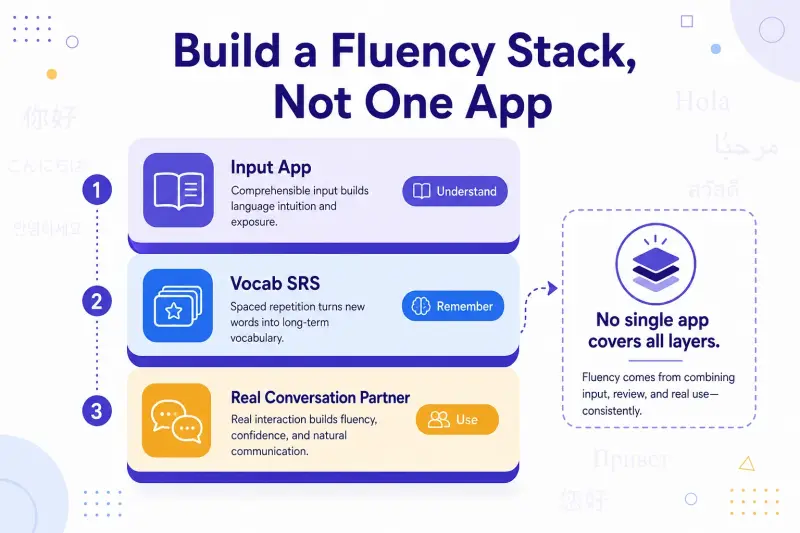
Building a Fluency Stack Instead of Picking One App
The learners who reach fluency fastest rarely rely on a single app. They build a small stack where each tool covers a different fluency ingredient, and the center of that stack is always real speaking.
A practical stack looks like this. Use a language exchange app as your engine for real-time conversation and human feedback. Add a pronunciation app if a specific accent issue holds you back. Keep a habit app if gamified streaks help you show up. The exchange app does the fluency heavy lifting; the others patch specific gaps. Our English fluency apps roundup for 2026 walks through building that stack, and the ranked English speaking practice app guide shows which apps deliver the most talk time.
If budget is your constraint, the good news is the fluency engine can be free. See the free English speaking apps guide for options that get you talking without a subscription, and remember the whole language exchange model exists precisely so real speaking practice stays accessible.
How Long Until You Are Fluent?
There is no honest single number, because fluency depends on your starting level, how much you practice, and how much of that practice is real speaking. What is reliable is the direction: daily real conversation moves you faster than any amount of passive study.
A learner who speaks fifteen focused minutes a day, gets corrected, and reuses those corrections will outpace someone doing an hour of tapping twice a week. The app matters less than the habit, but the right app makes the habit easier to keep, which is the real reason to choose one built around talking.
On the platform side, the same loop can include posting a short practice note on Moments for multi-speaker corrections, and joining Livestreams when you want a slightly more guided room without changing this article's theme.
These English app articles use different evaluation lenses on purpose: ranked by real talk time, free tiers only, and how far each path takes fluency. For a decision filter rather than a ranking, see how to choose an English speaking app.
Frequently Asked Questions
What is the single best app to learn English speaking fluently? The best fit is an app that gives you real, unpredictable conversation with feedback. HelloTalk does this through native-speaker chat and Voicerooms, and tutor apps like Cambly and italki do it through paid lessons.
Can an app really make me fluent, or do I need a teacher? An app that delivers real conversation can carry you a long way. A teacher adds structure and exam prep. Many fluent learners combine a free exchange app for daily speaking with occasional paid lessons.
Is HelloTalk good for fluency specifically? Yes, because it centers real-time conversation with native speakers and in-context corrections, the two things fluency needs most. Its limit is that partners are not certified teachers, so pair it with structure if you need a syllabus.
How much daily speaking do I need to become fluent? Aim for consistent real speaking rather than a magic number. Fifteen focused minutes a day of actual conversation, with feedback you reuse, beats long infrequent study sessions.
Do I need to pay to reach fluency? Not necessarily. The core fluency activity, real conversation, is free on an exchange app. Paid tools add structure and convenience but are optional for building the speaking reflex.
Raise Your Fluency Ceiling With People
Fluency is built one real conversation at a time, and the sooner you start the sooner it compounds. If you want an app built around actually talking with native speakers, you can try HelloTalk and put the fluency loop into practice this week.