Free English Speaking Apps in 2026: Which Ones Actually Get You Talking

Search for a free English speaking app and you will find plenty. Download a few and you will notice a pattern fast. The word "free" gets you a foundation of vocabulary and grammar, then the moment you want to actually speak, a paywall slides up. Free to install is not the same as free to practice speaking, and that distinction is the whole point of this guide.
So we looked at the popular options and asked one plain question: on the free tier, can you actually produce spoken English and get feedback, or is talking locked behind a subscription? The answer separates apps that are genuinely free for speakers from apps that are free samplers for readers.
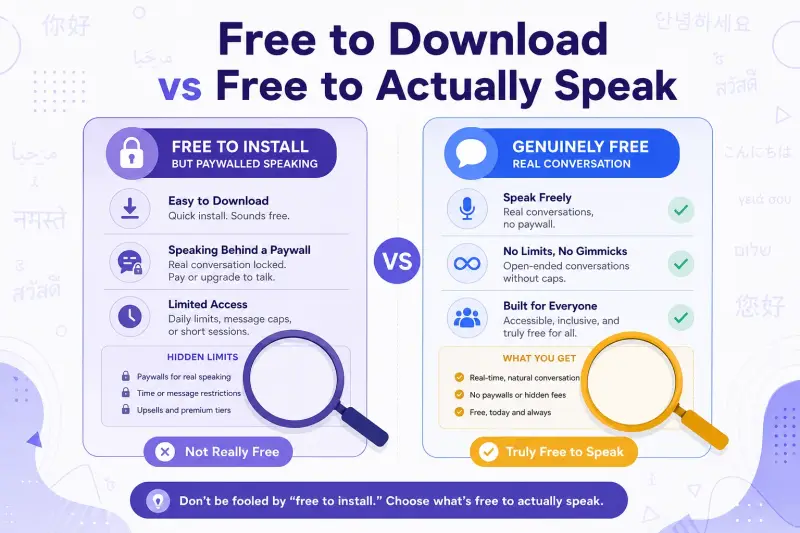
Free to Download vs Free to Actually Speak
Nearly every language app is free to download. The real question is what the free tier lets you do. Broadly there are three models, and only one of them makes speaking practice genuinely free.
-
Freemium course apps give you a handful of lessons free, then gate the rest. Speaking is usually a paid feature or a thin one.
-
Tutor marketplaces are free to browse but you pay per lesson, so speaking practice always has a price per hour.
-
Language exchange platforms are largely free because your practice partners are other people, not paid staff. Speaking is the free part, not the gated part.
That third model is why a well-built exchange app can offer so much for nothing. When your conversation partner is a native speaker who wants to learn your language in return, nobody has to be paid, and speaking practice stays free. It is the same logic behind the pillar concept of language exchange, where practice is a fair trade rather than a purchase.
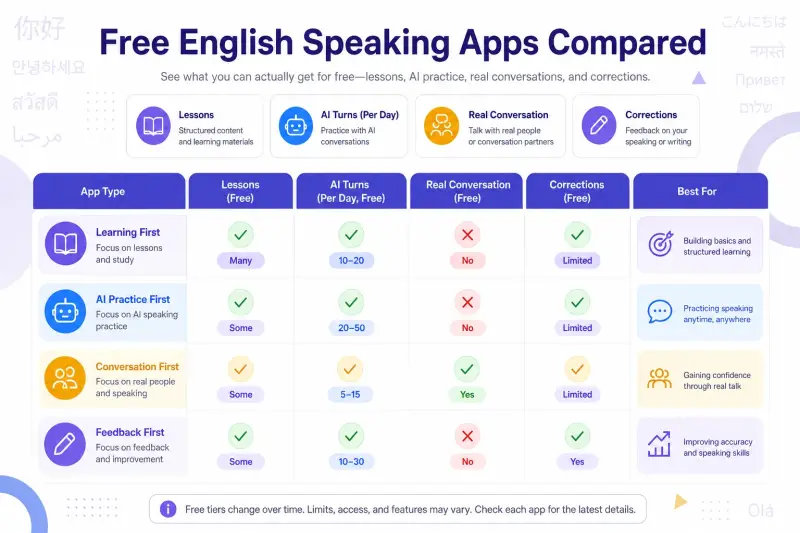
The Free English Speaking Apps, Compared
| App | Free speaking? | What the free tier gives you | The catch |
|---|---|---|---|
| HelloTalk | Yes | About 90% of core features free: chat with native speakers, voice messages, corrections, Voicerooms | VIP adds unlimited translation and extras |
| Duolingo | Limited | Full course path with short spoken prompts | Ads; little real conversation |
| Busuu | Limited | Some lessons and community feedback | Most content and speaking gated |
| Speak | Trial only | Brief taste of the AI partner | Real usage needs a subscription |
| ELSA | Limited | A few pronunciation drills daily | Full speech coaching is paid |
| Babbel | Trial only | First lesson free | Course locked behind subscription |
| italki / Cambly | Browse free | See tutors and prices | Every lesson costs money |
Read down the "free speaking" column and the picture is clear. Course and tutor apps are free to sample, not free to speak. A language exchange platform is the one where real talking, the actual fluency-building activity, sits inside the free tier.
Why HelloTalk Gives You So Much for Free
HelloTalk keeps roughly 90% of its core features free, and the free features are exactly the ones that build speaking. You can message native English speakers, send voice notes, receive grammar corrections directly in the chat, and drop into Voicerooms to listen and talk, all without paying. With 70M+ registered users across 200+ countries speaking 260+ languages, the pool of potential partners is large enough that free practice does not mean an empty room.
Here is what a free session actually looks like. You record a voice message about your weekend and send it to a partner. They reply by voice, and when your grammar slips, they tap to correct it, so you see the fix in context. Later you open a Voiceroom, listen to a live English discussion for a few minutes, then unmute and add your own point. None of that costs anything, and it is the same core loop a paid tutor would run you through.
The paid VIP tier exists (Monthly / Yearly / Lifetime; see in-app quote), and it adds conveniences like unlimited translation and an ad-free experience. But the speaking practice itself is not the thing you pay for. If you want the fuller comparison of what is and is not free across apps, our ranked guide to English speaking practice apps lays out talk time against cost.
Building a Free Speaking Routine That Works
Free is only useful if you use it, and the apps that stay free the longest are the ones that reward a light daily habit rather than a paid syllabus. A simple free routine beats an expensive plan you abandon.
Try this: five minutes of listening in a Voiceroom to tune your ear, five minutes sending and replying to voice messages with a partner, and one grammar point you noticed and want to reuse tomorrow. That fifteen-minute loop costs nothing and produces real spoken output. Pair it with the structure in our 30-minute daily English speaking practice routine and you have a free, repeatable plan.
If you want to see how free options stack up against paid ones for reaching actual fluency, the best app to learn English speaking fluently guide weighs both, and the broader English fluency apps roundup for 2026 covers the long game.
When Free Is Enough and When to Pay
Free is genuinely enough for most learners who just want consistent speaking practice. A language exchange app on its free tier can carry you a long way because the core activity, talking with real people, is not gated.
You might consider paying when you want something specific that free cannot give you: a certified teacher and a strict syllabus, targeted pronunciation coaching, or the convenience of unlimited instant translation while you chat. Even then, many learners keep the free exchange app for daily speaking and add one paid tool for a specific gap. Start free, prove the habit, then upgrade only where you feel a real limit. The top English learning apps for quick daily practice guide can help you build that free-first stack.
On the platform side, the same loop can include posting a short practice note on Moments for multi-speaker corrections, joining Livestreams when you want a slightly more guided room, and checking one line with AI pronunciation scoring or AI grammar notes before you hit send without changing this article's theme.
These English app articles use different evaluation lenses on purpose: ranked by real talk time, free tiers only, and how far each path takes fluency. For a decision filter rather than a ranking, see how to choose an English speaking app.
Frequently Asked Questions
Is there a truly free app to practice speaking English? Yes. A language exchange app like HelloTalk keeps about 90% of core features free, including chat, voice messages, corrections, and Voicerooms, so real speaking practice sits in the free tier rather than behind a paywall.
Are free English speaking apps as good as paid ones? For speaking practice, often yes, because the core activity is talking with real people. Paid apps add structure, certified tutors, or convenience features, but they are not required to build fluency.
Which free app has real conversations instead of only exercises? Language exchange apps are built around real conversations. You message and talk with native speakers directly, rather than tapping through pre-written exercises.
Can I learn to speak English fluently for free? You can get most of the way for free with consistent daily speaking practice on a free exchange app. Some learners add a paid tutor later for structure or exam prep, but daily free practice is the engine.
Do free apps have ads or limits? Many freemium apps show ads or cap daily lessons. A free exchange tier may show ads too, which is often what the paid VIP tier removes, but the speaking features themselves stay usable.
Use Free Platforms That Answer Back
You do not need a subscription to start speaking English today. If you want real conversations with native speakers at no cost, you can try HelloTalk free and see how far the free tier takes you.