Spanish Conversation Phrases That Actually Come Up in Real Chats

Textbooks teach you "La biblioteca está a la derecha." Real Spanish speakers say "¿Qué tal?" and "O sea..." and "Es que no sé." There is a gap between the phrases we memorize and the phrases that actually keep a conversation alive, and closing that gap is what this article is about.
This is a support piece in our beginner-speaking cluster. If you have not yet decided to speak early, start with the hub on how to start speaking Spanish before you feel ready. Here, we focus only on the words that do real work.
The phrases that carry a real Spanish conversation are not vocabulary words but reactions, fillers, and repair lines, because a conversation is kept alive by responding, not by reciting. You can survive a chat knowing almost no nouns if you can react, buy time, and ask for a repeat.
Why textbook phrases stall a conversation
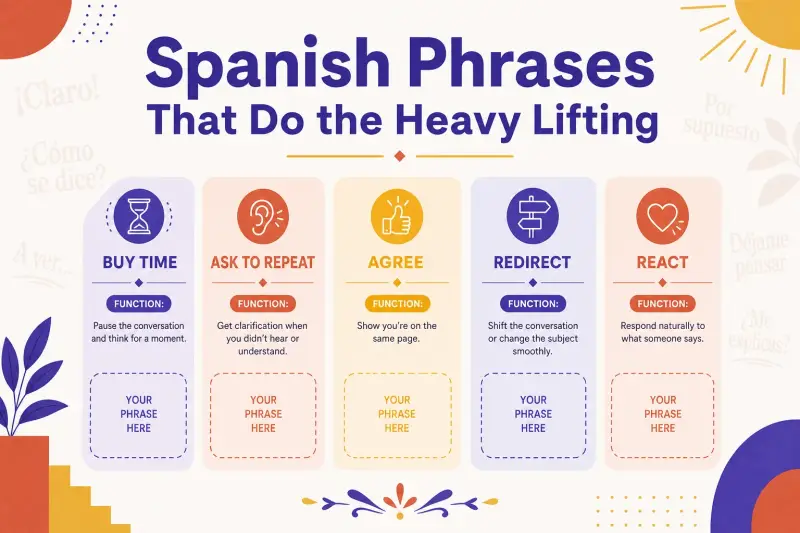
A conversation is a rally, not a monologue. Textbook phrases hand you complete, tidy statements, but they give you nothing for the messy middle, when you did not catch a word, need a second to think, or want to show you are listening.
Native speakers fill that middle with tiny, high-frequency phrases. Learn those first and you sound engaged even when your grammar wobbles.
A learner who masters 15 reaction and filler phrases will hold a conversation longer than one who has memorized 200 topic-specific nouns, because filler and repair phrases keep the exchange going while nouns just sit there. This is why we teach reactions before topics.
The phrases that do the heavy lifting
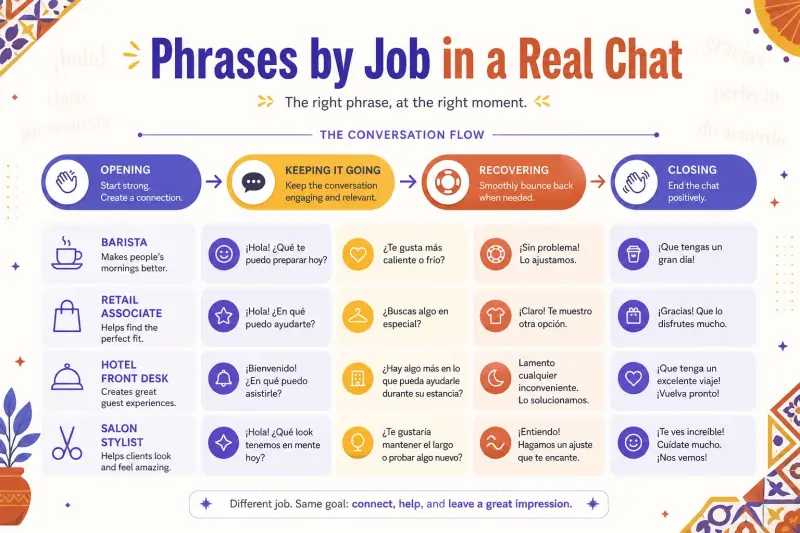
Here is a working set, grouped by the job each one does in a live chat. Spanish is used across roughly 20 countries, so a few of these vary by region, but every one below is widely understood.
| Job in the chat | Phrase (Spanish) | Rough meaning | When you fire it |
|---|---|---|---|
| Open casually | ¿Qué tal? | How's it going? | Any greeting, any level |
| Buy thinking time | O sea... / Es que... | I mean... / It's just that... | Mid-sentence stall |
| Show you're listening | ¿En serio? / ¡Qué bien! | Really? / How nice! | React to their news |
| Ask for a repeat | ¿Cómo? / Más despacio, por favor | Sorry? / Slower, please | You missed it |
| Admit a gap | No sé cómo se dice... | I don't know how to say... | Word escapes you |
| Keep it going | ¿Y tú? / ¿Qué más? | And you? / What else? | Bounce it back |
| Close warmly | Un placer / Hablamos pronto | A pleasure / Talk soon | Wrapping up |
Notice how few of these are "content." They are the connective tissue. Master this table and you can plug real nouns in later.
How to actually drill these until they're automatic
Reading a list does nothing. These phrases need to be so automatic that they leave your mouth before you translate. That takes reps with real replies coming back at you.
A practical drill is to pick one small thing that happened to you last week and tell it as a short story in Spanish, since the follow-up questions a listener asks are what pull your reaction and repair phrases out under pressure.
A reaction phrase only becomes usable once you have said it in response to something you did not script, because scripted practice trains recall but not reflex. You need unpredictable input to train reflex.
This is exactly where a real-people app beats a flashcard deck. On HelloTalk, four features turn these phrases into reflexes:
-
Chat-based learning: text a native speaker and drop these fillers into a live thread, with built-in translation and text-to-speech so you can hear "¿En serio?" said naturally and copy the rhythm. Inline grammar correction fixes what you fumble, without leaving the chat.
-
Moments: post a short clip using three of these phrases and let several native speakers correct your usage and tone at once.
-
Voicerooms and Livestreams: sit in a 24-hour voice room, catch how real speakers throw in "o sea" and "pues," then use them when you unmute.
-
AI learning tools: AI pronunciation scoring flags exactly which sound in "despacio" is off, so your repair phrases actually sound clear.
Because HelloTalk keeps 90% of core features free and connects 70M+ users across 260+ languages in 200+ countries, moving over 1 billion messages daily, you will find a Spanish speaker to test these on within minutes. If you have no partner right now, our guide to practicing Spanish with no one to talk to covers the solo versions of these drills.
Mistakes that make good phrases fall flat
-
Using formal textbook lines in casual chats. "¿Cómo se encuentra usted?" to a peer sounds stiff. "¿Qué tal?" fits.
-
Translating word for word. "Es que" is not "it is that," it is a soft "the thing is."
-
Learning phrases without their pronunciation. A mispronounced "¿Cómo?" gets misheard as a real question.
-
Skipping the repair phrases. The ability to say "más despacio" politely is what saves a conversation from collapsing.
For the deeper method behind why real-use language beats isolated study, see input vs output in language learning and the broader language-exchange pillar guide. When you are ready to use these live, follow your first Spanish conversation today.
This Spanish speaking cluster is meant to be used together: how to start speaking Spanish, phrases that show up in real chats, solo speaking practice with no partner, and making the first conversation happen. Pair any of them with the daily Spanish routine hub and the language exchange method guide.
Frequently Asked Questions
What are the most useful Spanish phrases for a real conversation? Reaction and repair phrases: "¿Qué tal?", "¿En serio?", "¿Cómo?", "O sea...", "¿Y tú?". They keep the rally going regardless of your vocabulary size.
Should I learn formal or informal Spanish first? Informal (tú) for most everyday chats. Learn usted for older strangers and formal settings, but the casual register is what you will use most on a language-exchange app.
Do Spanish phrases change a lot by country? Fillers and slang vary, but the core phrases here are understood across the roughly 20 Spanish-speaking countries. Pick up regional flavor from whoever you actually talk to.
How do I remember phrases under pressure? Use them in unscripted replies, not flashcards. Reflex comes from responding to things you did not expect, which is why chatting beats memorizing.
How many phrases do I need to start chatting? Around 15 reaction and filler phrases plus a self-intro is enough to hold a short back-and-forth. Build the habit with a routine that lasts.
Can I practice these without a partner? Yes, through shadowing, AI pronunciation tools, and voice rooms as a listener. Full solo playbook is in our no-partner practice guide.
Move Phrases Into a Live Reply
Phrases only become yours when a real person replies to them. Memorize the reaction set above, then use it on someone who will answer back.
Download HelloTalk at HelloTalk, find a Spanish speaker, and test your first "¿Qué tal?" today. Real people, real replies, mostly free.