
Japanese Graded Readers for Beginners: Which Ones Help You Read and Retell?

You open a book with "beginner" on the cover, reach the third line, and you are already on your fourth lookup. Ten minutes later the page is done, most of the words are checked, and you still could not say what it was about. Two different things produce that result, and they need different fixes: the level may be too high for reading without help, or the support you picked is taking you off the page every few words.
The short answer: use Tadoku's free reading catalog to sample until you find a level you can follow, use the ASK Japanese Graded Readers sets when you want graded volumes with publisher audio entries, and check either one afterwards in two separate steps. First confirm you followed the content, in any language. Then try to retell one idea in Japanese, which is a test of expression, not of comprehension.
Quick Comparison: Tadoku Free Books and ASK Japanese Graded Readers
A ranking of these two would be the wrong shape, because both are chosen the same way, by level, and they are useful at the same stage. The real differences are how much it costs you to abandon a book, what a specific item prints on the page, and where the audio lives. The third row in the table below is not a book at all. It is the step where you find out what stayed with you.
Read the table by the column that matches your current blocker. Go to "Finding your level" if you do not know where to start, to "Audio" if you want to hear the text you just read, and to "After reading" if finished books keep leaving nothing behind. Reading is one slot in a beginner's week, and the other slots sit in this wider look at effective online resources for beginner Japanese.
| Resource | Finding your level | Support printed with the item | Audio | Picking the next one | After reading |
|---|---|---|---|---|---|
| Tadoku free reading catalog | Catalog filters run from a Start level through Level 5, with the label shown on each item | Item icons flag features such as hiragana text, furigana and audio; Tadoku's introduction says the graded readers it lists print furigana over kanji | Items that include audio are marked with an icon, so check the one you open | Open several at one level, keep what you can follow, leave the rest | Nothing built in, so the check after reading is yours to run |
| ASK Japanese Graded Readers | Published as graded sets, with the level shown on the volume; you can still take a single volume at your level | Check the volume you are getting, since format varies across the series | The Tadoku site's audio section lists downloads for these readers by title, and some downloads ask for a code or password printed in the book | Stay in a level while it is still doing something, or sample one volume a step up | Read, then listen to the same text where you have the audio |
| HelloTalk retelling and reply | You set the difficulty by how much you try to say | HelloTalk chat keeps your retelling and any reply in one thread, so you can compare them line by line | HelloTalk voice messages let you say the retelling instead of typing it | Pick one event, fact or opinion you remember without reopening the book | A Japanese speaker may react to the content, ask about it, or rewrite one of your sentences |
Tadoku's free catalog and the ASK Japanese Graded Readers sets can both be picked by level; the practical difference is that sampling and abandoning costs nothing in the free catalog, while the published sets give you graded volumes with publisher audio entries listed by title.
Tadoku Free Books: Start With a Text You Can Follow
The free catalog's advantage is that quitting costs you nothing. If you have ever bought one book, decided it was too hard, and then read nothing for a while, you know what a single locked-in choice costs. With a free catalog you can open four items in one sitting, keep the one that moves, and close the others without feeling like you wasted anything. Tadoku's own reading guidance points the same way: skip what you do not understand, and put down a book that is not holding your interest. For people starting from close to zero, that guidance points to items built around pictures and audio as the easiest way in.
Before you open anything, use the two filters the catalog gives you. The level filter runs from a Start level through Level 5. The item icons tell you what is printed with the text, including whether it is hiragana only, whether kanji carry furigana, and whether audio comes with it. That is usually enough to avoid the mismatch where a book is right for your grammar and wrong for your kanji.
Then run one test on the first page. Read a short paragraph, look away, and say what it was about in whatever language comes easily. If that works for most paragraphs without a lookup, you are in a usable place.
Here is a passage written for this article at roughly that level, not taken from any published reader:
あさ、そとは あめでした。かさが ありませんでした。だから、はしりました。
"In the morning it was raining outside. There was no umbrella. So I ran."
Notice what the Japanese does not say. No sentence names a person. The reader supplies "I" from context, and a different context could make it "she" or "my brother". That is worth seeing early, because it is exactly the kind of thing that makes a retelling later feel harder than the reading felt.
A graded reader is at a workable level for you when you can say what a paragraph was about right after reading it, in any language, without going back to check.
A first session you can adjust: five minutes filtering by level, four items opened, two minutes each, then the rest of the time on the one that survived. The catalog is not only stories, either. It includes informational reading about food, science and culture, which matters later when you pick what to retell.
ASK Japanese Graded Readers: Check the Level and Matching Audio
Once you know roughly which level you can follow, a published set saves you the sorting. The Japanese Graded Readers volumes from ASK are organized by level, so the next book is already chosen for you. That does not mean you are locked into finishing every volume in a level before you are allowed to move. You can read three volumes at one level, try one a step up, and come back if it does not hold.
Check the level shown on the volume you are buying or borrowing. Secondhand copies and bundles are easy to mismatch with your actual reading level, and the level on the cover is faster to confirm than a returns process.
The audio is the reason this series belongs in a reading article rather than only a book list. The Tadoku site's audio section lists downloads for the Japanese Graded Readers by title, and some of those downloads ask for a code or password printed in the book, so do the check with your volume in hand. Once you have confirmed the file for your volume, you can build a routine on it instead of assuming.
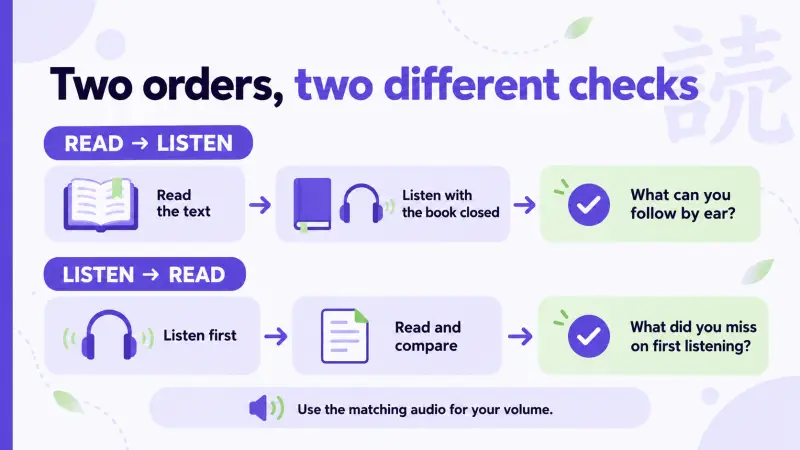
If you do have audio, pick one order and keep it for that book, because switching mid-book makes it hard to tell what changed:
- Read silently first, then listen once with the book closed and notice how much of the content you can still follow by ear.
- Or listen first, note the two or three things you caught, then read and see what went past you.
Both are fine, and they tell you different things. The first shows how much of your reading survives without the text in front of you. The second shows what your ears pick up cold. Neither one is the version that "counts". If you want listening material that goes beyond one book series, the wider question of pairing audio with a matching script sits in this guide to beginner Japanese audio resources that come with text.
Choose Reading Support Without Turning Every Page Into Translation
Support is not the problem; the number of interruptions is. Three kinds usually sit around a graded reader: furigana printed on the page, a dictionary you open, and a translation you check after the fact. They do not cost the same. Furigana is already there when your eye arrives, so reading it does not take you off the page. A lookup does, and so does a translation check in the middle of a scene.
Because printed furigana costs you no interruption and a dictionary lookup does, the number of times you stop matters more for reading practice than the number of words you did not know.
A starting budget you can adjust: one lookup per page, saved for a word that actually blocks the content, with everything else marked and left until you finish the chapter. If you find you need four, that is information about the level rather than a failure of discipline.
Inference often gets there before the dictionary does. Here are two lines written for this article:
おとこのひとは こうえんで さいふを ひろいました。 そして、こうばんに もっていきました。
Even if ひろう is new, the second sentence hands you most of it. A man and a wallet in a park, and then the wallet goes to the police box. "Picked it up" gets you close enough to keep reading, and the precise sense is there to confirm later. Note again that the second sentence names neither the man nor the wallet; Japanese lets both drop once they are established, and you carry them across.
When you do look something up, the sense that fits the sentence matters more than the first English word on the screen, which is its own skill; choosing a Japanese dictionary you can use on real messages covers how to check that. Words you actually want to keep belong in a review system rather than in the book's margin, and that is a separate job with separate tools, compared in this overview of Japanese learning tools across apps, textbooks and SRS.
Use HelloTalk to Retell an Idea and Hear a Reader’s Response
Finishing a book proves you turned the pages. What happens next depends on which question you want answered, and there are two of them.
The first is comprehension, and you can check it without any Japanese output at all. Close the book and put three events in order. Or say in your own language what the section was about. Or answer one content question: who found the bag, what the writer says changes between the two cities. If that works, you read it.
The second is expression, and that is what the Japanese retelling tests. Write three short sentences in your own Japanese with the book closed, and do not paste the author's text, which is not yours to reuse and tells a reading partner nothing about you. Failing to retell a passage in Japanese and failing to understand it are two different problems, and finding out which one you have is the reason to run the comprehension check first. If you understood it and the Japanese still will not come, the fix is not a lower reading level. Write down five keywords and one sentence pattern you want to use, then try again.
Then send it somewhere a person can answer. On HelloTalk, a retelling posted in chat sits in the same thread as whatever comes back, so you can see your sentence and a native speaker's version of it next to each other instead of on two different screens.
Here is an exchange written for this article to show the shape, not a real conversation:
You: きのう、みじかい はなしを よみました。おとこのひとが でんしゃに かばんを わすれました。えきの ひとが かばんを みつけました。
Reader: へえ、それで、かばんは もどってきましたか。
You: はい。つぎの ひ、もどってきました。
That follow-up is doing useful work. It asks about the content, so answering it means you read to the end. A reader might also ask something like かばんを みつけたのは えきの ひとですか, which can simply be interest, or can be a sign your sentence left the roles ambiguous. You cannot tell which from the question alone, and that is fine. Reopen the page and check who did what against the original.
If the item you read was informational rather than a story, retell one fact or one opinion instead of a sequence of events:
You: きょう、たべものの はなしを よみました。おおさかの おこのみやきと ひろしまの おこのみやきは、つくりかたが ちがいます。
A few ways this fits into HelloTalk without becoming a project of its own. HelloTalk voice messages let you say the same three sentences out loud, which is a different exercise and a genuine choice; if speaking is not what you are training this month, a typed retelling is not half a task. Posting the retelling to HelloTalk Moments puts it in front of more than one person, which helps when you want several reactions to how natural a sentence sounds rather than one. HelloTalk Voicerooms are worth dropping into as a listener on a day when you have read enough and want Japanese at conversational speed. Replies from real people are a possible resource here, not a guarantee and not the only valid way to check your reading, which is why the comprehension step stays in your own hands.
Decide Whether to Stay at the Same Level or Try a Harder Book
Now the two checks give you something to decide with. It is easy to move up early because moving up feels like progress, and just as easy to stall by working through one hard book slowly. The table below turns what you noticed into a next step; use it right after a book, while the content is still fresh, and give any change two or three books before you judge it. One session is too small a sample for a real level decision.
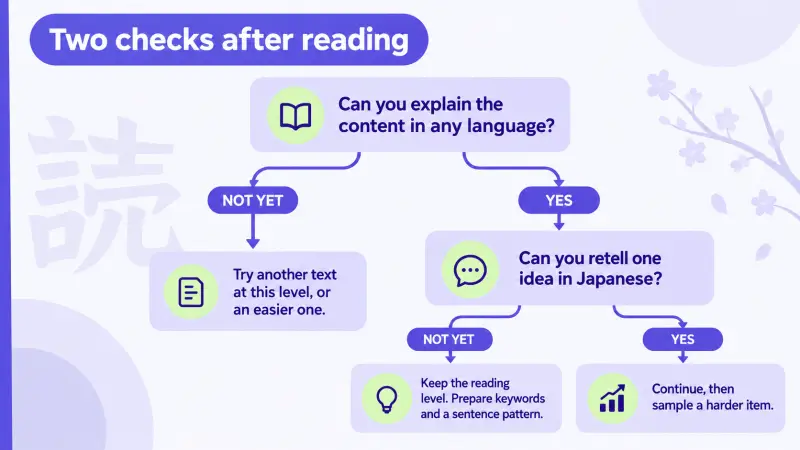
| What you noticed | What it points to | A next step to try |
|---|---|---|
| You could not put the events in order or summarize the section in any language | The text was probably too hard to follow unaided | Another item at this level, or one level down, then run the comprehension check again |
| The comprehension check went fine, but the Japanese retelling would not come | An expression gap rather than a reading problem | Stay at this reading level, prepare five keywords and one sentence pattern, then retell |
| You stopped many times per page for lookups | Either the level or the lookup habit | Same level, mark unknown words instead of opening the dictionary, and see whether comprehension holds |
| You followed the content, guessed a few words, retold a few sentences | The level is doing what it should | One more item here, then sample a single item one level up |
| It felt easy and the retelling ran long with extra detail | Room to try harder material | Take the higher level item, and drop back without ceremony if you stall |
| Clear on the page, hard to follow in the audio | Reading and listening are simply at different points | If listening is one of your goals, use easier audio for it; if it is not, there is nothing here to fix |
That last row causes the most arguing, and keeping reading goals separate from listening goals makes it easier to pick material for each. Reading gives you time that speech does not, so a text you read comfortably can be hard to follow when spoken. Treating them as two separate levels keeps you from deciding you "cannot listen" when you were only listening to material pitched at your reading level.
A cycle you can adjust to your week: one book, one short retelling sent to a reading partner, one reply read carefully, then the level decision from the table. The sizes in this article, three sentences, two books, one lookup per page, are starting points to tune, not thresholds you have to hit.
Frequently Asked Questions About Beginner Japanese Graded Readers
What makes a graded reader different from a textbook reading passage?
A graded reader is written inside a controlled range of vocabulary and grammar so that you can read a longer stretch of continuous text without stopping. Textbook passages are readable too, but they are usually short and tied to the chapter around them.
The other difference worth knowing is range. Graded reading catalogs include informational pieces on food, science and culture as well as stories, so a "retell one idea" task can mean the sequence of events in a story or a single fact from a non-narrative piece.
Should I start with the free Tadoku catalog or with an ASK Japanese Graded Readers set?
Both are chosen by level, so this is about cost and convenience rather than quality. Start with the free catalog if you do not yet know which level you can follow, because sampling and abandoning there costs you nothing and the level filter plus item icons do a lot of the sorting.
Move to the published sets when you want graded volumes in hand and the audio listed for the series by title. Plenty of people use both in the same month.
How many unknown words per page is too many?
The practical test is whether you can still say what a paragraph was about right after reading it. If you can, the unknown words are not stopping you, and the Tadoku approach explicitly allows skipping the parts you do not get.
If you cannot, the level is high for unaided reading right now, whatever your dictionary skills are.
Do Japanese graded readers come with audio?
Not automatically, and it depends on the item. The Tadoku site's audio section lists downloads for the Japanese Graded Readers by title, and some of those downloads ask for a code or password printed in the book, so keep the volume nearby when you go looking.
In the free catalog, items that include audio carry an audio icon, so check the specific item rather than assuming.
Can I use graded readers before I can read much kanji?
Often yes. Tadoku's introduction to its graded readers says the ones it lists print furigana over kanji, and the free catalog marks items that are hiragana only as well as items with furigana.
Still open the sample page of the specific item, since the amount of kanji varies by title and level. Being comfortable with hiragana and katakana first saves a lot of stalling either way.
How long should a retelling be, and what if my Japanese is not ready for it?
Three short sentences is a reasonable starting size, and one sentence is a perfectly good version on a tired day: who or what, what happened or what the writer said, and how it ended.
If you understood the reading but the sentences will not come out, that is an expression gap, and it points at the grammar you need for talking about events. Preparing a few keywords first is usually enough to get the first attempt out.
Should I read aloud or silently?
It depends on what you want from that pass. Silent reading keeps your attention on meaning and lets you cover more text, which is what a graded reader is built for.
Reading aloud is a production exercise, so it works better on a second pass, or on a few lines alongside the audio if your volume has it. Neither one is the correct method; they are answering different questions.