
Learning Spanish With Limited Time: Which Method Fits a 20-Minute Day?

Twenty Minutes on the Clock
The most efficient way to learn Spanish on a short day is to spend all twenty minutes producing, not reviewing. Producing means writing sentences, recording your voice, or talking to someone. Reviewing means rereading notes and redoing flashcards you know.
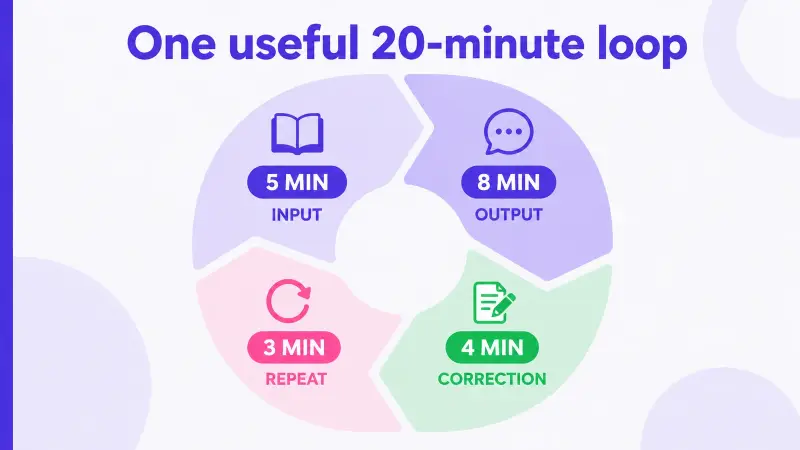
Twenty minutes fits exactly one loop: say something, get it corrected, say it again. That loop is the whole day. The full method comparison for longer sessions lives in the most efficient way to learn Spanish in 2026. This article answers a narrower question: what survives on a twenty-minute budget.
HelloTalk suits that loop because the fix and the next attempt sit in one thread. HelloTalk's chat-based learning puts in-chat translation, transcription, read-aloud audio, and live grammar correction inside the message you sent, so no minutes go to switching apps.
Here is the day as a table. Read the last column first if you are tempted to skip a row.
| Action | Minutes | Output | Cost of skipping |
|---|---|---|---|
| Write 5 sentences about your day | 6 | A text a native speaker can correct | You reuse only vocabulary you own |
| Post it and ask for corrections | 2 | Fixes from real speakers, often within the hour | You repeat the same three mistakes |
| Record a 60-second voice note of them | 6 | Audio of you saying words you just wrote | Your writing improves, your mouth does not |
| Read corrections and resay the fixed version | 4 | One corrected sentence set in memory | The loop never closes |
| Ask one follow-up in the HelloTalk chat where the fix arrived | 2 | A second attempt your corrector reacts to | The fix stays a note, never a habit |
Order matters more than timing. Write first, because writing is where you notice what you cannot say yet. Speak last, so you say the corrected version, not the broken one.
HelloTalk covers the last four rows: correctors, fast repair, voice. HelloTalk is not a course and gives no grammar syllabus, so ordered lessons still need a textbook.
Why a Short Day Is Not a Small Long Day
A ninety-minute session has room for waste. Twenty minutes has no slack, so habits that felt harmless on a long day become the entire day on a short one.
The first difference is setup cost. Opening an app, picking a lesson, and deciding what to study can eat eight of your twenty minutes. A short practice day only works if you decide what to practice before the timer starts, because decision time and practice time come out of the same twenty minutes.
The second is feedback latency. A correction arriving tomorrow lands on a sentence you no longer remember writing. Corrections are most useful while you still remember why you chose the wrong word, which is usually within the same hour rather than the next day. How feedback speed changes results is worked through in this look at faster corrections.
HelloTalk's Moments feed lets you post a few sentences publicly and collect corrections from several native speakers on the same text, so one short post can return three or four fixes. HelloTalk reports 70M+ registered users across 200+ countries, which is why a Spanish post at an odd hour still finds someone awake.
What You Have to Drop
On this budget the first casualties are the things that feel most like studying.
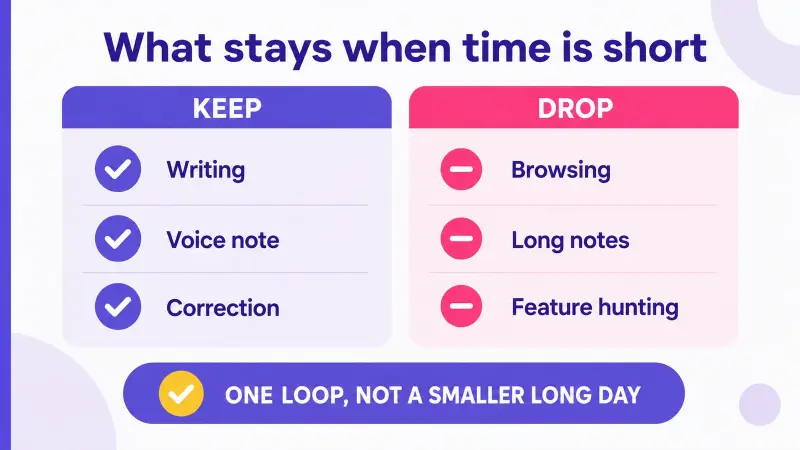
Drop grammar videos. Useful, but one costs your whole session and produces nothing correctable. Drop new-vocabulary lists too. Learning new words faster than you can use them creates a growing list of vocabulary you recognize on sight but cannot produce in speech. Twenty minutes is better spent using forty words well than meeting fifteen new ones.
Demote the review streak. Flashcard apps are good at telling you that you did something, which is not the same as telling you that you can say something. Cap them at three minutes.
What stays: writing, one recording, and reading corrections. Anything ending with another person responding to your Spanish stays. If your real ceiling is closer to a quarter hour, the tighter version is in the fifteen-minute Spanish routine.
A Template for Blank Days
Some days you open the app with nothing to say. Paste this, fill the blanks, send it.
Hola, estoy practicando español.
Hoy ______ (algo que hiciste esta mañana).
Fue ______ porque ______.
Mañana quiero ______.
No estoy seguro/a de cómo se dice "______" en español.
¿Me corriges, por favor?
One past tense, one reason clause, one future intention, one direct question. That last line does most of the work, because a specific question gets a specific answer while "correct me" often gets a thumbs up.
Say the lines out loud before sending. HelloTalk's AI pronunciation scoring flags which syllables came out wrong. A sentence you have written, had corrected, and then said out loud is far more likely to come back to you in conversation than one you only read.
Keep the template for a week. The frame staying still is what lets you notice your endings improving.
Frequently Asked Questions
Is twenty minutes a day actually enough to learn Spanish? It is enough to keep improving steadily, though not to reach fluency quickly. Twenty focused minutes of producing and correcting Spanish daily moves you further over six months than three unfocused weekend hours.
Should I split twenty minutes into shorter sessions? Splitting works for review but not for a production loop. Writing, posting, recording, and reading corrections need to happen close together so the feedback still connects to what you wrote.
What if nobody corrects my post? Post shorter and ask a narrower question. A five-line text with one explicit question about a single word gets answered far more often than a long paragraph.
Is speaking practice possible in twenty minutes? Yes, in recorded form. A 60-second voice note gives real articulation practice without scheduling a call. HelloTalk's Voicerooms also run around the clock, and you can join one as a listener.
Do I need to pay for anything to run this routine? No. HelloTalk keeps 90% of core features free, covering posts, corrections, voice notes, and chat. HelloTalk's VIP tiers are sold as regional monthly, yearly, or lifetime options (see in-app quote).
How long before twenty minutes a day shows results? Most learners notice easier sentence construction after 4-6 weeks of daily loops, and clearer pronunciation later. The change usually shows up as writing your five sentences faster.
Can I use AI corrections instead of waiting for people? For a short day, yes. HelloTalk's AI grammar correction returns an explanation immediately, which keeps the loop closed when no human replies in time. Human corrections remain better for tone.
When Twenty Minutes Runs Out
Some days even twenty minutes will not happen. Send one sentence instead, to one person, in Spanish, about something real. The habit stays alive, which matters more than the sentence does.
The pattern that holds up over a year is small and repeatable rather than ambitious and occasional. Write something true, let someone fix it, say the fixed version, come back tomorrow. Start your first loop at HelloTalk.