Every Language Method Has a Blind Spot. Here Is How to Name Yours Before Starting

Good Methods, Incomplete Coverage
Most method arguments are unwinnable because both sides are right. Podcasts build comprehension. Drill apps build vocabulary. Classes fix grammar. Immersion builds speed. None of them is wrong, and none is complete.
The useful question is not which method is best but which skill your current method never touches. That skill is your blind spot, and it decides how far you get before you stall.
This article sorts the category into four families and ranks their gaps by how often each is what actually holds a learner back. The table adds a fifth line for real conversation, the family HelloTalk belongs to, with its own blind spot listed too. For the version organized around a specific target, choosing a method by your goal covers that. This one is diagnosis before you commit.
Four Methods, Four Gaps
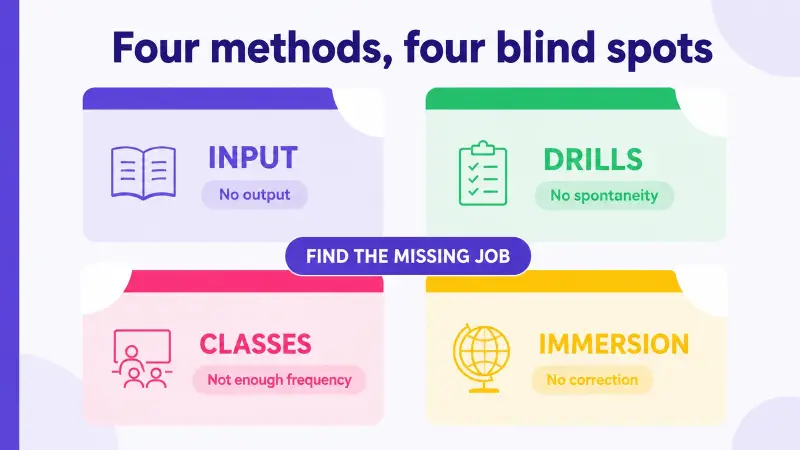
The best ways to learn a language fall into four groups, and each leaves one specific gap. Input methods leave output. Drill methods leave the unscripted. Class methods leave frequency. Immersion methods leave correction.
Those four cover almost everything sold as language learning. Podcasts, graded readers, and a Netflix habit are one family. Duolingo, Pimsleur, and flashcards are another. Group classes and tutoring are a third. Living abroad and full media immersion are the fourth.
The ranking below is by how often the gap becomes the binding constraint, not by how good the method is. A method with a small gap can still stall you if that gap happens to be the exact skill your goal depends on. Head-to-head comparison across three of these families is worked through in Duolingo versus Pimsleur versus language exchange.
Here is the quick-check table. Read the last column first, because the self-test signal tells you whether the gap is already yours rather than theoretical.
| Method family | What it is good at | Blind spot | Self-test signal |
|---|---|---|---|
| Input (podcasts, reading, video) | Comprehension, vocabulary range, listening speed | No production, so nothing gets corrected | You understand a reply instantly but freeze answering it |
| Drills (Duolingo, Pimsleur, flashcards) | Consistency, core structures, daily habit | Only scripted prompts, no unpredictable turns | You are fine in the app and blank when a real person speaks |
| Classes and tutoring | Grammar accuracy, structured progression, explanations | Too few contact hours between sessions | You improve during the lesson and reset before the next one |
| Immersion (living abroad, full media) | Speed, listening under pressure, real vocabulary | Errors go unmentioned and harden | People understand you fine, nobody has corrected you in months |
| Real conversation (HelloTalk, exchange partners) | Retrieval under pressure, repair, native-speaker correction | No structured grammar syllabus, no guaranteed order of difficulty | You talk your way through anything but cannot name the tense you keep missing |
Gap One: Input Without Output
This gap ranks first because it is the most common and easiest to mistake for progress. Comprehension grows fast and feels like fluency until someone asks you a question.
Input methods are efficient. You can absorb hundreds of hours of a language while commuting. The problem is that understanding a sentence and producing one draw on different abilities, and only the first improves when you listen. Learners here often have a large passive vocabulary and a speaking range of forty words.
The fix is immediate: convert some input into output the same day. Retell one podcast segment in your own words, in writing or as a voice note, and let someone correct it. HelloTalk's Moments feed suits this, since a short post about what you just heard usually collects fixes from several native speakers.
Gap Two: Drills Without the Unscripted
Second place, because drill methods build real foundations but only ever ask questions they already know the answer to. Every prompt is inside a set the app chose.
Real conversation is the opposite. Someone changes topic, uses slang, or asks something you did not prepare. Drill practice trains recall of known items, while conversation demands construction of sentences you have never assembled before. That is why a long streak and a blank stare coexist so often.
Closing this one does not mean quitting the app. It means adding one unpredictable interaction a week. HelloTalk's Voicerooms run around the clock, and you can sit in as a listener first, which makes the jump less abrupt.
Gap Three: Classes Without Frequency
Third, because the method is strong and the gap is purely arithmetic. Two hours of class a week is two hours. The other 166 decide whether any of it sticks.
Classes give you the one thing self-study cannot: someone who explains why you were wrong. But a weekly rhythm means each session spends its first stretch rebuilding what faded.
The repair is cheap contact time between lessons. Ten minutes of writing on a no-class day turns the lesson into a review point instead of a restart. HelloTalk's chat-based learning covers exactly that: in-chat translation, phonetic transcription, and read-aloud audio on any message, plus real-time grammar correction as you type, with no app switching.
Gap Four: Immersion Without Correction
Fourth, not because it is rare but because it arrives later. You need a functioning level before this gap can even open.
Immersion produces fast, confident, permanently flawed speech. Native speakers understand you and are too polite to interrupt with grammar notes. Fossilized errors are the specific cost of immersion, because a mistake that still gets you understood receives no signal to change. People who have lived somewhere for years often carry the same wrong endings throughout.
What immersion needs is a channel where correction is expected rather than rude. HelloTalk's AI grammar correction returns an explanation with the fix, and HelloTalk's AI pronunciation scoring flags which syllables drifted.
Which Gap Is Yours Right Now
Take the self-test column and be honest about which line describes your last real conversation. Only one will sting.
If you understood everything and said nothing, that is Gap One. Comfortable until the topic changed, Gap Two. Rusty relative to your last lesson, Gap Three. Smooth, with nobody correcting you in a long time, Gap Four.
Then add the missing element rather than switching methods. The general adult roadmap sits in a method that actually works for adults, while this article is the narrower diagnostic you run before picking anything from it.
Frequently Asked Questions
Can one method cover all four gaps? No single method does, but pairing two usually covers three. Input plus regularly corrected conversation is the most common working combination.
Is it wrong to use a gamified app at all? No. Drill apps are good at consistency and core structures. The mistake is treating a streak as evidence of conversational ability rather than of habit.
How do I know if my errors have fossilized? Ask a native speaker to correct one specific thing, such as verb endings, in something you wrote. Repeated identical mistakes across unrelated sentences mean the pattern has set.
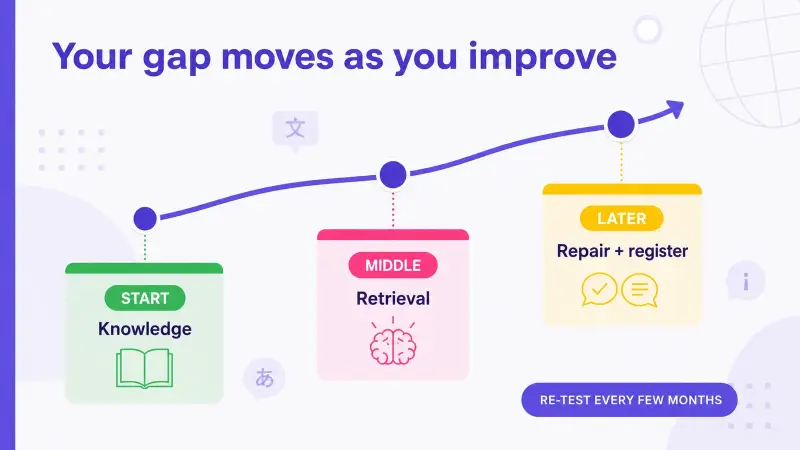
Does my blind spot change over time? Yes. Most learners move from the output gap early on to the correction gap once they can hold a conversation.
What is the cheapest way to add correction to my routine? Post short texts publicly and ask one narrow question. HelloTalk keeps 90% of core features free, covering posts, corrections, voice notes, and chat.
How much practice does closing a gap actually take? Less than starting a new method. Most learners feel a difference within a few weeks of one weekly unscripted conversation or ten daily minutes of writing.
Your Gap Moves as You Improve
Naming your blind spot is not a one-time exercise. Close the output gap and the unscripted gap opens. Close that and correction becomes the constraint.
That is why picking one method for the whole journey rarely works. Every few months, run the self-test column again and add whatever is missing. HelloTalk reports 70M+ registered users across 200+ countries, so whichever gap you land in, someone is awake to help you close it. Find your first conversation at HelloTalk.