
Best English Apps for Beginners Who Understand More Than They Can Say

Someone asks, "So what did you do this weekend?" You understood the question the moment you heard it. You know visited, sister, cooked, tired. Four seconds pass, and what comes out is "Weekend good. Yes." Then the conversation moves on without you.
That is not a vocabulary problem, and it is usually not a motivation problem either. It is an input-output gap, and the apps that fix it are not always the apps that got you this far. The useful answer is to sort tools into three jobs: apps that keep feeding you structured material, apps that let you rehearse sound and sentences with unlimited retries, and apps that put a real person on the other end who was not given your script.
Quick Picks for Beginners With an Input-Output Gap
Most "best English app" lists rank tools against each other as if they were competing for the same slot. For this specific gap, that framing does not help, because the tools do different jobs and you will probably end up using two of them. Read the table below by the middle column first: find the part of the gap you actually feel, then check the right column so you know in advance where that tool stops being useful.
| Resource | The part of the gap it handles | Where it stops |
|---|---|---|
| Duolingo | Keeps a steady daily supply of beginner material moving without planning effort | Exercises are mostly recognition-shaped, and your answer is checked against a fixed key rather than a meaning |
| Busuu | Structured lessons with writing and speaking tasks that other members can comment on | Community feedback varies in depth and arrives on other people's schedules |
| ELSA Speak | Pronunciation detail at the sound, word, and stress level | Judges how a sentence sounds, not whether it answers the question you were asked |
| Speak | Repeatable spoken turns with an AI partner and no social pressure | The exchange stays inside what the system is prepared for |
| Anki or another flashcard app | Pulling specific words and phrases from recognition into active recall | Tests items, not whole responses under time pressure |
| Cambly or italki | Scheduled sessions with a tutor who can explain and correct in depth | Paid lessons booked in advance, so it is not something you open in a spare five minutes |
| Speaky | Text-based contact with other learners and speakers | Mainly a messaging connection, with fewer study tools built around the conversation |
| HelloTalk | An unscripted reply from a real person, and correction on the message you actually sent | Real people answer when they can, so no reply timing is promised |
An input-output gap is a practice-type problem, not a vocabulary problem, which is why adding more lessons to a recognition-heavy routine rarely makes speaking easier. Access also differs in kind, not only in amount: course and pronunciation apps usually offer a free tier with a paid plan for more, tutoring platforms are paid by the session, and language exchange runs on other learners' willingness to reply.
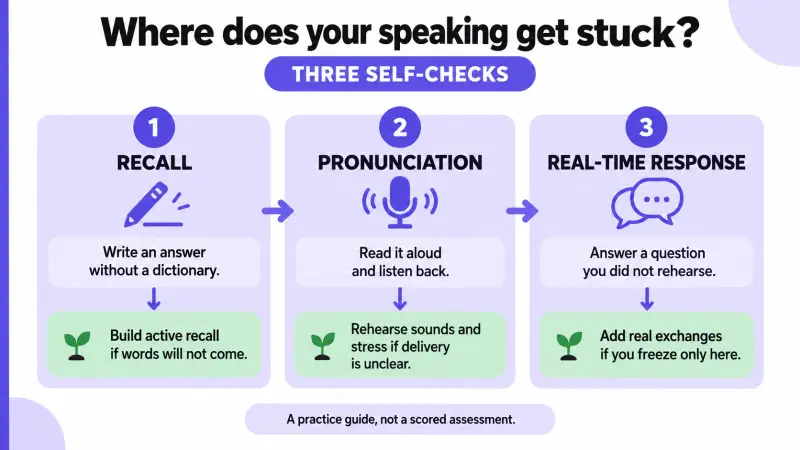
Check Whether the Problem Is Recall, Pronunciation, or Real-Time Response
Before choosing, find out which of the three is actually failing. Here is a suggested practice you can run in about fifteen minutes with a notebook and your phone's voice recorder. Nothing here is a test with a score, and it is not research; it is a way to stop guessing.
-
The recall check. Take one everyday question such as "What does your job involve?" and write a four-sentence answer with no time limit and no dictionary. If the sentences come out fine on paper, your vocabulary is present. If you keep reaching for words you would recognize instantly in a text, those words live in recognition memory only.
-
The pronunciation check. Read your written answer aloud once and record it. Listen the next day. If you cannot catch your own words, or a word sounds flat where the stress should fall, the sentence exists but the delivery does not carry it.
-
The real-time check. Have someone send you three questions you have not seen, or pick them at random from a list you wrote a week ago, and answer each aloud within five seconds. If your written answers were good and your recorded reading was clear but this collapses, the missing skill is response speed under pressure.
Most beginners with this profile fail the third check and pass the first. That result points away from more lessons and toward rehearsal plus real exchanges. If the first check is where you stall, spend a few weeks on structured material and active recall before you change anything else.
Use a Structured App to Stabilize the Language You Already Recognize
A course app is still worth keeping, because output needs raw material and you do not want to invent a syllabus at 7 a.m. The change is how you use it. A lesson that you complete by tapping the right option trains you to recognize a correct English sentence, which is the skill you already have too much of.
Three adjustments turn the same lesson into production work. Cover the answer options and say your answer aloud before you look. After each exercise, rewrite the model sentence with details from your own life, so "She works at a hospital" becomes "My cousin works at a small clinic near our house." At the end of the lesson, write three sentences using the day's pattern that you could genuinely send to another person this week.
If you are still deciding which course app to build this habit on, the wider comparison of beginner English apps by course structure sorts the main options by how they sequence material. Pick one and stay with it long enough that the vocabulary starts repeating; the repetition is what moves words from recognized to available.
Use Pronunciation or AI Speaking Tools for Controlled Rehearsal
Rehearsal is the step most people skip, and it is the cheapest one. In a controlled tool you can say the same sentence eleven times, hear where the stress landed wrong, and retry without anyone waiting. ELSA Speak works at the level of individual sounds and word stress, which is where a clear sentence often falls apart for beginners. Speak gives you full spoken turns with an AI partner, so you practice starting a sentence rather than only polishing one.
A suggested rehearsal set: choose five sentences you would actually need this month, such as an introduction, a question you want to ask a coworker, an apology for being late, a short opinion, and a request for repetition. Say each one five times, record the fifth, and keep the recording. That is roughly ten minutes.
The honest boundary is that rehearsal is predictable. The tool expects a certain answer, waits for you, and does not follow up with a question you never considered. That is exactly why it feels comfortable, and exactly why it does not finish the job. A closer look at how English speaking practice apps differ is useful if you want to compare what each one actually asks you to produce.
Use HelloTalk When You Need an Unscripted Human Reply
The five-second failure in your real-time check happens because a person replies with something you did not plan for. The only way to train that is to be replied to. HelloTalk supports text, voice, and video communication with speakers of the language you are learning, which means the sentence you rehearsed this morning can be sent to someone who has no idea what it was supposed to be.
The value is in the whole sequence, not in one feature. You arrive with source material from your lesson, you express it in a real message, you get a response written for you rather than for a textbook, and then you have something specific to review. HelloTalk's correction workflow applies to chat messages and to Moments posts, so an attempt you already made becomes the material for your next study session instead of disappearing into the chat history. Built-in translation and read-aloud help when a reply contains a phrase you have never met, so decoding the answer does not require leaving the conversation.
If sending a first message still feels heavy, listening comes first. HelloTalk's Voicerooms let you join as a listener, and the subtitles show spoken content as text while Tap-to-Translate can translate a word or sentence you select, so you can follow a live conversation before you take a turn in one. Livestreams work the same way for people who want structure and a host before they speak.
Real people reply on their own schedule, so send your attempt and go back to your lesson rather than sitting in the app waiting. That is not a flaw to design around; it is why a language exchange belongs next to a course app and a rehearsal tool rather than replacing them.
Build a Short Loop From Lesson to Reply to Review
Everything above only works if the pieces connect within the same day. A lesson you never use, a rehearsal you never send, and a correction you never reuse are three separate activities, not a learning process. The loop below is a suggested structure, not a promise about how fast anyone improves, and it is built to fit a single sitting of roughly half an hour.
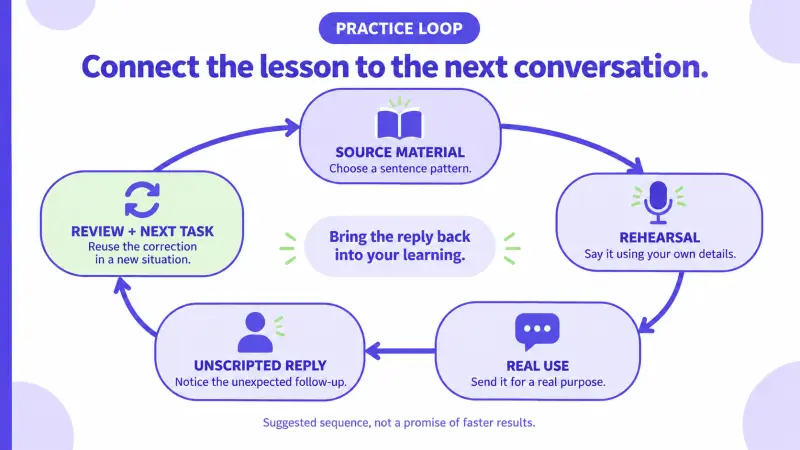
| Step | What you do | Suggested time | What you end up with |
|---|---|---|---|
| 1. Source material | Take three sentence patterns from today's lesson | 10 minutes | Three patterns written in your own words |
| 2. Rehearsal | Say each pattern aloud five times, adapt one with your own details, record it | 5 minutes | One clean recording you are not embarrassed by |
| 3. Real use | Send a message or post that uses one pattern for a genuine purpose | 3 minutes | An attempt that exists outside your notebook |
| 4. Unscripted response | Read or listen to the reply and answer the follow-up you did not plan | 5 minutes | Evidence of where your real-time response breaks |
| 5. Review and next task | Save the correction, write one line on why it was wrong, and plan tomorrow's sentence using that structure in a different situation | 5 minutes | Tomorrow's first task, already decided |
Step five is the one that decides whether any of this compounds. A corrected sentence you read and nod at is still passive input. The same sentence reused in a new situation the next day is production. If half an hour is more than your week allows, the same five steps compress well into shorter sessions, and the rundown of English apps built for quick daily practice covers how to keep a short routine from becoming recognition-only again.
Speaking improves when every study item passes through one real exchange, because that is the only step where you cannot predict what comes next. When your rehearsed sentences are ready for that step, HelloTalk is where you can put them in front of someone who will answer in their own words, correct the message you actually sent, and give you something new to bring back to your next lesson.
Frequently Asked Questions About English Apps for Speaking Beginners
Why can I understand English but not speak it?
Understanding and producing draw on different abilities. Reading and listening let you work from context, so a partly known word is often enough, while speaking requires the exact word, the right form, and the right order within a couple of seconds. Most beginner study routines give far more recognition practice than production practice, so the gap widens even while your comprehension improves.
If I can only use one app, which type should it be?
Choose based on your diagnostic result. If you cannot produce sentences on paper, keep a structured course app. If your written sentences are fine but your speech is unclear, a pronunciation tool gives faster returns. If both are fine and you freeze only in live exchanges, a language exchange app where real people reply is the single most direct fix.
Are AI speaking tools enough, or do I still need a person?
AI tools are good for rehearsal because they are patient, repeatable, and available at any hour. They are limited in that the exchange tends to stay within what the system anticipates. A real person introduces unplanned questions, slang, and follow-ups, which is the exact pressure that causes beginners to freeze, so most people benefit from both rather than choosing one.
How much should I rehearse before messaging a real person?
Enough to have one sentence you can say without stopping, which for most beginners is a few minutes of repetition. Waiting until you feel ready usually means waiting for a level of comfort that only arrives after real exchanges. Sending a short, imperfect message and dealing with the reply teaches more than a fourth rehearsal round of the same line.
Should I start with text or with voice messages?
Text first is reasonable if the five-second delay is your main problem, because writing lets you build the sentence without time pressure while still producing language for a real reader. Voice messages are the natural next step, since they add pronunciation and rhythm while still letting you re-record before you send. HelloTalk supports both, so you can move between them depending on the day.
What should I do when someone replies with something I do not understand?
Ask directly, using a sentence you keep ready for exactly this, such as "Sorry, I did not catch that. Can you say it in a simpler way?" Asking for clarification is normal in every language and is itself speaking practice. Built-in translation and read-aloud in HelloTalk also help you decode an unfamiliar phrase without abandoning the conversation.
Do I need a paid tutor at this stage?
Not necessarily. Tutors on platforms such as italki or Cambly are valuable when you want structured explanation, exam preparation, or focused work on a recurring error. For an input-output gap, the more common shortage is volume of unscripted exchanges, which you can build through free rehearsal and language exchange before adding scheduled paid lessons.