
Best Language Learning Apps for Self-Study, Guided Lessons, and Real Conversation

You have a long streak on one app, a half-finished course on another, and a folder of saved vocabulary you keep meaning to review. Then someone messages you in the language you are studying, asks a follow-up question you never rehearsed, and everything you installed goes quiet in your head. That is usually not a sign you picked the wrong app. It is a sign that three of your apps organize the same part of learning and none of them organizes the part where a real person answers you.
The practical way to choose is to sort apps by what they decide for you. This article uses four modes, in the order most learners add them: self-study tools, guided lesson paths, pronunciation and AI speaking rehearsal, and real conversation with people. The order is a typical sequence of needs, not a ranking, and most learners eventually run two or three of these modes at once.
Language apps differ less by which language they teach than by how much of your learning sequence they decide for you.
Quick Picks by Learning Mode
Before comparing names, it helps to know which decision you currently need someone else to make. If you cannot tell what to study next, you need a sequence. If you know exactly what is weak but keep avoiding it, you need review pressure. If you can build sentences on paper and freeze in the moment, you need a person. The table below maps each of the four modes to what it decides for you, the apps most often used in that mode, and the part it deliberately leaves in your hands. If you would rather compare by skill goal instead of by learning mode, the wider breakdown in how the main language learning apps compare in 2026 sorts the same tools by reading, listening, and speaking outcomes.
| Learning mode | What it decides for you | Commonly used apps | Best when | What it leaves to you |
|---|---|---|---|---|
| Self-study | Almost nothing; you pick the material and the order | Anki, Memrise, LingQ, Clozemaster | You already know which words and patterns are weak | Noticing the gaps you have not spotted yet |
| Guided lessons | The order, the difficulty, and what comes next | Duolingo, Busuu, Babbel, Pimsleur | You are starting a language or restarting after a break | Moving a practiced sentence into an unscripted moment |
| Pronunciation and AI speaking | The prompt, the target form, and the retry count | ELSA Speak, Speak | You want unlimited attempts with no social pressure | Judging whether the sentence suits the person and setting |
| Real conversation | Nothing about content; a person supplies the reply | HelloTalk, Speaky, plus booked tutoring on italki or Cambly | Language you have studied has never been answered by anyone | Bringing a topic and the material you want to test |
Read the last column first. It is the honest boundary of each mode, and it explains why learners who stay inside one column for a year tend to plateau in a predictable way.
Self-Study Apps: Best When You Can Choose Your Own Sequence
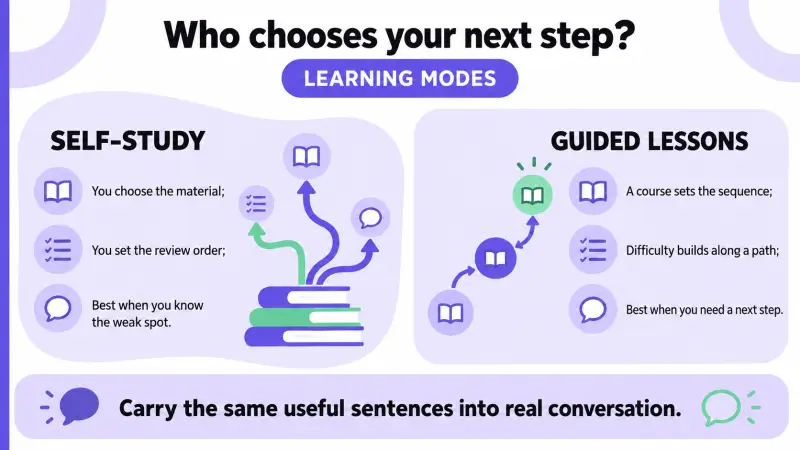
Self-study mode covers flashcard systems with spaced review, reading apps with tap lookups, and any personal word list you maintain yourself. The appeal is efficiency: nothing in the queue is there unless you put it there, so you never spend twenty minutes on a lesson about restaurant vocabulary you already know.
That efficiency depends entirely on the accuracy of your own diagnosis. Most learners build decks from words they met while reading, which trains recognition, then wonder why speaking feels untouched. You can recognize a word in a list and still not retrieve it inside a sentence with the right particle, ending, or word order.
Self-study tools review the material you already selected, so they cannot reveal the gaps you have not noticed yet.
Two habits keep this mode productive. First, make cards from sentences rather than isolated words, using sentences you would plausibly say about your own life. Second, put a monthly limit on how much new material you add, so review does not quietly become the entire study session. As a suggested practice, take five cards you already know well and rewrite each one as a question you could actually ask a person this week. If you want a broader framework for planning your own study sequence, the habits covered in these language learning strategies pair well with a self-managed review system.
Guided-Lesson Apps: Best When You Need a Clear Path
Guided-lesson apps take the sequencing decision away from you. Duolingo, Busuu, and Babbel run graded exercise paths on screen. Pimsleur runs an audio-first sequence that asks you to answer aloud before you see anything written. What they share is a defined next step, which matters more than most learners admit, because the cost of deciding what to study each day is what usually kills a routine in week three.
Access differs by product. Several of these apps run a free tier with an optional paid plan for extra practice or offline use, and those arrangements change over time, so check the current terms rather than assuming what was true last year.
The honest boundary is predictability. Exercises have one intended answer, the vocabulary is pre-selected, and the difficulty rises on a schedule that has nothing to do with your actual conversations. That produces learners who complete a unit on daily routines and still stall when a real person asks a slightly different question about their weekend.
A guided lesson path answers the question of what to study next, but it cannot tell you whether your sentence sounds natural to a specific person in a specific situation.
Suggested practice after each unit: close the app, then write three sentences about your own week using only that unit's grammar. If you cannot produce three, the unit is finished but the material is not.
Pronunciation and AI Speaking Apps: Best for Controlled Rehearsal
This mode exists for one job: repetition without social cost. ELSA Speak scores pronunciation at the sound level. Speak and similar AI conversation tools generate prompts you can answer aloud again and again. Nobody is waiting, nobody is confused, and you can say the same sentence eleven times until your mouth stops fighting it.
Rehearsal is genuinely useful at two moments: right before a first real conversation, and right after a correction you have not yet absorbed. It gives you attempts, which is exactly what silent study does not.
Pronunciation and AI speaking tools are rehearsal spaces, which means you can repeat a sentence as often as you like, but the reply never brings information you did not expect.
A scripted or generated partner will not misunderstand you in the specific way a stranger does, will not switch to a different politeness level because of who you are talking to, and will not tell you that your grammatically correct sentence sounds oddly formal for a message to a friend. Treat this mode as the warm-up lane. Suggested practice: record one sentence three times, keep the clearest take, then send that version to an actual person and see what comes back.
HelloTalk: Best When the Missing Piece Is a Real Response
The gap most learners hit after a year of apps is not vocabulary size. It is that nothing they studied has ever been answered by someone who was not following a script. That is the specific mode HelloTalk covers, and it works best when you bring material into it rather than arriving empty-handed.
A full loop inside the app looks like five steps. You start with source material, meaning a pattern, phrase, or unit you just studied somewhere else. You express it, as a text message, a voice message, a video call, or a short Moments post written in your target language. A real person responds with something you did not plan for, which is the part no rehearsal tool can supply. You then review what came back: HelloTalk supports corrections on chat messages and on Moments posts, along with message translation, transliteration, and read-aloud, so you can see what changed and hear how the corrected version should sound. Finally you turn that into the next learning task by reusing the corrected sentence in a different situation, which is where the learning actually sticks.
HelloTalk functions as the real-use layer of a learning system, where something you studied gets expressed, answered by a person, corrected in place, and returned to you as your next practice item.
The other formats fit different energy levels. Moments is a public post, so one sentence can draw responses from several people rather than depending on a single conversation thread. Voicerooms let you join and listen before you say anything, and Voiceroom subtitles display spoken content as text, with Tap-to-Translate available for a word or sentence you select. Livestream sessions add a hosted format where you can follow along and interact when you are ready. No app can promise when a particular person will reply, so a reasonable approach is to keep one or two partner conversations going and post to Moments as well, rather than waiting on one message. If the two-way part is new to you, what a language exchange actually involves explains how trading languages works in practice.
How to Move Between Modes Without Restarting Your Progress
The costly mistake is treating a mode change as an app change: you quit the guided course, download something new, and start again at unit one with vocabulary you learned eight months ago. Progress does not live in the app. It lives in the material you can already produce, and that material can move.
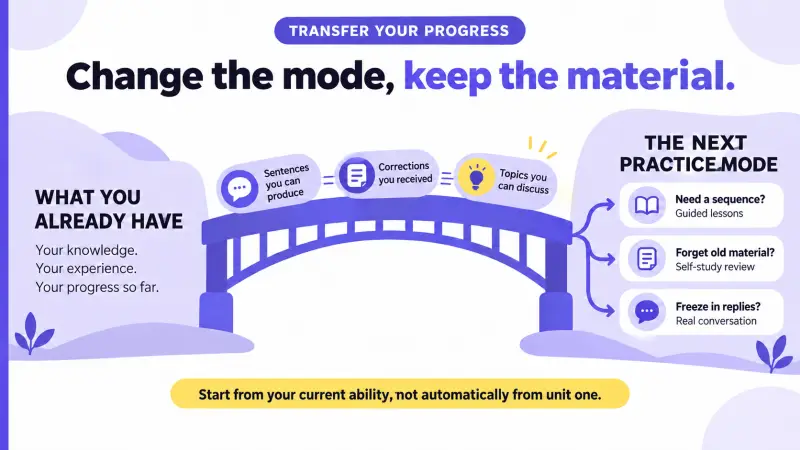
The table below turns the four modes into a diagnostic. Find the symptom you actually have this week in the first column, add the mode that addresses it, and carry the listed item with you instead of starting fresh. The last column is a suggested first action, not a guaranteed result.
| What you notice | Mode to add next | What to carry across | Suggested first action this week |
|---|---|---|---|
| You know the word but freeze when someone asks out loud | Real conversation | The ten sentences you can already build without help | Send one voice message using two of them |
| You finish lessons but forget last month's units | Self-study | The units you completed | Build review cards from your own sentences, not the app's |
| You have no idea what to study next | Guided lessons | Your current topic and level | Enter at the unit matching your weak grammar, not at unit one |
| Someone corrected you and you did not understand why | Self-study plus real conversation | The original sentence, the correction, and the situation | Rewrite the corrected sentence for a different situation and ask whether it still fits |
| Your grammar is fine but people ask you to repeat | Pronunciation rehearsal | One sentence you say often | Record it three times, keep the clearest, then use it with a person |
Run this check monthly rather than daily. Modes are worth switching when a symptom repeats, not when a session feels boring. And when the missing piece is clearly a real response, HelloTalk is where you can take a sentence you studied this morning and find out how a person actually answers it.
Frequently Asked Questions About Choosing a Language Learning App
Which language learning app is best for a complete beginner?
For a true beginner, a guided-lesson app is usually the most practical starting point, because the biggest early obstacle is not knowing what to study next. Duolingo, Busuu, Babbel, and Pimsleur all supply a defined sequence. Add a conversation app once you can build short sentences on your own, rather than waiting until the course feels finished.
Can one app cover self-study, lessons, and real conversation?
Some apps span two modes reasonably well, but very few cover all three at the depth a learner needs. A guided course gives you a sequence and predictable exercises; a real conversation gives you unscripted replies and situational judgment. Those are different jobs, and expecting one product to do both perfectly is the reason many learners feel stuck without knowing why.
How many apps should I use at the same time?
Two is manageable for most schedules, and three is the practical ceiling. A workable pairing is one app that decides your sequence plus one place where a real person responds. Adding a fourth usually splits your attention rather than adding coverage.
Do I need a paid plan to practice conversation?
Not necessarily. Several conversation and exchange apps, including HelloTalk, offer free access to core communication features alongside optional paid plans, while tutoring marketplaces such as italki and Cambly are built around booked paid sessions. Access terms change over time, so check what is currently offered instead of relying on older summaries.
When should I start talking to real people?
Earlier than most learners expect, and specifically once you can build a handful of short sentences and ask one or two questions. Text and voice messages let you take your time composing, which makes the first exchanges far less stressful than a live call. Waiting for a feeling of readiness tends to postpone the step indefinitely.
What is the difference between an AI speaking partner and a language exchange partner?
An AI speaking tool gives you unlimited controlled attempts on a prompt you can repeat until the form is stable. A language exchange partner gives you something different: an unplanned reply, a reaction to how your sentence lands, and information about whether the wording suits the relationship and situation. Rehearsal prepares the sentence; a person tests it.
How do I avoid losing progress when I switch apps?
Carry material, not streaks. Before you change anything, write down the sentences you can produce unaided, the corrections you have received recently, and the topics you can already discuss. Enter the new app at the level that matches that list, and use your own sentences as the first review items rather than starting from the default beginner deck.