
How Soon Should Korean Beginners Practice Honorifics With Real People?
You can read Hangul, you can assemble 저는 학생이에요 (jeoneun haksaengieyo), and then a Korean speaker your own age answers with 응, 반가워 (eung, bangawo). Now you are stuck mid-message: keep the -요 ending, drop it, or ask what they prefer? The speech level chapter in most textbooks sits several units ahead, and no app lesson tells you which ending fits a person you met an hour ago.
The short answer is that this moment is the practice, not a problem to postpone. Korean beginners can start practicing honorifics with real people as soon as they can build a short sentence with a verb, because every Korean sentence ending already selects a speech level whether or not the learner chose one on purpose. What changes with experience is not whether you use a level, but how well you can match it to a person and a situation.
Start Honorific Practice as Soon as You Can Build Short Sentences
Waiting feels safer than it is. If you delay real interaction until you "understand honorifics," you spend months producing whatever ending your course happened to teach first, usually either -요 or -습니다, with no idea where that ending actually belongs. The ending becomes a habit before it becomes a choice, and habits are harder to relabel than blanks are to fill.
There is a usable readiness test. Before your first real honorific practice, you want to be able to do these four things, which most beginners reach within a few weeks of consistent study:
- Read Hangul well enough to type a short sentence without transliteration help.
- Produce a three to five word sentence with a subject and a verb, such as 저는 커피 마셔요 (jeoneun keopi masyeoyo).
- Ask one simple question, such as 어디 살아요? (eodi sarayo).
- Recognize the -요 ending and the -습니다 ending when you see them, even if you cannot yet explain the difference.
That is enough. You do not need a full conjugation table, and you do not need vocabulary beyond greetings, a few verbs, and your own basic information. If you are fitting Korean around work or study, the sequencing in a short daily plan for learning Korean when time is tight shows where this kind of small live practice sits next to reading, patterns, and listening, and none of it requires a long uninterrupted block.
Learn the Two Beginner Speech Levels You Will Use Most
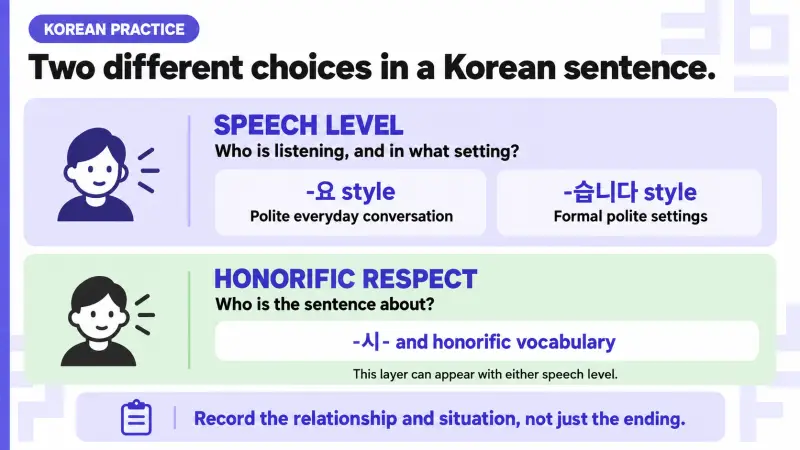
Traditional descriptions of Korean list several speech levels, and a few of them are rarely heard in ordinary modern conversation. Beginners do not need the full inventory. The two levels worth learning first are the polite -요 style and the formal -습니다 style, and the honorific marker -시- is a separate layer that can attach to either one. Mixing up those two things, the level you use toward your listener and the respect you mark toward the person you are talking about, causes more confusion for beginners than the endings themselves.
The table below is a reference you can keep open during your first weeks of real practice. Read it by column: what the forms look like, where you are most likely to meet them, and whether a beginner should be producing them yet or only recognizing them.
| Level or layer | What it looks like | Where beginners meet it | Beginner status |
|---|---|---|---|
| 해요체, polite -요 style | -아요/-어요, -이에요/-예요, -(으)세요 | Everyday conversation, messaging, most beginner course material, language partner chats | Produce it; this is your default |
| 합니다체, formal polite style | -ㅂ니다/-습니다, questions in -ㅂ니까/-습니까 | Self introductions, announcements, service and business settings, broadcasts | Produce a few fixed sentences; recognize the rest |
| 해체, casual 반말 | -아/-어, 이야/야 | Close friends of similar age, family, dramas and variety shows | Recognize first; use only when invited |
| Honorific -시- and honorific vocabulary | 가세요, 가십니다, 드시다, 계시다, 주무시다 | Talking about or to someone older or senior | Start with a handful of set forms |
Notice that -시- appears in both the -요 row and the -습니다 row. 가세요 (gaseyo) and 가십니다 (gasimnida) both mark respect toward the person going somewhere; they differ in formality toward whoever is listening. That is why a sentence can be polite and still sound wrong, or respectful and still sound too stiff for a chat window.
For the underlying grammar, the National Institute of Korean Language publishes reference material on speech levels and its standard Korean curriculum listing, and its framing is useful here: level choice is treated as something decided by relationship and situation rather than by a fixed politeness ranking. If you want to see how different study sites teach that same material, the comparison of how Korean learning websites present speech levels covers which ones give you drills and which give you explanations.
Attach Each Sentence to a Relationship and Situation
Knowing the forms is the smaller half. The part that decides whether you sound natural is the label you attach to each sentence: who you are speaking to, how you met them, and where the exchange is happening. A sentence stored without that label is a sentence you will use in the wrong place.
Defaulting to the polite -요 style with anyone new rarely sounds wrong in Korean; the noticeable beginner errors come from dropping into casual speech with someone who did not invite it. That single default removes most of the risk from early practice, which is why you can start now instead of waiting for social fluency.
Here is a suggested practice format that costs about a minute per sentence. Each time you save a Korean sentence, write four things next to it rather than one: the sentence, who you would say it to, where the exchange happens, and which level you used. A saved card might read: 다시 말해 주세요, to a language partner I met last week, in a text chat, -요 style. Two weeks later that card still tells you something; a bare vocabulary entry does not.
Early practice also goes more smoothly when you pick relationships with clear boundaries. These four are manageable for a beginner because the expected level is fairly stable:
- A new online language partner of unknown age: use the -요 style and leave it there until they say otherwise.
- A shop, café, or service interaction: you can use the -요 style, and you will hear 합니다체 coming back at you.
- A group voice chat where you greet everyone at once: the -요 style works, with a formal self introduction if the room is large.
- Someone clearly older, or a teacher: use the -요 style plus -시- on verbs about them, and address them by title rather than by name alone, such as 선생님 (seonsaengnim) rather than a bare given name.
One habit to build early: address people by name plus 씨 (ssi) or by a title, not by the pronoun 당신 (dangsin), which does not work as a general "you" with new contacts. Pronoun avoidance is part of honorific competence, not a separate topic.
Compare the Same Message Across Different Levels
Once you have a default, the fastest way to feel the system is to write the same message three ways and look at what actually changed. Usually it is more than the ending: the verb may swap for an honorific one, the request may get longer, and the whole sentence may shift in directness.
The comparison below uses four messages a beginner genuinely sends in the first month. Read across each row and notice which column changes the verb itself, not just its tail.
| Message you need | Casual 해체 | Polite 해요체 | Formal 합니다체 | Where the formal version fits |
|---|---|---|---|---|
| Thank you | 고마워 (gomawo) | 고마워요 (gomawoyo) | 감사합니다 (gamsahamnida) | Service, work, and anyone you have just met |
| Could you say that again? | 다시 말해 줘 (dasi malhae jwo) | 다시 말해 주세요 (dasi malhae juseyo) | 다시 말씀해 주시겠습니까? (dasi malsseumhae jusigetseumnikka) | Phone calls, help desks, formal meetings |
| Have you eaten? | 밥 먹었어? (bap meogeosseo) | 식사하셨어요? (siksahasyeosseoyo) | 식사하셨습니까? (siksahasyeotseumnikka) | The -시- and 식사하다 mark respect toward the person asked |
| I am learning Korean | 한국어 배워 (hangugeo baewo) | 한국어 배워요 (hangugeo baewoyo) | 한국어를 배우고 있습니다 (hangugeoreul baeugo itseumnida) | Group introductions, first posts, class settings |
The third row is the one that repays study. 밥 먹었어요? is polite in ending but plain in vocabulary, while 식사하셨어요? lifts the verb itself. Both are correct sentences; they simply point at different people in different relationships.
A suggested practice drill: choose five messages you actually send in a week, write each at two levels, and keep the pair together. You are not memorizing translations, you are building a small set of switchable sentences you can test on a real person.
Use HelloTalk Partners for Contextual Preference, Not Universal Rules
Now the part that a textbook cannot do for you. Written explanations describe the system; a real person tells you how it plays out in their own life, which is exactly the information missing from your saved cards.
This is where HelloTalk fits inside the wider process rather than replacing any of it. The loop runs in five moves: you take a pattern from whatever course or reference you are using, you express it yourself in a message, a real person answers in a way you did not script, you review what came back, and you set the next practice task from that review. HelloTalk's chat supports text and voice messages in Korean, and HelloTalk's correction feature lets a native speaker mark up a message you sent in chat or a post you published to Moments, so your attempt and the revised version stay side by side instead of disappearing into a conversation. HelloTalk's Voicerooms display spoken content as subtitles, and Tap-to-Translate can translate a word or sentence you select, which helps when a speaker uses an ending you have not studied yet. If you are still deciding where to practice, the overview of what to look for in a Korean language exchange app compares these environments by task.
The care point is interpretation. A native speaker's answer about honorifics describes their own relationships and setting, so treat each reply as one labeled example rather than a rule that covers every situation. A 24-year-old who tells you 편하게 말해요 is inviting you into casual speech with them specifically, not issuing a general permission slip for people their age. Someone who works in a formal office may flag a sentence as too casual that a university student would call completely normal.
Ask questions that carry the context inside them. Instead of asking whether a sentence is rude, ask how it would land in a named situation:
- If I sent this to a coworker about ten years older on a Monday morning, how would it sound?
- Would you use this ending with someone you met once at a friend's party?
- Does this feel too formal for a chat message, or is it fine in writing?
- Which of these two versions would you actually type, and who would you type it to?
When two or three people give you different answers, that variation is the finding. Write down the situations they each pictured, because the situations are what differ, not the grammar.
Save the Feedback and Reuse the Sentence in a New Situation
Feedback that stays in a chat log is feedback you will read once. A correction becomes usable only when you reuse the corrected sentence with a different person or in a different setting, because honorific choice is decided by context rather than by the sentence alone. The reuse is the test; the correction is only the input.
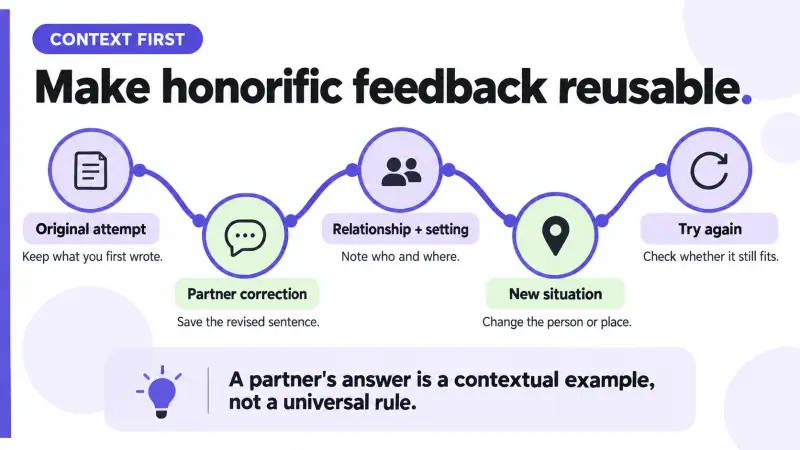
The table below turns the five kinds of honorific feedback beginners receive most often into a specific next task. Use it as a routing sheet: find the row that matches what your partner changed, record what the middle column asks for, then do the task within the next few days while the exchange is still fresh.
| Feedback you receive | What to record | Suggested next task |
|---|---|---|
| Ending changed from -요 to -습니다 | The setting your partner had in mind | Rewrite the same content as a short self introduction for a group or a first public post |
| -시- added to a verb | Who the sentence was about, and their relationship to you | Write three sentences about someone older or senior and check which ones need -시- |
| Address term changed to name plus 씨 or to a title | The age gap or role your partner mentioned | Send a greeting to a different contact using the address term that matches that person |
| Honorific vocabulary swapped, such as 먹다 to 드시다 | The pair itself, not only the corrected sentence | Use the honorific word in one question and the plain word in one statement the same day |
| "Grammatically fine, but we would not say it here" | The exact situation your partner named | Rewrite the message for that situation and ask a second partner how it lands |
Keep the original attempt visible in your notes. Seeing 밥 먹었어요? next to 식사하셨어요? with a note saying "he pictured me asking his manager" teaches more than a clean corrected sentence with no history. Over a few weeks, these paired entries become your own reference on speech levels, built from situations you were actually in. If you want that reuse step to happen somewhere with real people rather than in a notebook, HelloTalk gives you chat, Moments, and Voicerooms as three different settings to retry the same sentence and see whether the level still fits.
Frequently Asked Questions About Korean Honorific Practice
How soon after starting Korean can I practice honorifics with a real person?
As soon as you can read Hangul and build a short sentence with a verb, which many learners reach within a few weeks. You do not need to finish a grammar unit on speech levels first, because any sentence you send already uses one. Starting early means you learn the endings as choices attached to people rather than as decontextualized forms.
Should beginners learn the -요 style or the -습니다 style first?
Learn the -요 style first for production and the -습니다 style for recognition and a few fixed sentences. The -요 style covers most everyday conversation, messaging, and language exchange, while -습니다 belongs to introductions, announcements, service settings, and formal writing. Both are polite, so neither one is a risk with a stranger.
Is it rude if a beginner uses the wrong speech level?
Using the -요 style where a Korean speaker would have used -습니다, or the reverse, usually reads as a learner mistake rather than an insult. The version that stands out more is casual 반말 with someone who did not invite it, since that signals a closeness that has not been agreed on. Defaulting to the -요 style with anyone new keeps you on safe ground while you learn the distinctions.
When is it acceptable to switch to casual speech with a language partner?
When that specific person invites it, often with a phrase such as 편하게 말해요 or 말 놓으세요. Treat the invitation as belonging to that one relationship, not to everyone of a similar age. It is also normal to accept the invitation and still keep -요 for a while; nobody will find that odd.
Do I need to know someone's age before choosing a speech level?
Not before your first messages. Korean speakers often establish age and relationship early in a conversation, but a beginner does not need to ask directly; the polite -요 style works until the relationship becomes clearer. If age comes up naturally, add it to the label you keep next to the sentences you practiced with that person.
Can I practice honorifics without speaking out loud yet?
Yes. Text messages, short written posts, and recorded voice messages all force you to select an ending, which is the honorific decision itself. HelloTalk's correction feature works on both chat messages and Moments posts, so written practice can still bring back level and vocabulary feedback before you move to live speaking.
What should I ask a language partner about honorifics?
Ask about situations rather than about rules. Questions such as "would you type this to a coworker ten years older" or "which of these two would you actually send, and to whom" produce answers you can file with a relationship label. Collect two or three answers on the same sentence, since differences between speakers tell you where the context boundary really sits.