
Japanese in 15 Minutes a Day: What Belongs in Your First 8 Weeks?

You have fifteen minutes before work, a beginner app already open, and no clear sense of whether today should be more hiragana, more vocabulary, or a listening clip. Two weeks later the sessions still feel productive, and then someone writes おげんきですか (o-genki desu ka, how are you) and nothing comes out. The resource is usually not the problem. The problem is that fifteen minutes gets spent on whatever the app serves next, instead of on an order that moves from reading kana to answering a real person.
So here is what actually fits into a quarter of an hour, block by block, and where a free beginner textbook, a structured app, and a real conversation partner each earn their slot.
Quick Answer: What Can a 15-Minute Japanese Routine Cover?
A 15-minute Japanese session holds about three small tasks, and one of them has to be production, or the routine only trains recognition. Five minutes of review, five minutes of one new item, five minutes of saying or writing something yourself is the shape that survives a busy week. Two tasks of seven or eight minutes also works. Four or five tasks does not, because switching costs eat the session.
It helps to be honest about the ceiling too. Fifteen minutes a day will not carry you through hundreds of kanji, long-form reading, or a full grammar reference in eight weeks. What it does carry is a readable script, a set of phrases you can produce without thinking, four or five sentence patterns you can fill with your own words, and a first handful of real exchanges. If you have a bigger daily budget and want the wider route through beginner Japanese, the guide to learning Japanese fast as a beginner covers the whole path rather than this one time constraint.
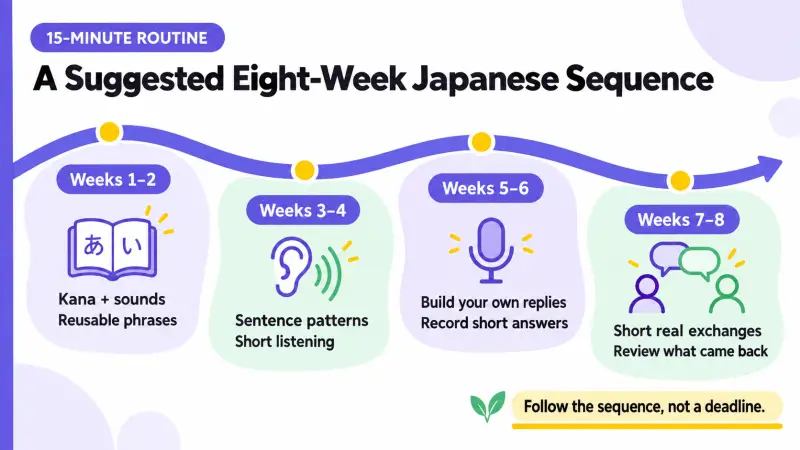
The plan below runs in four two-week blocks, in sequence rather than in order of importance: script and sound, patterns and short listening, response building, then short real conversations. Each block assumes the previous one produced something usable. The table is a quick overview of how the minutes divide and what each block should leave you with; the sections after it give the execution detail, including what to do on a specific day.
| Block | Main focus | Suggested 15-minute split | What the block leaves you with |
|---|---|---|---|
| Weeks 1-2 | Hiragana, core sounds, fixed phrases | 6 min kana reading, 5 min sound drill, 4 min saying one phrase aloud | Slow but real kana reading, five or six phrases from memory |
| Weeks 3-4 | Sentence patterns and short listening | 5 min pattern, 5 min short audio, 5 min swapping your own words in | Four or five patterns you can fill, plus ears used to beginner speed |
| Weeks 5-6 | Building replies, not just recognizing | 4 min review, 5 min listening to a question, 6 min writing or recording an answer | Prepared answers to the questions beginners actually get asked |
| Weeks 7-8 | Short real conversations | 3 min prep, 7 min exchange, 5 min reviewing what came back | One short exchange per session and a list of corrections to reuse |
Eight weeks is a workable order, not a promised timeline; the sequence of tasks matters more than finishing the blocks on schedule. If hiragana takes you three weeks, the rest of the order still holds.
Weeks 1-2: Learn Hiragana, Core Sounds, and Reusable Phrases
Learning the 46 basic hiragana first is worth two weeks because it lets you read beginner course material in its original form, instead of depending on romanized spelling that disappears from real material later. Almost every beginner textbook, subtitle, and chat message you will meet is written in kana and kanji, so kana is the gate.
Read them in vowel rows rather than in random order: あいうえお, then かきくけこ, さしすせそ, and onward. Five new characters a day at six minutes each is a calm pace and finishes the set inside two weeks with room for review. Reading recognition comes first; handwriting every character is optional at this stage and can quietly eat your whole session.
The sound work matters more than most beginners expect, because vowel length changes meaning. おばさん (obasan, aunt) and おばあさん (obaasan, grandmother) differ only in how long that vowel is held. Spend the middle five minutes reading aloud, not silently, so your mouth learns the rhythm at the same time your eyes learn the shapes.
For the production slot, use fixed phrases you would genuinely say on day one. The Japan Foundation's free beginner course Irodori: Japanese for Life in Japan, Starter, opens Lesson 1 with greetings and first-contact exchanges rather than grammar tables, which is a good model for what belongs in week one. A workable starter set: はじめまして (hajimemashite, nice to meet you), よろしくおねがいします (yoroshiku onegaishimasu, said when you meet someone), すみません (sumimasen, excuse me or sorry), ありがとうございます (arigatou gozaimasu, thank you), わかりません (wakarimasen, I do not understand).
As suggested practice for one week 1 session: read あ through こ aloud twice, read the same ten characters in a beginner word list, then say はじめまして and よろしくおねがいします out loud five times each. If you have more than fifteen minutes a day to give, the beginner first-month plan spreads this same foundation across longer sessions with more writing and reading practice.
Weeks 3-4: Add Sentence Patterns and Short Listening
Once kana reading is no longer painful, the bottleneck changes. You can decode words but you have no frame to put them in, so the next two weeks add patterns and ears at the same time.
Treat a pattern as a slot machine, not as grammar to be studied. Four or five patterns will carry a surprising amount of beginner conversation:
- XはYです (X wa Y desu) for identifying things, as in わたしはアレックスです
- Xがすきです (X ga suki desu) for likes, as in ラーメンがすきです
- Xをします (X o shimasu) for activities
- Xにいきます (X ni ikimasu) for going somewhere
- いっしょに~ませんか (issho ni ~masen ka) for inviting someone
Each session, take one pattern and swap in three words that are true about you. Truth matters here, because the sentences you invent in week 3 are the sentences you will actually need in week 7.
The listening slot should be short and repeated rather than long and passive. Take thirty to sixty seconds of audio from your beginner course and play it twice: once for the general situation, once hunting for the specific pattern you drilled that day. Beginner audio at natural speed is fine as long as the clip is short and you know what you are listening for.
Week three is also where most beginner routines quietly die, because the novelty is gone and you still cannot say much. That drop-off has predictable causes, and the breakdown of why beginner Japanese plans fail around week three is worth reading before you hit it rather than after. The practical defense inside a 15-minute routine is to keep the production slot, even on days when you skip the new material.
Katakana can start here in small doses. Five characters a week inside the review slot is enough, since most of what you meet early will be loanwords like コーヒー and メニュー.
Weeks 5-6: Build Replies Instead of Only Recognizing Japanese
Recognizing Japanese and producing Japanese are separate skills, so a routine built only on multiple-choice recognition leaves you silent when a real person asks a simple question. This is the block where the same material gets flipped from input to output.
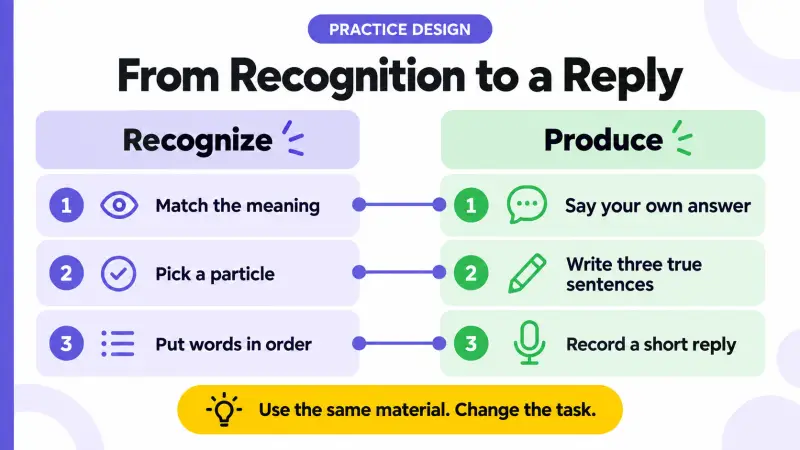
The method is to take the patterns from weeks 3-4 and attach a real answer to each of them, then rehearse that answer until it survives without notes. The table below shows the difference in task design using items you will already have, and it is suggested practice rather than a fixed curriculum.
| Item from your material | Recognition task (what most apps ask) | Response task to add in weeks 5-6 |
|---|---|---|
| しゅみはなんですか (shumi wa nan desu ka, what are your hobbies) | Match the sentence to its English meaning | Say your own answer aloud: しゅみはりょうりです |
| ~がすきです (~ ga suki desu, I like ~) | Pick the correct particle in a quiz | Write three true sentences about food, music, and a place |
| どこからきましたか (doko kara kimashita ka, where are you from) | Tap the words into the right order | Record a 15-second reply with your city plus one extra detail |
| わかりません (wakarimasen, I do not understand) | Read it inside a sample dialogue | Use it in a real message when a reply is too fast for you |
A useful habit in this block is recording yourself for twenty to thirty seconds, then listening back once before deleting it. You will hear dropped particles and rushed vowel length faster than you will notice them while speaking.
This is also the earliest sensible point to let other people see your Japanese, without a live conversation yet. A two-sentence self-introduction posted publicly is a low-pressure way to find out whether your sentences read naturally, and HelloTalk supports corrections on Moments posts as well as on chat messages, so written attempts can come back marked up rather than unanswered. Whatever comes back becomes the next day's review slot.
Weeks 7-8: Test the Routine in Short Real Conversations
By now you have kana, a few patterns, and prepared answers. The last block treats a real exchange as a test of the routine rather than a reward at the end of it, because a conversation shows you exactly which prepared sentence collapses under pressure.
Keep the target small. One topic, five to eight turns, and a plan for what to do when you do not understand. Two fallback phrases carry most of it: もういちどおねがいします (mou ichido onegaishimasu, one more time please) and ゆっくりおねがいします (yukkuri onegaishimasu, slowly please). A beginner who can stall politely stays in the conversation; a beginner who can only answer perfectly leaves it.
Order the formats by pressure. Text messages first, because you can reread and edit. Then a voice message of fifteen to thirty seconds, which lets you rehearse and re-record before sending and still produces real speech for someone to react to. Live voice comes last, and only if you want it. Nobody owes you a reply on a schedule, and partner availability varies, so build the session around what you send rather than around what arrives.
The review slot is what turns the exchange into learning. After each conversation, write down one sentence you wanted to say and could not, plus one correction you received. Those two items are the next session's material, which keeps the plan running past week 8 without a new curriculum:
- The sentence you could not build shows you which pattern to add next
- The correction shows you which pattern you already have but are using wrong
Where HelloTalk and a Language Partner Fit Into the Eight-Week Plan
A common mistake is to treat a language partner as a final exam. It works better as one stage inside a loop you repeat: source material gives you the pattern, you build a sentence with it, a real person responds to that sentence, you review what came back, and the review sets the next practice task. Your course or app owns the first stage. A person owns the third.
A language partner supplies what fixed course material cannot: an unscripted response to the specific sentence you just produced, plus a judgment about whether it sounds natural in that situation. Textbook Japanese is correct by definition; whether a native speaker would actually phrase it that way at a convenience store is a different question, and only a person can answer it.
Inside a 15-minute routine, the parts of HelloTalk that fit are the ones that keep the session short. HelloTalk's chat includes message translation, transliteration, and read-aloud, so you can send a sentence in Japanese, check a reply you half-understand, and hear how it sounds without leaving the conversation. HelloTalk's correction tools work on chat messages and on Moments posts, which means both your private attempts and your public two-liners can come back marked. Voice messages let you rehearse before sending, and HelloTalk's Voicerooms can be joined as a listener when you want input rather than output, with subtitles showing spoken content as text and Tap-to-Translate available for a word or sentence you select.
Two honest limits are worth stating. HelloTalk is the real-use and feedback layer, not a graded course, so keep your structured source material for weeks 1-4 and let the app carry expression, response, and review. And no app can promise how fast a reply arrives, so plan your session around sending and reviewing rather than waiting.
A reasonable rhythm for the last two blocks: post or message on three days, review corrections on two days, and spend one day listening only. Then start the loop again with whatever your review list says you cannot yet say.
Frequently Asked Questions About Learning Japanese in 15 Minutes a Day
Is 15 minutes a day really enough to learn Japanese?
It is enough to build a beginner foundation and start short conversations, and not enough to reach fluency on a fixed schedule. Fifteen daily minutes done consistently beats two long weekend sessions for script memory and speaking reflexes, because kana recall and sentence production both improve through frequent short exposure rather than occasional long study.
Should I learn hiragana and katakana at the same time?
Learning hiragana first is the simpler order, since beginner course material and most chat messages lean on hiragana and kanji. Katakana can start around week 3 in small doses of a few characters per week, which is usually enough to read loanwords like コーヒー and メニュー on a menu.
When should I start kanji in this plan?
Kanji is not part of the first eight weeks as a memorization project. What helps earlier is recognizing a small number of high-frequency characters you actually meet, such as 日, 本, 人, and 大, without drilling readings. Systematic kanji study is a better fit once your sentence patterns are stable and you have more than fifteen minutes to give.
Do I need to speak before I message a native speaker?
No. Text messaging is the lowest-pressure entry point, because you can reread, edit, and use a dictionary before sending. A reasonable order is text messages first, then short voice messages you can re-record, then live conversation if you want it.
What happens if I miss three or four days?
Restart with the review slot, not with new material. Spend one session reading kana you already learned and saying your prepared phrases aloud, then resume the block you were in. Beginners lose more progress by restarting the entire plan from day one than by returning to the middle of it.
Can I follow this order while using a structured app or course?
Yes, and that is the intended setup. A structured app or a free beginner textbook like Irodori Starter can own the new material inside each session, while the production slot and the later conversation blocks handle what apps rarely cover, which is building your own sentences and getting a human response to them.
How long should my first Japanese voice message be?
Fifteen to thirty seconds is plenty. That is roughly two or three sentences, which is long enough to give a partner something to react to and short enough that you can rehearse it inside a fifteen-minute session and still have time to review what comes back.