
Why Does English Fluency Need More Than One Familiar Voice?

Plenty of English learners understand their teacher perfectly and then lose the thread the moment a stranger speaks. The reason is specific, and so is the fix. Reliance on a single familiar voice can leave a listening-transfer gap, because part of what you learned was that one person's speed, pitch, and word choices rather than English itself. To be clear about scope from the start: this article is about the listening and speaking transfer problem inside fluency, not about fluency as a whole, which also depends on vocabulary, grammar, and much else.
If your English works with one person and fails with everyone else, nothing is broken. You trained on one voice, and the pattern reflects the narrow voice exposure you practiced.
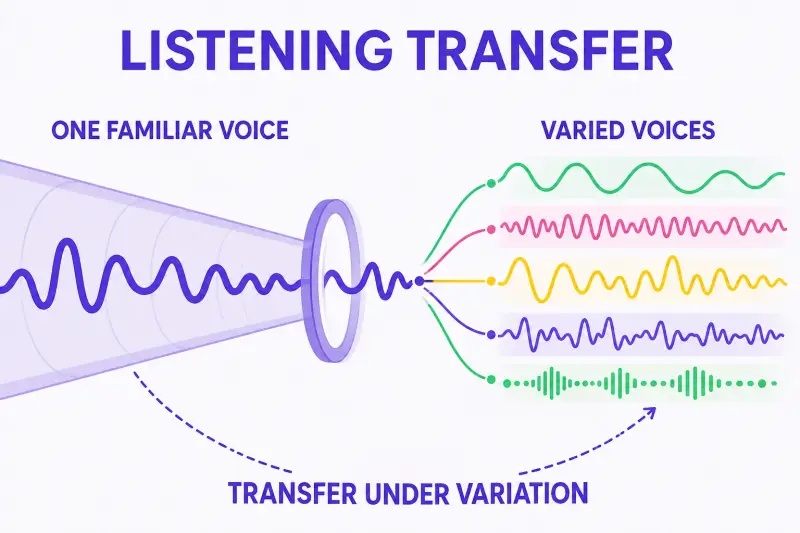
What a single familiar voice actually teaches you
A familiar voice teaches real English plus a layer of shortcuts, and the shortcuts are the problem. After months with the same teacher or the same podcast host, you have adapted to one speaking rate, one accent, one melody, and one habitual vocabulary. The National Center for Voice and Speech puts the average rate for US English speakers at about 150 words per minute, but individual speakers vary around that average, cut different corners, and link words differently. Your comprehension of the familiar voice quietly includes predictions about all of that.
A stranger can break those predictions all at once. New pace, new vowel qualities, new filler words, and suddenly you are decoding raw audio again instead of confirming expectations. With around 1.5 billion total English speakers worldwide and only about a quarter of them native, English exposes listeners to an unusually wide range of voices, which makes deliberate voice variety especially relevant when training for it.
What the multi-speaker research found, and its limits
There is a well-known research thread here, and it is worth citing precisely because it is narrower than it sounds. In studies at Indiana University in the early 1990s, Japanese learners of English who practiced telling apart the sounds r and l with recordings from five different speakers later handled new words and unfamiliar voices better, while learners trained on a single speaker improved mainly on the exact materials they had practiced. Follow-up work in 1997 found that this perception-only training even carried over modestly into how learners pronounced the sounds themselves.
Now the limits. These experiments were about hearing one pair of sounds, not about conversation, vocabulary, or fluency in any broad sense, and later attempts to replicate the multi-speaker advantage have produced mixed results. For what fluency itself covers beyond the listening slice this article isolates, what English fluency means is the wider map.
What the research supports is a narrow claim: in the sound-perception tasks studied, variety in voices during practice helped the trained skill survive contact with new voices, and that claim should not be inflated into a general law of language learning. The honest takeaway is directional, and the table below keeps the two training styles side by side so the direction stays clear. Before reading it, one note on purpose: the table is a boundary-setting tool, separating what each style demonstrably builds from what it cannot prove, with the practice column showing how to act on the difference this week.
| Question | One familiar voice | Many different voices |
|---|---|---|
| What it builds | Deep comfort with one speaker's pace, accent, and phrasing | Tolerance for variation in pace, accent, and phrasing |
| What it demonstrably helped in research | Performance on the exact trained voice and materials | Handling new words and unfamiliar speakers, in a narrow sound-perception task |
| What it cannot prove | That your English works beyond that speaker | That variety alone produces fluency; it does not |
| Main risk | Comprehension may drop with unfamiliar voices | Early sessions feel harder and slower |
| How to practice it | Keep one anchor partner or show for confidence | Rotate partners, join group audio, vary accents weekly |
The bridge from table to routine is the last row: the rest of this article turns "rotate and vary" into a concrete weekly setup, because the research points at variety but leaves the scheduling to you.
Building a multi-voice week without losing your anchor
One workable structure is an anchor plus rotation, and it addresses both failure modes. Keep one familiar voice, a regular partner or a favorite show, as the place where you consolidate and feel progress. Around that anchor, rotate: one new conversation partner each week, one group audio session where several people talk over each other a little, and listening material that deliberately switches accents, an Indian speaker one day, a Scottish one the next, an American non-native the day after. If the deeper problem is that studying has crowded out speaking altogether, the case for switching from studying to speaking tackles that bottleneck first.
Two adjacent skills decide how much you get out of the rotation. When an unfamiliar voice loses you mid-exchange, the recovery moves are the same repair mechanics covered in why repairing a misunderstanding is a learning event, and they are worth drilling before you need them. And every voice that defeats you is data: the system in letting real conversations decide what you study next turns those defeats into a study queue instead of a confidence problem.
Where HelloTalk fits a multi-voice routine
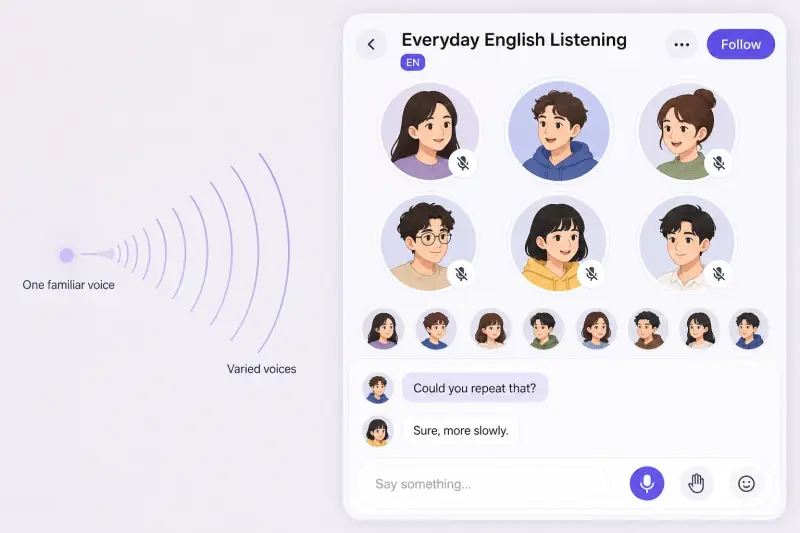
Limited access to varied voices can be one source of the problem, and access is where a large exchange platform can help. For the underlying argument that access to many real speakers is itself a learning resource, see the hub on learning through conversation before you know much, and for the broader method picture, language learning strategies that actually work. HelloTalk's Voicerooms and Livestreams are the most direct tool here: a group audio room puts several unrehearsed voices in your ears at once, you can join as a listener before ever speaking, and different rooms may expose you to different accents, ages, and speeds.
HelloTalk's chat-based learning tools make partner rotation survivable for a learner, since voice messages from a new partner can be replayed so you can listen again to the parts a new accent obscured, and when the exchange moves into text, in-chat translation and transliteration help you check meaning, all inside the same thread. HelloTalk's Moments feed widens the written and audio variety the same way: public posts from many different users expose you to phrasing habits a single partner alone would not show you.
And HelloTalk's AI learning tools cover your own production side, with AI pronunciation scoring providing a score and flagging sounds to review, and AI grammar correction offering suggested fixes for the sentences you send to each new partner. HelloTalk was named the 2017 Google Play Best Social App, and most of HelloTalk's core features are available for free, which matters when the whole strategy depends on talking to more than one person.
FAQ
Is it bad to keep listening to my favorite English podcast host?
No, a familiar anchor voice is useful for confidence and consolidation. The problem is exclusivity, not familiarity: keep the anchor and add deliberate variety around it, rather than replacing one comfortable voice with another.
How many different voices per week is enough?
There is no researched number for conversation. One optional design is one new partner, one group audio session, and one unfamiliar accent in your listening material per week, scaled to whatever stays sustainable rather than treated as a threshold.
Should beginners train with multiple voices, or is this for advanced learners?
Starting with small doses of variety early is a reasonable design, since listening habits formed around a single voice are what later needs widening. Keep beginner sessions short and low-stakes, such as listening in group rooms without speaking.
Do I need native speakers, or do non-native voices count?
Non-native voices count fully. Roughly three quarters of the world's English speakers use it as a second language by Ethnologue's count, so a practice diet that includes non-native voices reflects how English is actually used, and there is no reason to limit training to polished native audio.
Why do I understand movies but not real people?
Film audio is mixed and scripted, and you also get visual context and subtitles. Real conversations can add improvisation, overlap, and voice variation that scripted media may not reproduce in the same way, which is the variation this article suggests training on directly.
Will multi-voice practice fix my speaking too, or only listening?
Mainly listening, with possible indirect benefits for speaking. The 1997 Indiana follow-up found perception training modestly improved pronunciation of the trained sounds, but speaking fluency itself still needs its own production practice with real partners, and English fluency broken down by skill maps which kind of practice feeds which skill.
One familiar voice got you started. Strangers are the exam. If you want new voices to train on, HelloTalk offers group audio rooms where you can seek wider voice exposure.