
I have studied English for more than ten years, but why am I still unable to speak a word when meeting native speakers?
We may have had this experience:
When we were traveling abroad, the front desk of the hotel was an American. He asked us "How long are you staying?" in a very normal speed. We had these words in our brains - "how long" and "staying", we all knew them and could even translate them - but we couldn't put them together, and then the panicked silence came.
Or in the workplace, a foreign colleague said something very casual. We generally understood it, but we didn't know how to answer it, so we could only smile awkwardly and nod.
Or more commonly: I watch English videos and watch English subtitles, and I feel like I understand it, but once I have to speak by myself, my mind goes blank.
After learning English for more than ten years, this scenario still happens repeatedly - this is not an isolated situation, it is the true state of the vast majority of English learners.

Why language learning is slow for most people comes down to one core gap: study methods build knowledge, but knowledge doesn't automatically convert to speech. The next section explains exactly where that gap opens.
Knowing the reason for this is simpler than we think.
English education in many countries does one thing very well: teach us to pass English exams. College entrance exams, standardized tests, IELTS, TOEFL. You can prepare for these exams through the system. Memorize vocabulary, learn grammar, and study real questions. If you follow a set process, many people will get high scores.
But the English tested in the exam and the English used in real conversations are two different things.
The exam is certain: the questions have correct answers, and our job is to choose them. Conversation is uncertain: we don't know what the other person will say next, and we need to organize the language in real time and speak it in real time without a draft.
The training methods for these two abilities are completely different. The ability accumulated by completing questions will not automatically be converted into conversation ability. Just like we passed the written test for a driver's license, it does not mean that we can drive - the actual operation requires individual practice.
What is true English fluency?
Before discussing how to learn, let's first define the word "fluency" clearly, because many people's understanding of it is inherently biased.
Fluency is not:
- Perfect grammar in every sentence
- Accent sounds like American
- Vocabulary reaches a specific number
Fluency is:
- Be able to express what we want to say without long pauses and searching for words in our brains
- Can understand what native speakers say at normal speed, not the kind that is specially slowed down for us
- Conveys our true personality - our sense of humour, our opinions, our emotions - not just information
- You can also pick up topics you haven't prepared for during the conversation. You don't need to translate in your head first.
By this measure, most people are closer to fluency than they think. The missing step is often not more vocabulary or more solid grammar, but the number of times you practice speaking - the number of times you speak frequently with real people in real conversation scenarios.
A real way to build English fluency
The most important step: Start talking to real native English speakers
Seriously, all methodological discussions will eventually come back to this sentence: Go and talk to real people.
This is not an exercise in talking to AI. It's not about memorizing the dialogue from the textbook. It's not like watching English dramas over and over again. It's real people, real dialogue. The other person doesn't know what we will say next, and we don't know what the other person will say next. We are communicating in a real way.
The reason why this kind of practice is irreplaceable is that it trains an ability that can only be cultivated in real conversations: Response directly in English without thinking at the conscious level. We know a word and we can say a word in 0.5 seconds, which are completely different things. Only a large number of real conversations can shorten this reaction time.
Where can I find someone to talk to?
HelloTalk solves this problem most directly. It is a language exchange platform - we help native English speakers practice the language they want to learn, and they help us practice English. It has 70 million+ registered users worldwide, supports 260+ languages, and has a very active English-speaking community. 90% of its core functions are completely free. It won the 2017 Google Play Best Social Application Award and received 2024 Global Google Play Home Page Recommendation.
Use interest tags to find native English speakers who like the same things - we like basketball, American TV series, e-sports, travel, cooking... Choose what we are really interested in and chat with a native speaker who also likes it. The topic will naturally arise and continue.
Practice speaking, not just writing
Many people's "English practice" is actually writing practice - think of words slowly, check them repeatedly, revise them carefully, and then send them out.
The ability to write is valuable, but it does not provide the immediacy needed to speak.
Speaking does not give us time to look up words, does not give us time to consider, and does not give us time to revise. We must formulate a response and say it within seconds after the other person has finished speaking. This immediacy can only be built with practice.
Several ways to practice speaking specifically:
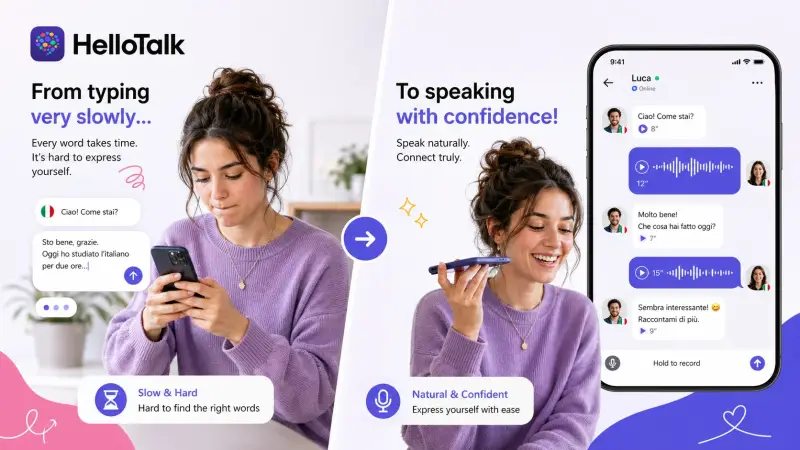
- In HelloTalk, try to send voice messages instead of text messages. The slight pressure of recording is exactly the practice scenario we need - we can't modify it infinitely and just send it out when we're done, just like a real conversation
- Enter HelloTalk's Voicerooms, enter as a listener first, listen to the rhythm, intonation, commonly used modal particles and transitional words of native speakers, and then turn on the microphone to participate after you get used to it.
- Reading practice: Listen to a piece of English spoken at a natural speed, pause, and immediately imitate the intonation and rhythm and speak it again. Don't pursue every word correctly, pursue rhythm and naturalness
Correct errors in spoken language, not written errors
This is a problem that many people don't realize: The mistakes we make when writing and the mistakes we make when speaking are often two different sets.
When we write, we have time to apply the rules we have learned, and when we speak, the language is automatically produced - only then will the deeply fixed mistakes appear. For example:
- Article: Say "I went to hospital" instead of "I went to the hospital"
- Preposition collocations: say "depend of" instead of "depend on", "interested for" instead of "interested in"
- Common verb collocations: say "do a mistake" instead of "make a mistake"
- Pronunciation habits: The pronunciation of many words in actual spoken language is not exactly the same as in the dictionary. Serialization, weakening, and omission can be seen everywhere.
These errors in spoken language need to be discovered and corrected during speaking exercises and cannot be corrected by doing written grammar questions.
Post an English recording in HelloTalk's Moments and ask native speakers "Does this sound natural?" The feedback we receive will directly point to those places that are unnatural when speaking - which expressions are grammatically correct but are not actually used by native English speakers, which pronunciation habits sound accented, and which expressions have more authentic alternatives.
HelloTalk's AI Grammar Correction works in real time as we send messages, highlighting grammatical problems, explaining the reasons, and giving the correct form. It targets common error patterns among language learners and is more precise than general-purpose grammar tools.
Expand vocabulary in real contexts
Memorizing word lists is one of the least efficient ways to build active vocabulary.
It's not that memorizing words is useless, but the probability of words memorized from the vocabulary list staying at the "recognition" level is much higher than staying at the "use" level. We can recognize the word, but we can't pronounce it when speaking, or we're not sure if it's the right combination after using it.
Words learned in real conversations are different. It is tied to a specific conversational moment - what we were talking about when the native speaker used the word, the tone in which he said it, and how the word felt in that sentence. This kind of memory is much stronger than simple word meaning memory, and it is easier to recall it naturally when speaking.
Practical approach: In a HelloTalk conversation, when a native speaker uses an expression that we haven't seen before or are unsure of, don't just look up the meaning and move on. Use this expression once in a reply and ask the other person, "I used this word here - does that sound right?" After a real use, coupled with a confirmation feedback, the word will truly enter our active vocabulary.
Find the scene where we really need English
People who have a specific purpose will almost always improve their English faster than people who say "I want to learn English well."
The reason is simple: when we have specific goals, the practice has a direction, and each conversation is practicing what we really need to use, rather than an aimless general exercise.
Use HelloTalk's interest tags to find native English speakers who match our goals:
Workplace English: Match native English speakers in our industry and practice professional expression and communication methods that we will actually use. It is not the general sentence patterns in "Business English" textbooks, but the language that people in our industry and position actually use in actual work. HelloTalk's Livestreams have specialized workplace English courses, and you can also find native speakers in the same industry for one-to-one language exchange.
Study Abroad: Want to study in an English-speaking country? Connect with local students on HelloTalk in advance and practice English for class discussions, group assignments, and tutor conversations - this English is not exactly the same as test English and daily spoken English, and requires special practice. Practice in advance so you don't have to adapt again when you arrive.
Interest-driven English: Whatever we like, we find native speakers who like the same thing. If you like basketball, talk about games with English-speaking fans; if you like Marvel, talk about the latest movies with native English speakers; if you like fitness, talk about training plans and diet. When we use English to talk about topics that we already care about, our expressions will become natural, our vocabulary will be remembered, and our motivation will continue.
Travel Preparation: Before traveling to an English-speaking country, connect with locals on HelloTalk. Not just practicing general spoken English, but practicing conversations we will actually use when we get there - asking for directions, ordering food, chatting, and handling emergencies. Practice it before setting off so that you won't panic when encountering these scenes in the local area.
Frequently asked questions, direct answers
"I have no problem with grammar, but I speak very slowly and pause a lot. What should I do?"
The reason for speaking slowly is that the speed of "retrieving words" from the brain is not fast enough, and every word spoken must go through conscious thinking. The only way to fix this is a lot of real speaking - either more grammar exercises, or more talking.
Specific suggestions: Stay as a listener in HelloTalk Voicerooms for a few days to feel the rhythm of native speaker conversations, and then turn on the mic after you get used to it. In the early stage of opening the microphone, only speak short sentences, do not pursue long sentences, and pursue naturalness. The sense of rhythm is established slowly, and there is no rush, but once it is established, there is no going back.
"I can understand it, but I can't keep up with the native speakers when they speak faster. What should I do?"
The listening materials in the textbook have been processed so that the speaking speed is slow, the pronunciation is clear, and there are no omissions of continuous readings. Real conversation is completely different. Native speakers use a lot of contractions ("want to" becomes "wanna"), reductions ("going to" becomes "gonna"), weakening (many words are weakened in the sentence), plus the speed of speaking, it almost sounds like another language.
The solution is: listen to more English spoken at a real speed, don't turn on subtitles, or turn on English subtitles instead of your native language subtitles. It's great to listen to real conversations between native speakers in HelloTalk Voicerooms. At the same time, please ask our HelloTalk companion to speak to us at normal speaking speed and do not slow down deliberately - this discomfort is exactly the practice stimulation we need.
"I feel awkward speaking English in front of native speakers. I always feel like I will be laughed at. What should I do?"
To be honest, the vast majority of native English speakers have a positive attitude towards non-native speakers communicating in English. They focus on the conversation itself, not whether our grammar is perfect.
Moreover, language exchange on HelloTalk is inherently a scene of mutual help - we help them practice their target language, they help us practice English, everyone is learning from each other, and there is no condescending judgment. Finding that we have made a mistake and being corrected is the most normal thing here and does not need to be treated as an embarrassment.
"I don't know where to find native English speakers, what should I do?"
Download HelloTalk, set the target language to English, use interest tags to find native speakers who like the same things, and start chatting within 5 minutes of registration. 90% free, the threshold is very low.

A practical daily schedule
The question of how long does it take to learn a language is really a question of what you do with the time. Sixty minutes structured around real interaction — not isolated drilling — looks like this:
| Time | Content |
|---|---|
| 10 minutes | Send voice messages with HelloTalk and have conversations with your English speaking partner |
| 15 minutes | HelloTalk Voicerooms - listen first, then turn on the mic when you are ready |
| 10 minutes | HelloTalk Moments - Send an English recording and collect feedback on "sounds natural?" |
| 15 minutes | English podcasts or videos - active listening, paying attention to idiomatic expressions and connected speech patterns |
| 10 minutes | Review all the corrections received that day and say the correct form out loud several times |
60 minutes a day, 40 minutes of real human interaction. Compared with "memorizing words for 60 minutes every day", every minute of this arrangement is directly practicing the abilities required for fluency.
Finally
English fluency does not appear automatically when knowledge is accumulated to a certain level. It is an ability that is built with practice, and only with specific kinds of practice - with real people, speaking, being corrected, and continuing.
We have studied English for so many years and a lot of knowledge is there. The missing step is to use them.
HelloTalk makes this step easy: you don't need to find a native speaker nearby or spend a lot of money to sign up for a native-speaking tutor's class, you can start today.
Open it, find our first English speaking partner, and speak your first words.
Even if it's said stumblingly, that sentence is more useful than memorizing another hundred words.