How to Learn a Language Fast in 2026: Real Timelines for Travel, Work & Daily Conversation
If you've been grinding through Duolingo for a year and still freeze when someone says "¿Cómo estás?", you're not alone — and you're not the problem. The problem is that almost every "learn a language fast" promise online ignores the one question that actually matters: fast for what?
Two weeks to confidently order food in Rome is one thing. Three months to run a meeting in English with overseas clients is another. Six months to hold real, flowing conversations with people in their own language is something else entirely. Each of those goals is reachable. They just take different timelines, different methods, and a different definition of "fluent."
This guide cuts through the hype with real timelines based on FSI data, a clear three-scenario framework (Travel, Work, Daily Conversation), and the methods that consistently move people forward — including the one variable that compresses every timeline by 30–50%.
Why Most People Learn Languages Slowly (And What "Fast" Actually Means)
Before we get into the timelines, let's name the trap that catches most learners. The reason you're not speaking yet probably isn't effort. It's that the method was built for the wrong outcome from day one.
The "Fluency Illusion" — Why Apps Fool You
Open most language apps and you'll see a green progress bar, a streak counter, and a satisfying ding when you tap the right answer. What you won't see is whether any of it transfers to a real conversation.
Research on second language acquisition keeps pointing to the same finding: recognition is not production. Tapping the correct translation in a multiple-choice quiz uses an entirely different part of your brain than constructing a sentence under social pressure with someone staring back at you waiting for a reply. You can stack 365-day streaks on a flashcard app and still freeze the first time a French waiter speaks to you.
This is the fluency illusion: the feeling of progress without the substance of it. The XP goes up, but the speaking doesn't.
"Fast" Depends on Your Goal (Travel ≠ Work ≠ Fluency)
There is no single answer to "how long does it take to learn a language" because there is no single target called "knowing a language." There are at least three different finish lines, and choosing the wrong one is why so many learners feel like they're underperforming:
-
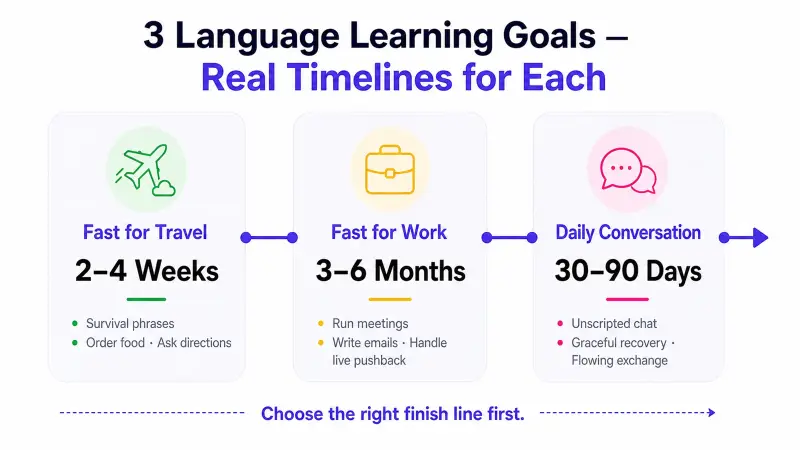
Travel-ready means ordering food, asking directions, exchanging pleasantries, handling small emergencies. A focused learner can hit this in 2–4 weeks.
-
Work-ready means running meetings, writing emails, handling pushback on a video call. This is a 3–6 month commitment.
-
Conversationally fluent means flowing, unscripted conversation on everyday topics. This is a 6–18 month journey depending on the language.
Each goal needs a different daily routine, different vocabulary, and different practice partners. Mix them up — say, drilling business vocabulary when you actually want to chat with locals in Tokyo — and you'll feel stuck even when you're making real progress on someone else's definition of fluency.
The 3-Scenario Framework
The rest of this guide is organized around these three goals:
Fast for Travel — Get conversational in 2–4 weeks Fast for Work — Reach professional use in 3–6 months Fast for Daily Conversation — Real chat in 30–90 days
For each, you'll get a realistic timeline, a phase-by-phase plan, and the specific kind of practice that gets results.
How Long Does It Actually Take? The FSI Data You Should Know
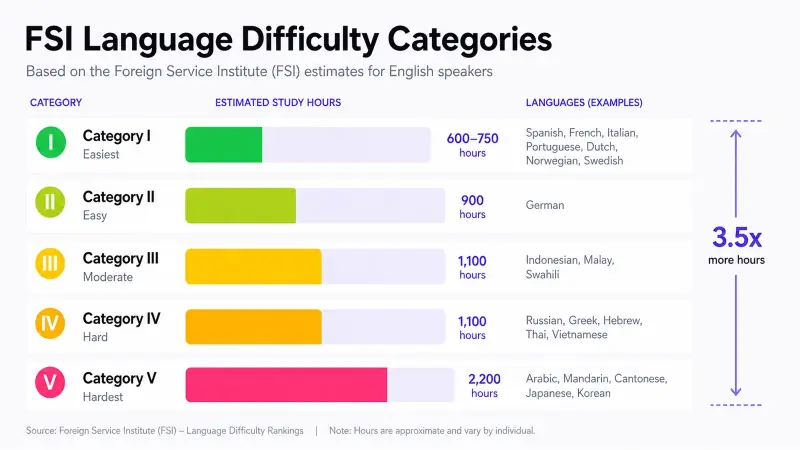
The most reliable timeline data available comes from the U.S. Foreign Service Institute, which has been teaching diplomats languages to professional-working proficiency for over 50 years. Their numbers are based on tens of thousands of learners hitting a measurable speaking standard, not marketing claims.
FSI Difficulty Categories (For English Speakers)
| Category | Hours to Professional Proficiency | Example Languages |
|---|---|---|
| Category I | 600–750 hours | Spanish, French, Italian, Portuguese, Dutch, Norwegian, Swedish |
| Category II | 900 hours | German |
| Category III | 1,100 hours | Indonesian, Malay, Swahili |
| Category IV | 1,100 hours | Russian, Greek, Hebrew, Polish, Turkish, Thai, Vietnamese |
| Category V | 2,200 hours | Arabic, Mandarin, Cantonese, Japanese, Korean |
A few things worth noticing. Spanish and Italian are roughly three times faster for an English speaker than Mandarin or Arabic. And "professional proficiency" — FSI's benchmark — is well above conversational. To just chat comfortably with locals, you can cut these numbers by 30–50%.
Hours per CEFR Level (Approximate, Category I Languages)
| CEFR Level | What You Can Do | Hours Needed |
|---|---|---|
| A1 | Basic phrases, introductions, simple questions | 70–80 hours |
| A2 | Travel scenarios, simple everyday conversation | 150–180 hours |
| B1 | Independent travel, hold a conversation on familiar topics | 350–400 hours |
| B2 | Work fluently, express complex ideas | 500–600 hours |
| C1 | Near-native, nuanced communication | 700–800 hours |
For most "I want to actually speak this language" goals, you're aiming somewhere between A2 and B1 — which is reachable in 3–6 months at one hour of focused practice per day.
5 Variables That Decide Your Speed
The FSI numbers assume a specific kind of learner with a specific schedule. Your actual timeline depends on five variables, ordered by impact:
-
Daily time invested — Consistency beats intensity. 30 focused minutes a day outperforms a 4-hour Saturday cram by a wide margin, because language learning is built on repetition and recall cycles that work best when spaced.
-
Language similarity to your native tongue — Already speak Spanish? Italian will come three times faster than to a monolingual English speaker. This is the easiest variable to plan around but the hardest to change.
-
Access to native speakers — This is the single variable that compresses every timeline by 30–50%. Practicing with a real human forces you into production mode, which is where actual fluency builds.
-
Motivation type — Learning because you have to (instrumental motivation) gets you started. Learning because you love the culture, the music, the people (integrative motivation) gets you to the finish line.
-
Method — Passive consumption (watching subtitled shows, listening to podcasts) builds comprehension. Active production (speaking, writing, getting corrected) builds fluency. Most plans over-index on the first.
The aha moment most learners eventually reach: 30 minutes a day of real conversation will outperform 5 hours a week of passive study, every single time. The rest of this guide is built around that finding.
Fast for Travel — Get Conversational in 2–4 Weeks
This is the most reachable goal on the list and the most under-served. You don't need fluency to have a great trip. You need maybe 200 high-frequency phrases, the confidence to use them imperfectly, and the muscle to handle the moment when a local replies with something you didn't fully catch.
What "Travel Fluent" Actually Means
Travel fluency is a specific, narrow skill: handling predictable transactional conversations in a friendly setting. Ordering food. Asking for directions. Buying a metro ticket. Saying you're vegetarian. Apologizing for not understanding. Thanking a stranger for their patience.
The good news is that 80% of those interactions repeat the same 50 phrases in slight variations. If you can produce those 50 phrases reliably and understand the most common responses, you have travel fluency.
The 14-Day Travel Framework
Days 1–7: Survival Vocabulary Spend 30 minutes a day on the absolute basics — greetings, numbers 1–100, days of the week, basic food vocabulary, directions, and the polite words (please, thank you, sorry, excuse me). The goal isn't perfection. It's recognition and rough production. Use a frequency-based word list, not a textbook order.
Days 8–14: Real Conversations This is where most travelers fail — they show up in country having only ever practiced with an app, and the first real exchange wrecks their confidence. Don't be that person. Start having short, low-stakes conversations with native speakers a week before your trip. Voice messages, text chats, video calls — any modality where a real human is producing the language back at you.
Some languages are dramatically faster to reach travel-ready than others. If you're flexible on destination, the easiest languages to learn for travel start with Spanish, Italian, and French — all reachable in 2–3 weeks of focused work. A practical move is to match with native speakers in your destination on a language exchange app like HelloTalk a week before you fly — by the time you land, you already know real people there, and the first conversation isn't terrifying. For trickier languages like Thai, expect the timeline to stretch; we have an 8-week Thai learning plan built specifically for that case.
Fast for Work — Reach Professional Use in 3–6 Months
Workplace language is its own beast. The vocabulary is denser, the consequences of misunderstanding are higher, and the social stakes — looking competent in front of clients, colleagues, and bosses — make many otherwise confident learners freeze up entirely.
Why Work Language ≠ School Language
The English you learned in school was optimized for passing tests. Work English is optimized for getting things done while sounding competent. These are not the same skill, and the gap explains why many people with strong reading and writing in their target language still can't make it through a video call.
Four specific differences matter:
-
Speed: Meetings move fast. There's no time to mentally translate.
-
Uncertainty: People interrupt, change topics, and use jargon you've never seen.
-
Professional register: There's a specific way to disagree, push back, ask for clarification, and decline politely that doesn't show up in textbooks.
-
Multi-party dynamics: Following three voices at once on a call is fundamentally harder than a 1-on-1 conversation.
The 90-Day Work Language Framework
A focused 90-day plan moves most learners from "I can read industry articles" to "I can run a meeting." A detailed phase-by-phase breakdown lives in our 90-day plan to learn English fast for work, but the high-level structure is:
-
Days 1–30: Scenario vocabulary — meeting phrases, email templates, small talk, phone etiquette
-
Days 31–60: Meeting and email fluency — running discussions, handling pushback, writing diplomatic emails
-
Days 61–90: Presentation and negotiation — pitching, persuading, navigating complex stakeholder dynamics
The skill that compresses this entire timeline is finding practice partners who actually work in your industry. Generic "let's practice English" sessions plateau quickly because the vocabulary doesn't match what you encounter at work. Apps like HelloTalk let you filter language partners by profession, which makes finding peers in your field — software engineers, nurses, marketers — practical rather than theoretical. For a deeper comparison of the best apps for industry-specific English practice, see our full review.
A Real Case
Wei is a software engineer at a Shanghai startup. His written English was solid — he read technical documentation daily — but he'd avoided meetings with the US team for three years because he froze whenever someone asked him a direct question. He committed to 30 minutes a day for 90 days: 10 minutes shadowing tech podcasts, 10 minutes voice-messaging another engineer (a Brazilian developer he matched with online), and 10 minutes reviewing his recorded answers from the day before. By day 60 he was leading the standup. By day 90 he'd presented a feature design to the full team. Total practice time: 45 hours.
Fast for Daily Conversation — 30 to 90 Days to Real Chat
Daily conversation is what most people actually want when they say "I want to speak the language." Not formal correctness. Not test scores. Just the ability to walk into a coffee shop, a friend's house, a casual group chat, and participate without the conversation grinding to a halt around you.
What "Conversational" Really Means
Conversational fluency means three things together:
-
You can express what you want to say (even if imperfectly)
-
You can understand most of what's said back (even if not every word)
-
You can keep the conversation moving when you don't (asking for repetition, paraphrasing, switching topics)
That third skill — graceful recovery — is what separates people who can "speak" a language from people who can actually use it. Most curricula skip it entirely.
The Daily Conversation Track
Days 1–30: Build the Speaking Habit The first month isn't about getting better. It's about getting reps. Daily speaking practice — even 10 minutes of it — establishes the neural pathways that make later fluency possible. The exact method matters less than the consistency. Voice journals, shadowing, AI conversation partners, language exchange apps like HelloTalk — pick one and stick with it. The one rule: whatever method you choose, it has to involve producing the language, not just consuming it. For a worked example, see our 30-minute daily Spanish routine.
Days 31–60: Break the Fear Barrier This is where most learners quit. You've put in 30 days, you can produce basic sentences, and now you have to actually talk to a real person at conversational speed. The fear is universal and it shows up differently across languages — Spanish learners freeze at speed, Japanese learners get trapped by the silence barrier, Arabic learners freeze at register choices. The fix for each is the same: lots of low-stakes reps with patient partners.
Days 61–90: Real Fluency Through Practice By day 60 you've broken the barrier. The next 30 days are about expanding range — different topics, different registers, different speakers. Variety beats volume here.
Overcoming the Speaking Fear
The single biggest predictor of whether someone reaches conversational fluency isn't talent, time, or even daily practice volume. It's whether they can push through the speaking fear in months 1–2.
The fear is universal but the trigger varies. For learners stuck after years of English study, the issue is usually why a decade of studying doesn't lead to speaking — passive study builds recognition, not production. Arabic speaking anxiety often centers on dialect choice and register. Different language, same root cause.
The fix is the same regardless: real conversations with patient native speakers, repeated daily until the fear stops being the main thing in the room.
A Real Case
Aiko moved to Tokyo from Beijing for grad school. Her reading comprehension was strong — she'd passed JLPT N2 — but she'd spent the first six months speaking almost no Japanese, ordering food by pointing and avoiding social invitations from classmates. She started a 60-day plan focused entirely on speaking: 15 minutes of voice messages each morning with two Japanese practice partners (both of whom were learning Mandarin), 15 minutes of shadowing in the evening. The shift came around day 25 when she realized her partners weren't judging her grammar — they were just happy to chat. By day 60 she was meeting one of them in person for weekly conversation exchanges. Total practice time: 30 hours.
The One Variable That Compresses Every Timeline: Real Conversations
Across every framework above, the same factor keeps appearing: access to real conversations with patient native speakers. It's the difference between 4 weeks and 4 months for travel fluency. It's the difference between 6 months and 2 years for work fluency. It's the difference between giving up at month 2 and actually getting somewhere.
Most learners agree they should practice with native speakers — they just can't make it happen daily. Tutors are paid by the hour, which makes a weekly session realistic but a daily habit out of reach for most budgets. Local meetups depend on your city having an active community for your target language. Friends who speak it eventually get tired of being treated like practice partners. And most language apps that advertise "speaking practice" actually deliver AI dialogue trees, so the production muscle never really builds.
The model that solves this is mutual language exchange: pair learners whose target language is each other's native language. A Spanish speaker learning English matches with an English speaker learning Spanish. Both sides benefit, so the relationship sustains for the months daily practice actually requires.
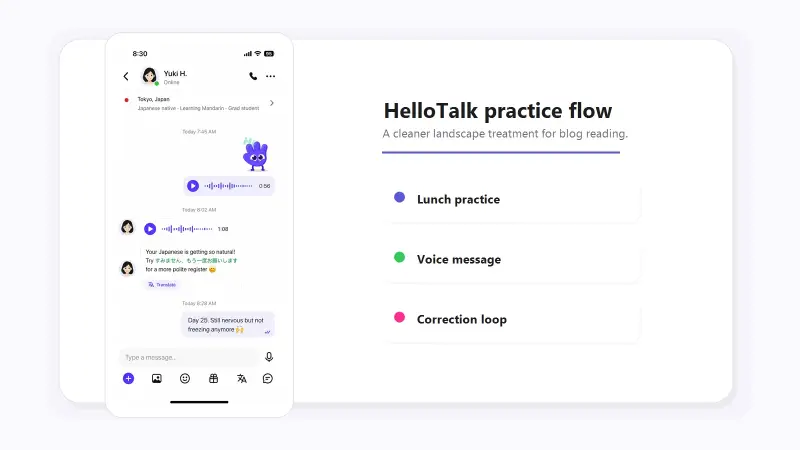
HelloTalk is the largest community built on this model — 70 million users across 200+ countries, 260+ languages — which means there's almost always someone online learning your language while speaking the one you want to learn. The 90% of core features that are free (matching, chat, voice messages, in-chat translation, native speaker corrections, voice rooms) cover what you need for the timelines above. For travel, you can match locals in your destination before you fly. For work, you can filter by profession to find industry peers. For daily conversation, voice messages mean you can practice asynchronously when schedules don't line up.
The key isn't the platform itself — it's the consistency that a sustainable practice relationship enables. Whether you use HelloTalk, find a partner some other way, or build your own system, the non-negotiable is that you're producing the language daily with real humans who are invested in helping you. If you want a side-by-side breakdown of options, our comparison of 7 methods for daily speaking practice walks through what works at each stage.
Your 30 / 90 / 180-Day Action Plans
30-Day Travel Survival Plan
| Week | Daily Time | Focus |
|---|---|---|
| Week 1 | 30 min | 50 survival phrases + numbers |
| Week 2 | 30 min | Pronunciation + listening |
| Week 3 | 30 min | First conversations with locals (online) |
| Week 4 | 30 min | Scenario practice (restaurant, taxi, hotel) |
90-Day Work Readiness Plan
| Phase | Daily Time | Focus |
|---|---|---|
| Days 1–30 | 45 min | Scenario vocabulary + meeting phrases |
| Days 31–60 | 45 min | Email + voice call practice |
| Days 61–90 | 60 min | Presentation + negotiation reps |
180-Day Conversational Fluency Plan
| Phase | Daily Time | Focus |
|---|---|---|
| Month 1–2 | 30 min | Build the speaking habit |
| Month 3–4 | 45 min | Break the fear barrier |
| Month 5–6 | 60 min | Range expansion + complex topics |
Each of these plans assumes you're combining structured practice with regular real conversations. The single adjustment that compresses every timeline above is making those conversations daily — which is why most learners who hit these timelines use a language exchange app for the speaking portion of their plan. For a worked example of what a daily routine looks like in practice, see our 30-minute daily English speaking routine.
FAQ
Q1: Can I really learn a language in 1 month? You can reach a meaningful subset of a language in a month — specifically, travel survival level (CEFR A1) — if you put in 30 focused minutes daily and prioritize real speaking practice from day one. You won't be fluent. You will be functional in basic situations.
Q2:Which language is fastest to learn for English speakers? According to FSI data, Spanish, Italian, French, Portuguese, and Dutch are the fastest, all sitting in Category I at roughly 600–750 hours to professional proficiency. To reach conversational level (the goal most learners actually want), you can cut those numbers by 40–50%.
Q3:Do I need a teacher, or can I self-learn? You can absolutely self-learn — millions of people have — but you cannot self-learn in isolation. The single non-negotiable is regular practice with real native speakers. That can be a paid tutor, a language exchange partner, or a friend who speaks the language. Without that, self-study plateaus fast.
Q4:How many hours per day should I practice? For most goals, 30 focused minutes daily beats 3 hours on weekends. The reason is spacing: language acquisition happens during sleep and rest cycles between practice sessions, not during the sessions themselves. If you can do 45–60 minutes daily, you'll progress faster, but the diminishing returns kick in quickly past one hour.
Q5: Is it possible to become fluent in 3 months? "Fluent" is doing a lot of work in this question. You can reach conversational fluency in an easy language (Category I) in 3 months if you're putting in 60+ minutes daily of high-quality practice including real conversations. You will not reach professional fluency in 3 months — that's a 12–18 month project minimum.
Q6:Why is speaking practice more important than grammar drills? Grammar drills build recognition (knowing what's correct when you see it). Speaking practice builds production (creating correct language under pressure). Production is the harder skill and the one you actually need for real-world fluency. Most curricula over-invest in the first because it's easier to measure.
Q7:Are AI conversation partners as good as real native speakers for learning fast? For the first 30 days, AI conversation partners are genuinely useful: low social pressure, available anytime, and patient enough for repetitive drilling. But AI plateaus fast for fluency development. Real native speakers introduce unpredictability — different accents, unexpected topic shifts, natural speed — that AI simply cannot replicate. Once you can produce basic sentences consistently, real speakers compress your timeline by 30–50% compared to AI-only practice. A practical split: use AI for warmup and low-stakes drilling in weeks 1–4, then add real native speaker exchanges as the primary mode from month 2 onward. Apps like HelloTalk make this transition easy — you start with text chat, build confidence, then move to voice messages and live calls at your own pace.
Q8: Can I learn a language fast if I only have 15 minutes a day? Yes, but with realistic expectations. Fifteen focused minutes daily produces real progress, just on a longer timeline than 30–60 minutes. For travel fluency, expect 6–8 weeks instead of 2–4. For conversational level, plan for 9–12 months instead of 6. The key is protecting those 15 minutes from passive activities — no passive listening, no reading. Every minute needs to be active production: speaking out loud, sending voice messages, or drilling recall under pressure. Consistency matters more than volume at this time investment. Fifteen minutes every day for a year outperforms 2-hour weekend sessions by a significant margin, because spacing is what locks language into long-term memory.
Start Speaking Today
The pattern across every timeline in this guide is the same: speed comes from method + real conversation, not from effort alone. You can study a language for ten years with the wrong method and not be able to order a coffee. You can hit conversational level in 90 days with the right one.
The first step isn't picking a textbook or downloading an app. It's saying your first imperfect sentence to a real person who's patient enough to listen, and then doing it again the next day. The compounding starts there.
HelloTalk and match with your first practice partner. Whatever your goal — travel in three weeks, work fluency in three months, real conversations in three months — the timeline starts the moment you say your first sentence out loud.