The 7 Easiest Languages to Learn for Travel in 2026 (Ranked by Time to Conversational)
You've got four weeks before the trip. You want to do more than point at a menu. You want to order coffee the right way, ask for directions without pulling out your phone, and have at least one real moment of connection with someone who lives there.
The good news is that some languages are genuinely among the easiest languages to learn for English speakers, not in the infomercial sense, but in the sense that a few weeks of focused effort gets you travel-ready. Before you pick one, it's worth understanding real timelines for learning a language so you go in with accurate expectations, not wishful thinking.
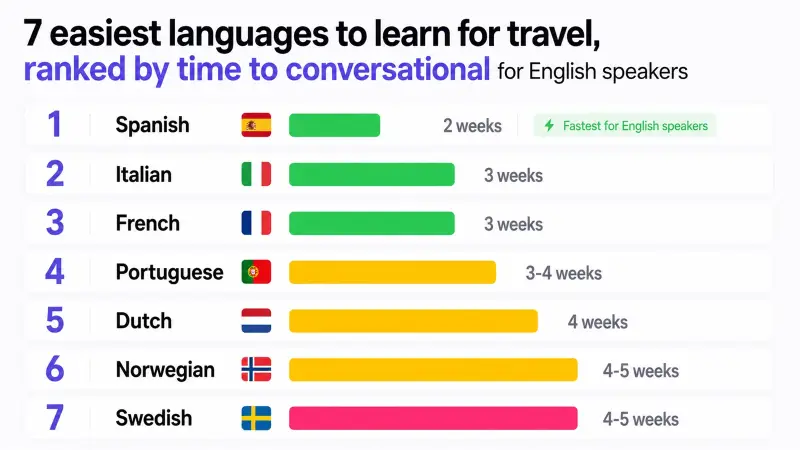
This guide ranks 7 languages by time to travel-ready, focusing purely on what you'll actually use: ordering food, navigating, making friends, and handling surprises.
How We Ranked the Easiest Languages to Learn for Travel
Not all "easy" languages are equally useful. These seven were ranked on four criteria:
- Shared vocabulary with English: cognates, loan words, and similar roots that give you a running start
- Phonetic regularity: how consistently words are spelled the way they sound
- Alphabet familiarity: no new script required, or a very quick one to pick up
- Travel coverage: how many countries and popular destinations use the language
Grammar complexity mattered too, but for travel purposes, imperfect grammar doesn't fail you. Comprehensibility does.
#1 Spanish: 2 Weeks to Travel-Ready
Spanish tops nearly every "easiest language" list for good reason. The writing system is almost perfectly phonetic. The vocabulary shares thousands of words with English. And the grammar, while real, is forgiving enough that broken Spanish still gets you fed and pointed in the right direction.
Three things make Spanish fast to pick up:
- Thousands of cognates: hospital, hotel, restaurante, información, oficina — you already know these
- Predictable pronunciation: with a few exceptions, Spanish sounds exactly like it looks
- Huge geographic reach: 20+ countries, including the most-visited destinations in Latin America and Europe
Your travel survival pack for Spanish:
| Phrase | Meaning |
|---|---|
| Disculpe, ¿habla inglés? | "Excuse me, do you speak English?" |
| ¿Dónde está...? | "Where is...?" |
| La cuenta, por favor. | "The bill, please." |
| ¿Cuánto cuesta? | "How much does it cost?" |
| No entiendo. | "I don't understand." |
The fear of actually opening your mouth in Spanish is the real obstacle for most learners, and it's fixable. A practical guide on overcoming the fear of speaking Spanish walks through exactly what holds people back and how to push past it before your trip.
#2 Italian: The Easiest European Language After Spanish
If you already have some Spanish, Italian feels like a familiar song in a slightly different key. Even without Spanish, Italian is among the fastest European languages to get travel-ready in.
The shared Latin roots with English mean business and abstract vocabulary is surprisingly accessible: comunicazione, informazione, stazione, hotel, pizza (obviously). Italian pronunciation is extremely consistent — what you see is what you say, with very few exceptions.
Your travel survival pack for Italian:
| Phrase | Meaning |
|---|---|
| Scusi, parla inglese? | "Excuse me, do you speak English?" |
| Dov'è...? | "Where is...?" |
| Il conto, per favore. | "The bill, please." |
| Quanto costa? | "How much does it cost?" |
| Non capisco. | "I don't understand." |
Italian rewards even minimal effort from visitors, and locals tend to respond warmly when travelers try. If you're planning to go deeper before your trip, the best way to learn authentic Italian covers resources and methods worth bookmarking.
#3 French: 3 Weeks for the Travel Basics
French has a reputation for difficulty, and in some ways it's earned. But for travel purposes, not fluency, it's more accessible than the stereotype suggests.
Three things to keep in mind:
- Pronunciation is the real challenge: silent letters, nasal vowels, and liaisons take a few weeks of listening practice before they feel natural
- Vocabulary is surprisingly familiar: English has borrowed heavily from French — "restaurant," "café," "hotel," "ballet," "résumé" all trace back here
- Imperfect French is welcomed: attempting French in France, Belgium, and Québec generally gets a warmer reception than going straight to English
Your travel survival pack for French:
| Phrase | Meaning |
|---|---|
| Excusez-moi, parlez-vous anglais? | "Excuse me, do you speak English?" |
| Où est...? | "Where is...?" |
| L'addition, s'il vous plaît. | "The bill, please." |
| C'est combien? | "How much is it?" |
| Je ne comprends pas. | "I don't understand." |
If you have 3 months before your trip, a structured 3-month French plan maps out exactly how to go from zero to comfortable conversation, ideal for destinations where French is the primary language.
#4 Portuguese: A Hidden Gem
Portuguese is underrated as an easy language for English speakers. It shares extensive Latin-root vocabulary with English, sits on a similar grammar skeleton to Spanish, and opens up compelling travel destinations: Portugal, Brazil, Cape Verde, and parts of West Africa.
Two things to know upfront:
- Brazilian vs. European Portuguese sound quite different: more open and rhythmic in Brazil, more clipped and vowel-reduced in Portugal. Pick one accent to focus on based on where you're heading.
- If you already know Spanish: most of Portuguese becomes readable within a week. The speaking takes longer, but you'll navigate menus and street signs almost immediately.
Your travel survival pack for Portuguese:
| Phrase | Meaning |
|---|---|
| Com licença, fala inglês? | "Excuse me, do you speak English?" |
| Onde fica...? | "Where is...?" |
| A conta, por favor. | "The bill, please." |
| Quanto custa? | "How much does it cost?" |
| Não entendo. | "I don't understand." |
#5 Dutch: One of the Fastest Languages for English Speakers
Dutch is linguistically the closest language to English, closer than German, closer than any Scandinavian language. For a trip to the Netherlands or Belgium, the ROI on learning Dutch basics is exceptional.
Three reasons Dutch comes fast to English speakers:
- Similar word order: Dutch sentences follow patterns English speakers recognize intuitively
- Shared Germanic roots: enormous vocabulary overlap in everyday words (hand, water, school, winter, bed)
- Most Dutch people speak excellent English: Dutch works as a nice-to-have social layer, not a survival requirement
Your travel survival pack:
- Sorry, spreekt u Engels? — "Excuse me, do you speak English?"
- Waar is...? — "Where is...?"
- De rekening, alsjeblieft. — "The bill, please."
- Hoeveel kost het? — "How much does it cost?"
#6 and #7: Norwegian and Swedish — The Scandinavian Pair
Norwegian and Swedish are often ranked as the fastest languages for English speakers to reach basic comprehension in. The grammar is simpler than German, the word order is familiar, and vocabulary overlap is significant.
Three things they share:
- Low tonal complexity for travel use: both have pitch accent features, but they're far less critical for basic comprehension than tones in Mandarin or Thai
- Mutual intelligibility: learn Norwegian and you can read most Swedish (and vice versa), useful if you're traveling between Scandinavian countries
- High English proficiency among locals: similar to Dutch, your local-language attempts land as a warm social gesture rather than a survival requirement
Your survival pack (Norwegian):
- Unnskyld, snakker du engelsk? — "Do you speak English?"
- Hvor er...? — "Where is...?"
- Regningen, takk. — "The bill, please."
Quick Wins: The 14-Day Travel Speaking Pack for Any Language
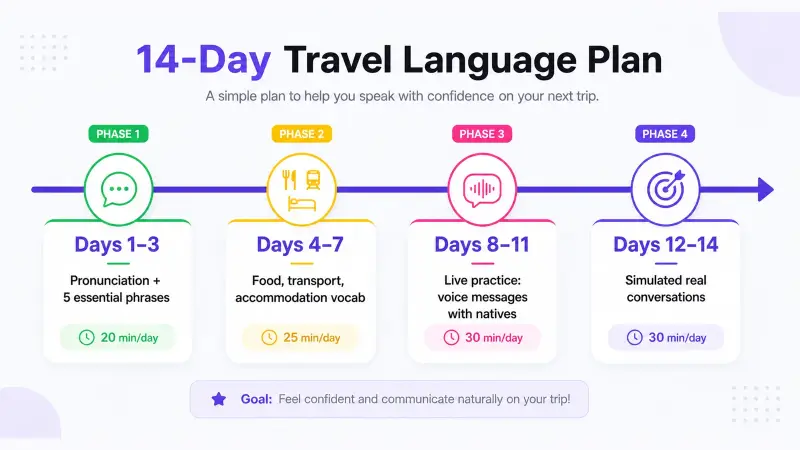
Regardless of which language you pick, this 14-day framework gets most travelers to functional survival status before they fly.
| Days | Focus | Daily Time |
|---|---|---|
| 1–3 | Pronunciation basics + the 5 essential phrases | 20 min |
| 4–7 | Food, transport, and accommodation vocabulary | 25 min |
| 8–11 | Live practice: send voice messages to native speakers | 30 min |
| 12–14 | Simulated real conversations, handle the unexpected | 30 min |
The hardest part isn't the vocabulary. It's getting actual speaking reps in before you land. Most people do all the prep in their head and then freeze on arrival.
Apps like HelloTalk let you find native speakers in your destination city before you fly. By the time you land, you already know real people there. You've heard the accent. You've heard how they actually order at a café. The gap between "studied it" and "can use it" shrinks dramatically.
How to Find Locals for Speaking Practice Before You Travel
Getting real speaking practice before your trip doesn't require a language school or a tutor. Three steps that work:
- Use interest-based matching: connect with native speakers who share a hobby or interest, travel planning, food, music. Shared topics make the conversation sustainable for weeks, not just one awkward exchange.
- Practice with voice messages first: text chat, then voice messages, then live call. Each step feels significantly easier than jumping straight to a video call. Voice messages in particular let you think before you speak, replay what they said, and build confidence at your own pace.
- Ask specific questions about your destination: "What do locals always order at breakfast in your city?" gets a far more useful response than "Let's practice Spanish" — and it's genuinely interesting for your partner too.
For the research behind how long each language actually takes and why some compress faster than others, check fast language learning timelines.
Whether you use HelloTalk or any other language exchange platform, the key is getting asynchronous speaking practice in before you land, not just passive vocab review.
What About Harder Languages Like Thai or Japanese?
The 7 languages above are all Indo-European, which gives English speakers a structural head start. But plenty of popular travel destinations use languages with more distance from English.
Thai and Japanese are genuinely more demanding: new scripts, tonal or pitch-accent systems, and grammar that works very differently from English. That said, they're not impossible for travel purposes. You just need more time and more realistic expectations.
For Thai specifically, an 8-week plan for learning Thai shows what realistic progress looks like, useful if you're heading to Thailand and want to do more than smile and point.
The same survival-pack logic applies: even 2 weeks of focused effort on a harder language gets you the phrases that matter most, and locals appreciate the attempt more than you'd expect.
FAQ
Q1: What's the easiest language to learn for an English speaker?
For English speakers, Spanish is consistently ranked the easiest to reach travel-ready in. The phonetic writing system, vast cognate vocabulary, and widespread travel use make it the highest ROI choice for most people. Italian and Portuguese follow closely, particularly for Europe and Latin America travel.
Q2: Can I really learn a language for travel in just 2 weeks?
For survival-level travel use, ordering food, asking directions, basic greetings, yes: 2 weeks is realistic for Spanish, Italian, or Portuguese with 20–30 minutes of focused daily practice. You won't hold deep conversations, but you'll handle the moments that matter most.
Q3: Should I learn the local language or just rely on English?
In most major tourist destinations, you can get by on English. But even a few phrases in the local language changes the quality of your experience. People smile differently, recommend places they'd never tell obvious tourists about, and treat you as a guest rather than a visitor. The effort signals respect, and that matters everywhere.
Q4: Which language should I learn first if I've never studied any foreign language?
Start with Spanish. Three reasons: first, the phonetic spelling means you pronounce words almost exactly as they're written, which removes a major barrier for first-time language learners. Second, the cognate overlap with English is enormous — words like "hotel," "restaurant," "información," and hundreds more are recognizable from day one, so your vocabulary builds faster than it feels. Third, Spanish is the most geographically useful language for travel, covering 20+ countries across three continents. If you later want to add French, Italian, or Portuguese, your Spanish foundation transfers — verb structures, gendered nouns, and pronunciation patterns overlap significantly. First-time learners who start with Spanish build confidence quickly, which makes them more likely to stick with language learning long enough to reach usable fluency.
Q5: Can I learn enough travel language to get by using only a free app?
Yes, for survival-level travel use. Free tools can cover the core vocabulary you need: greetings, food ordering, numbers, directions, and basic questions. The limitation of most free apps is that they teach vocabulary in isolation rather than conversation — you learn words, but not how native speakers actually string them together. The gap shows up when you use a textbook phrase and get a response at natural speed that you can't follow. Apps like HelloTalk add the missing element: free access to native speakers who respond the way they'd actually talk, in real conversation rhythm. For travel purposes, combining a free vocabulary app with a language exchange app gives you both the words and the realistic conversational exposure, all without paying for a course.
Q6: If I'm traveling through multiple European countries, which language helps the most?
French and Spanish together cover an enormous share of continental Europe and are the two strongest choices for multi-country travel. French is an official or widely spoken language in France, Belgium, Switzerland, Luxembourg, and Monaco, and remains a useful second language across much of North Africa if your route extends there. Spanish covers Spain and is widely understood in parts of Latin America if your trip extends west. For Eastern Europe, neither helps much — local languages dominate and English is more useful there than any other foreign language. If you can only pick one language for a broad European trip, French edges out Spanish for pure continental coverage. If your trip includes the Iberian Peninsula or Latin America, Spanish is the stronger investment.
Start with One Language, One Trip
Pick the language for your next destination and spend 14 days on the framework above. Two weeks isn't fluency, but it's enough to navigate, find the best local lunch spot, and have at least one real conversation that didn't come from a phrasebook.
Open HelloTalk and match with someone in your destination city today. Send them one message: "I'm visiting [city] next month — what's the one thing locals always eat that tourists miss?" That's your first lesson, and Day 1 has already started.