How to Learn English Language Quickly for Work: A 90-Day Plan for Non-Native Professionals
You passed the TOEFL. You scored high on the reading section. You understand your manager's emails without a dictionary. But the moment a client asks an unexpected question on a Zoom call, your mind goes blank: you know the words, but they won't come out.
If you've been wondering how to learn the English language quickly specifically for professional use, the answer isn't more vocabulary drills. It's a different kind of practice entirely. For context on real timelines for learning a language for work, professional speaking fluency takes 3–6 months of the right practice, not 3–6 years of more study.
This 90-day plan is built around the specific skills work English demands: fast retrieval under pressure, professional register, and real-time thinking in English. It's structured for people with full-time jobs, 30 to 60 minutes a day, not hours in a classroom.
Why Work English Is a Different Skill (Not a Vocab Problem)
Most non-native professionals who struggle in meetings aren't vocabulary-deficient. They're undertrained in a different set of skills. Work English differs from academic English in four specific ways:
- Speed: Meetings don't wait. You have seconds to retrieve a word, form a sentence, and respond before the conversation moves on.
- Uncertainty: Real conversations go off-script. Role-play apps prepare you for predictable dialogues; real meetings don't follow a script.
- Professional register: Knowing "discuss" is different from knowing when to use "circle back," "take this offline," or "let's table that." Register is absorbed from exposure, not vocabulary lists.
- Multi-party dynamics: Following three people speaking simultaneously, tracking who said what, and inserting yourself at the right moment are skills that only real conversation practice builds.
The gap isn't knowledge. It's what researchers call production under pressure: the ability to activate vocabulary you already know, under real-time social conditions, without freezing.
The 90-Day Framework to Learn English Fast for Work
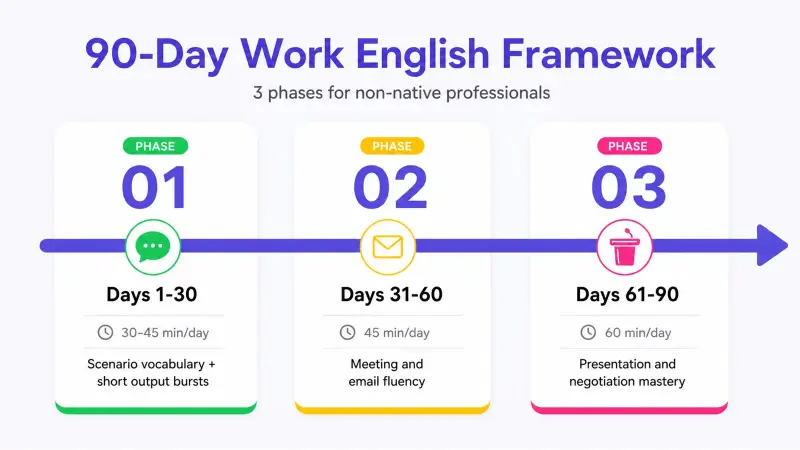
This plan runs in three phases, each building on the previous one:
| Phase | Days | Daily Time | Goal |
|---|---|---|---|
| 1 | 1–30 | 30–45 min | Scenario vocabulary + short output bursts |
| 2 | 31–60 | 45 min | Meeting and email fluency |
| 3 | 61–90 | 60 min | Presentation and negotiation |
The goal isn't to cover everything in 90 days. It's to rewire your production habits around the specific scenarios your job involves. That's what "learning English quickly for work" actually means in practice.
Days 1–30: Building Scenario Vocabulary the Fast Way
Before you can speak fluently in meetings, you need vocabulary that fires quickly in context, not vocabulary you recognize when reading but can't access mid-sentence under pressure.
Four core scenarios to focus on in the first 30 days:
- Meeting phrases: "Could you elaborate on that?" / "I see your point, but..." / "Let me confirm I understood correctly." Practice these as full chunks, not isolated words.
- Email templates: Professional email register is learnable quickly. Focus on openings, requests, and closings: "I wanted to follow up on..." / "Please let me know if..." / "Looking forward to hearing from you."
- Small talk patterns: The 5 minutes before and after meetings. "How's the project going?" / "Did you catch the announcement?" These sound trivial but they're where professional relationships actually form.
- Phone and negotiation basics: "Can I put you on hold for a moment?" / "I'd like to propose..." / "Let's find a solution that works for both sides."
Spend 10 minutes a day drilling these in context, not flashcards, but complete sentences spoken out loud. Record yourself. Listen back. The gap between how you think you sound and how you actually sound is where most early progress lives.
Days 31–60: Reaching Meeting and Email Fluency
This is the phase where passive knowledge becomes active output. The vocabulary from Phase 1 now needs to come out at real-world speed, in real conversations.
Finding practice partners who share your professional background is the single thing that compresses this phase the most. Apps like HelloTalk let you browse language partner profiles by their listed profession, so you can connect with software engineers in São Paulo, marketing managers in Berlin, or lawyers in Madrid. Practice conversations where vocabulary overlaps with your actual job land differently from generic business English drills.
For building meeting fluency:
- Shadow real meetings: Find recordings of business English meetings on YouTube. Shadow the responses, not just the presentations — the back-and-forth is what you need to practice.
- Simulate your actual meetings: Take a real agenda from last week and practice how you would have responded to each point. Record it. Compare to what you actually said.
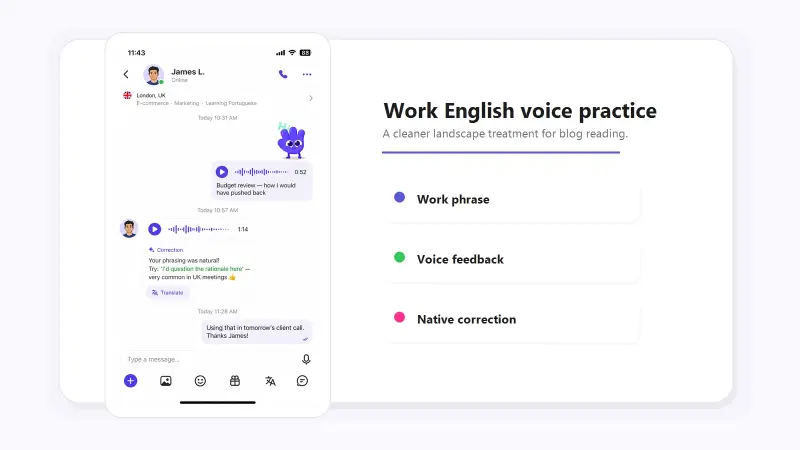
- Use voice messages for daily practice: Five voice messages per day, each one answering a different meeting question, compound faster than weekly tutoring sessions.
For professional writing, the best apps for industry-specific English practice covers tools that specialize in professional communication and provide writing feedback, worth adding during this phase.
Days 61–90: Presentation and Negotiation Mastery
By Day 61, you should be able to participate in meetings without long pauses. Phase 3 targets the two highest-stakes scenarios: presenting to an audience and negotiating with counterparts.
Three practice types for this phase:
- Record and review: Give a 2-minute work presentation on camera. Watch it back, not for pronunciation, but for structure and register. "Does this sound like what I'd say in a real meeting?"
- Debate practice: Find a language partner and argue both sides of a professional decision. The skill of holding a position in English under mild pressure is what makes negotiation feel natural.
- Simulate high-stakes scenarios: Practice the specific situations you dread. Salary negotiation. Delivering bad news to a client. Presenting to senior leadership. Name the scenario, script the key phrases, then practice until the script disappears.
4 Daily Habits That Compound Over 90 Days
The plan above works only if the daily habits stick. These four are the minimum viable routine:
- Morning voice memos (10 min, commute): Speak in English about what you're going to do today, your schedule, priorities, main concerns. This activates English production before the workday starts.
- Lunch break shadowing (10 min): Pick one 2-minute clip of professional English. Shadow it, matching rhythm and intonation, not just words.
- Email rewriting practice (10 min): Take one email you sent or received in your native language and rewrite it in English. Focus on register, not just translation.
- Weekly conversation with a native speaker partner: One 30-minute session per week with someone in your field. This is your quality check — where you discover the gaps self-study is missing.
How to Practice English Fast Without a Native-Speaker Coworker
Not everyone works in an international team. If your daily environment is entirely in your native language, you need to create English output opportunities from scratch.
Three approaches that work:
- English-only voice journaling: At the end of each day, record a 5-minute English summary of what happened. No notes, no script. This forces retrieval under low stakes, training for high-stakes meeting moments.
- Professional language exchange: Find someone in your field who speaks English natively and wants to learn your language. The mutual exchange format is sustainable, both parties have equal motivation to keep showing up.
- Watch your industry, not general English: Find English YouTube channels or podcasts in your specific field, not general TV shows. The vocabulary that appears repeatedly is exactly what your brain needs to automate.
Understanding why studying for years doesn't lead to speaking helps reframe the actual problem. It's not a knowledge gap. It's a production habit gap. The fix is output, not more input.
Apps like HelloTalk make the professional language exchange approach practical day-to-day: browse partner profiles to find people in your field, use voice messages for async practice when schedules don't overlap, and access native speaker corrections directly in the chat. Whether you use HelloTalk or another platform, the mechanism is the same: regular output with real people, in your professional context, with feedback.
Common Pitfalls That Slow Down Your English Progress
Most people who spend years "learning English" without reaching professional fluency are caught in the same patterns:
- Input without output: Watching English videos and calling it practice. Your brain processes input differently from production — one doesn't train the other.
- Practicing only what you're already comfortable with: If emails come easily, spending practice time on email doesn't move you forward. Practice the scenarios that make you nervous.
- Waiting for perfect before speaking: The perfection trap means you keep "preparing to speak" without actually speaking. Fluency comes from spoken errors and corrections, not from more preparation.
- Generic practice instead of work-specific practice: General English exercises don't prepare you for a client call in your industry. Every minute of practice not tied to your specific job scenarios is lower-ROI than it looks.
A Real Learner's Journey
Sofia is a marketing manager in São Paulo who scored in the 87th percentile on the TOEFL and still stumbled over every sentence on international team calls.
She spent Days 1–30 on meeting phrases and email templates for marketing. She shadowed 10 minutes of marketing-specific English every morning during her commute.
In Days 31–60, she found a native English-speaking marketing professional through a language exchange platform, someone working in e-commerce in London who wanted to learn Portuguese. They spoke for 30 minutes every Friday. The other six days, Sofia sent voice messages about her work week: what was discussed, what she struggled to say, how she actually said it.
By Day 61, Sofia was contributing to international team calls without drafting sentences in advance. By Day 90, she led her first external client presentation in English and got through it without a single long pause.
The change wasn't vocabulary. It was production under pressure, trained by weeks of low-stakes output that prepared her for high-stakes moments.
FAQ
Q1: Can I really learn English fast enough for work in 90 days?
Professionally functional, yes. You won't reach the level of someone who grew up speaking English, but you can reach confident meeting participation, clear professional writing, and the ability to handle unexpected questions without freezing. Check how long it actually takes to learn a language for context on what different investment levels realistically produce.
Q2: How many hours per day do I need to practice English for work?
30–45 minutes of focused, output-oriented practice daily is more effective than occasional 2-hour sessions. Consistency matters more than volume — your brain automates patterns through repeated activation, not through cramming.
Q3: Should I use AI or real native speakers to practice?
Both, in the right order. AI conversation partners are excellent for low-stakes warmup, removing social pressure and getting your speaking muscles activated. Real native speakers are irreplaceable for authentic register, unpredictable responses, and feedback that reflects how you'd actually land in a professional setting. Use AI daily; schedule real speaker sessions weekly.
Q4: Is business English the same as professional English for tech or finance?
No, and the difference matters in practice. "Business English" is a broad category covering general meeting language, email conventions, and professional small talk. Tech English, finance English, legal English, and medical English each have distinct vocabulary, register expectations, and communication norms layered on top. A finance professional using generic business English phrasing in a client meeting sounds competent but not native to the industry — phrases like "runway," "burn rate," or "covenant compliance" carry weight that generic business courses never cover. The fastest path to field-specific fluency is exposure to authentic conversations in your domain: listening to earnings calls, joining professional forums, or practicing with a partner in the same field. Language exchange platforms that let you filter partners by profession make this kind of targeted practice accessible without paying for specialist courses.
Q5: How do I know if my work English is actually improving?
Three reliable signals: first, you stop mentally translating before speaking — you reach for English words directly, without routing through your native language. Second, you can handle unexpected questions in meetings without the "please repeat that" panic — you buy time naturally, the way native speakers do ("That's a good point, let me think for a second"). Third, colleagues start treating your English as a given rather than something they accommodate. These shifts happen in different orders for different people, but all three should be visible within 60–90 days of consistent output practice. If none of them appear after 90 days, the practice is likely too passive — more listening and reading than speaking and writing.
Q6: Can I improve my work English if I don't have any English-speaking coworkers?
Yes. The absence of English coworkers removes incidental exposure, but it doesn't remove the ability to practice actively. The key is replacing informal workplace English with structured substitutes: email correspondence with international contacts, participation in industry forums where English is the default, and scheduled conversation practice with native-speaking partners. Apps like HelloTalk let you find English-speaking professionals in your industry for language exchange — they get practice in your language, you get authentic work-context English from someone who speaks it natively. Twenty minutes of that exchange three times a week produces more measurable improvement than passively absorbing English in an office environment where most colleagues share your native language anyway.
Open HelloTalk, browse partner profiles in your field, and find your first practice partner today. Send them one voice message about your job — just describe what you do in English, 30 seconds. That's the first rep of 90 days.