Should You Learn Japanese? An Honest 2026 Guide Before You Commit
It starts with something small. Maybe it was an anime you couldn't stop watching, or a video game that made you wish you could read the original text. Maybe you visited Japan once and something about the country got under your skin — the food, the people, the way everything felt both unfamiliar and oddly welcoming. Maybe you're dating someone Japanese, or you have a colleague you'd love to actually talk to, not through Google Translate. If you've already made the decision and just need people to practice with, HelloTalk connects you with Japanese native speakers ready for real conversation.
Whatever the starting point, there's usually a gap between "I love everything about Japan" and "I'm actually going to learn Japanese." That gap is filled with a question most people circle for months without quite landing: should I actually do this?
This isn't a hype piece about how Japanese will change your life. It's an honest guide to what you're getting into — the real difficulty, the real rewards, and how to know whether this language is genuinely the right fit for you right now.
The Honest Truth About Japanese Difficulty
Let's get this out of the way upfront, because you deserve a straight answer: Japanese is hard. Genuinely hard.
The US Foreign Service Institute ranks Japanese as a Category IV language — their most difficult category — for English speakers. That's the same tier as Mandarin, Arabic, and Korean. The reasons aren't mysterious.
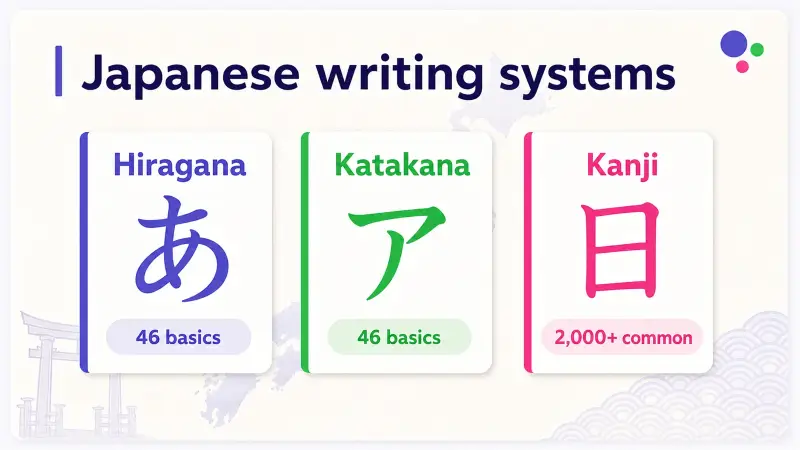
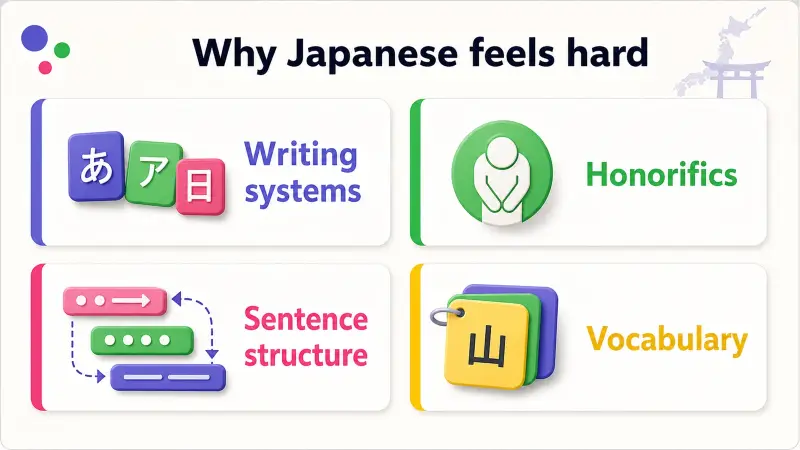
Three writing systems
Japanese uses three scripts, often in the same sentence. Hiragana and katakana are phonetic syllabaries (46 characters each) that most learners can pick up in a few weeks. Then there's kanji — Chinese-derived characters, each with multiple readings — and the standard literacy benchmark is around 2,000 kanji. That's a lot of memorization, spread over years of study.
Honorific levels and register
Japanese has a complex system of speech levels that change depending on who you're talking to — a boss, a friend, a stranger, a customer. The grammar shifts. The vocabulary shifts. What you say to a close friend in casual conversation is often completely different from what you'd say in a professional context. Learning Japanese means learning multiple registers of the language, not just one.
Sentence structure is inverted
Japanese is a subject-object-verb language, which means the verb comes at the end of the sentence. For English speakers, this requires actively rewiring how you construct thoughts. It gets natural with time — but it takes time.
Here's the honest reframe though: difficulty is not the same as impossibility. Millions of non-native speakers have learned Japanese to fluency. The path is demanding, but it's well-worn. Consistency over time matters far more than natural talent.
Why People Who Stick With Japanese Say It's Worth It
For learners who do commit, Japanese tends to generate a specific kind of devotion that's hard to explain to people who haven't experienced it. Here's what they usually point to.
Cultural depth that doesn't translate
Japan has produced an extraordinary range of literature, cinema, art, and popular culture. But a lot of it loses something in translation — the wordplay, the register shifts, the cultural subtext. Reading manga in the original Japanese, watching films without subtitles, understanding what a character actually said versus what the translation approximates — these are experiences that genuinely can't be replicated any other way.
Career in a unique industry
For people working in or aiming for the anime, gaming, manga, or entertainment industries — or for professionals seeking to work in Japan — Japanese fluency is a meaningful credential. Japan remains a major economy with deep creative and tech industries, and Japanese-speaking professionals are consistently in demand in specific sectors.
The study itself has depth
This sounds abstract, but many Japanese learners describe the process of learning the language as one of the most intellectually engaging things they've ever done. The writing systems, the grammar, the cultural logic embedded in the language — it's genuinely interesting to study, even when it's hard. For people who enjoy depth and complexity, Japanese delivers both.
The payoff is real and specific
There's a particular moment that Japanese learners describe — the first time you read a sentence in a manga without looking anything up, or the first time you understand a full exchange in a Japanese film. It's not just satisfying in the abstract. It's the direct product of everything you put in, made visible. That feedback loop is powerful.
What a Realistic Learning Timeline Actually Looks Like
No point softening this: Japanese takes a long time.
The FSI estimates approximately 2,200 hours of study to reach professional working proficiency in Japanese for English speakers. Compared to Spanish's ~600 hours, that's a significant difference.
What does that look like in practice?
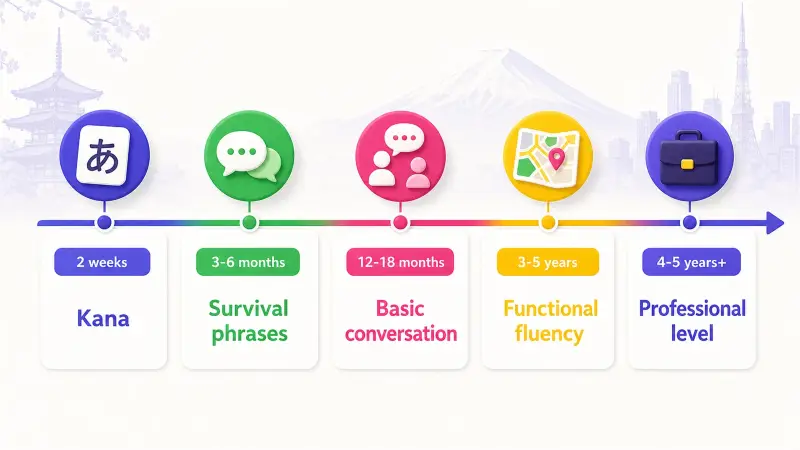
- 3-6 months of daily study: You'll have hiragana and katakana solid, basic sentence structure, and survival-level conversational Japanese
- 12-18 months of serious daily effort: You'll be able to hold basic conversations, read simple texts, and follow some spoken Japanese with context
- 3-5 years of consistent practice: Functional fluency — able to navigate daily life in Japan, read news, watch TV with some effort
- 5+ years: Comfort and confidence across contexts
| Milestone | What it looks like | Approximate time (1hr/day) |
|---|---|---|
| Hiragana & Katakana | Read menus, signage | 2-4 weeks |
| Basic conversations | Greet, introduce yourself, order food | 3-6 months |
| Casual daily conversation | Chat with friends, follow simple shows | 12-18 months |
| Comfortable TV watching | Follow dramas without subtitles | 2-3 years |
| Professional working level | Meetings, writing reports | 4+ years |
"Progress" in Japanese feels different than it does in easier languages. The early months can feel slow because there's so much foundational work to do before you can do anything with it. Most learners hit a wall around months 3-6 where the novelty wears off and the grind sets in. The people who make it through that wall are the ones who had something real pulling them forward — a trip planned, a relationship, a genuine love of the culture.
This is not meant to discourage you. It's meant to help you go in with eyes open, which is the only way to actually succeed.
Who Japanese Suits Best
-
Pop culture enthusiasts with a genuine love of anime, manga, gaming, or Japanese music will find that their existing passion provides the motivation that carries them through the hard stretches. When your hobby and your study overlap, the hours don't feel like hours.
-
People planning to live or work in Japan have the clearest practical argument. If you're going to be there, you need the language. Full stop. And having a concrete use case — a move date, a job offer, a partner's family — is one of the most powerful motivators in language learning.
-
Patient learners who value depth over speed tend to thrive with Japanese. If you're someone who enjoys process, who likes going deep on something complex, who doesn't need quick external validation to stay engaged — Japanese will reward that temperament.
-
People with Japanese in their personal lives — a partner, close friends, family ties — have a built-in reason to practice that no app or classroom can replicate. Relationship-driven motivation is some of the most durable motivation there is.
Who Might Think Twice
This isn't about telling anyone not to learn Japanese. It's about being honest that the fit matters.
If you're primarily career-motivated without a specific Japan connection, Mandarin may be a more strategically practical choice. China's economic footprint is broader, the speaker base is larger, and if your goal is simply to maximize professional leverage in Asia, Mandarin often wins that calculation. Japanese is worth learning for the right reasons — but "it seems useful" alone may not carry you through 2,200 hours.
If you want quick wins and early conversational ability, Japanese will frustrate you. The early stages are foundation-heavy and slow. There's no shortcut through the writing systems. If rapid progress and early fluency are important to your motivation, a language like Spanish — genuinely one of the easiest languages to learn for English speakers — might give you a better experience, at least for a first language.
If you're drawn to Japanese purely by aesthetics or a passing trend, it's worth waiting until the feeling deepens into something more durable before investing years of effort. The learners who make it are the ones who feel pulled, not just interested.
There's no shame in any of this. Choosing the right language for the right reasons is how you end up actually learning it. If you're still exploring your options, the best languages to learn guide is a good place to think through the full picture.
How HelloTalk Helps Once You've Committed
Once you've decided Japanese is your language, the most important thing you can do — after getting your foundations solid — is practice with real Japanese speakers. Not voice actors on a tape. Not a chatbot. Actual native speakers having actual conversations.
This is the gap that kills most language learners' progress, and it's also the gap HelloTalk is built to close. HelloTalk's 70 million+ user community includes a large, active Japanese user base — students, working adults, and language enthusiasts who want to practice their English while you practice your Japanese. The exchange is mutual, which means conversations feel genuine rather than like a service transaction.
Take Marcus, a game developer in Berlin who had studied Japanese solo for a year using textbooks and apps. He could parse grammar exercises fine but froze every time he tried to type a real message. He started posting short journal entries in Japanese on HelloTalk's Moments feed — within days, two native speakers had corrected his phrasing and replied in kind. Those corrections, grounded in real context, moved him faster in two weeks than months of structured drills had.
Practically, this means you can post in Japanese on Moments and have native speakers correct your writing in real time, drop into Voicerooms where Japanese conversations are happening right now, and use HelloTalk's inline correction feature to get specific feedback mid-conversation. Japan consistently ranks among HelloTalk's most active language communities — which means finding a practice partner is a matter of minutes, not weeks. And with 90% of features free, the barrier to starting is low.
For a practical overview of which tools and resources actually work for Japanese beginners, What learning resources should Japanese beginners choose? tests 20+ options with honest assessments — especially useful given how fragmented the Japanese learning ecosystem is across writing systems, listening tools, and speaking practice.
Frequently Asked Questions
Is Japanese the hardest language for English speakers?
By official US government benchmarks, yes — Japanese is one of four languages the FSI classifies as Category IV, their most difficult tier. The combination of three writing systems, inverted sentence structure, and complex honorific registers makes it uniquely demanding. That said, millions of people have learned it, and the difficulty is manageable with a clear plan and consistent effort.
How long does it really take to learn Japanese?
The FSI estimates around 2,200 study hours to reach professional working proficiency. At one hour per day, that's roughly six years. Most learners reach basic conversational ability — enough to navigate daily life in Japan — within 18 months to 2 years of consistent daily practice. The timeline varies widely based on how much time you invest and whether you practice with real speakers.
Should I learn hiragana before starting to speak?
Yes, and it won't take long — most learners can learn both hiragana and katakana within two to four weeks. Having the phonetic scripts solid before you start speaking prevents you from developing bad pronunciation habits based on romanized Japanese (romaji). Think of it as a small, one-time investment that pays off for the entire rest of your learning.
Do I need to learn all 2,000 kanji to be conversational?
No. Basic conversation relies primarily on hiragana, katakana, and a few hundred common kanji. You can hold everyday spoken conversations with minimal kanji knowledge. The 2,000 kanji benchmark refers to functional literacy — reading newspapers, books, and professional documents — which is a later-stage goal. Don't let the full kanji list intimidate you at the start.
Is Japanese useful outside of Japan?
More than most people realize. Japan has one of the world's largest economies, and Japanese is widely used in the anime, gaming, manga, and tech industries globally. Japanese-speaking professionals are in consistent demand in translation, localization, international business, and tourism sectors worldwide. Japanese communities exist in many major cities — particularly in the US, Brazil, and Australia — meaning the language has practical reach beyond Japan's borders.
What's the best way to practice Japanese speaking with real people?
Language exchange is the most effective and accessible method. Finding a Japanese native speaker who wants to practice English creates a natural, mutual conversation environment. Apps like HelloTalk connect you with real Japanese speakers globally for this purpose, with features like Voicerooms for live conversation and Moments for written practice with native corrections. Consistency matters more than method — even short daily exchanges compound significantly over time.
So, Should You Learn Japanese?
If you've read this far, you probably already know your answer.
If you felt your motivation deepen as you read — if the difficulty made it feel more worthwhile rather than more daunting — Japanese is likely the right call for you. The people who succeed with this language are almost always the ones who wanted it for reasons that went deeper than convenience.
If you felt the timeline and complexity pull your enthusiasm down, that's useful information too. There's no wrong answer here, only honest ones.
For those who are ready: the learning starts now, and the people to practice with are already waiting.
Join HelloTalk free and start connecting with Japanese native speakers today.