The Best Ways to Learn a Language in 2026: What the Research Actually Says

Search for the best way to learn a language and you get a fight. App people say apps. Textbook people say textbooks. Someone always shows up to say that children learn without grammar, so we should too.
The argument is mostly about the wrong variable. The strongest predictor of whether someone reaches conversational level is not which method they picked, but how many hours of spaced, spoken, corrected practice they accumulated. Method matters, but it matters as a way of producing those hours efficiently, not as a magic key.
So let's look at what each method actually buys you, with real numbers attached.
Start with the hour count, not the method
Before comparing tools, it helps to know the size of the job.
On the Cambridge scale of guided learning hours, reaching B1 (holding a conversation about familiar topics) takes roughly 350 to 400 hours, and B2 takes 500 to 600. Those are structured hours with guidance, not minutes of tapping through a streak.
The US Foreign Service Institute, which has trained diplomats since 1947, puts French, Spanish and Italian at roughly 600 to 750 class hours to reach professional working proficiency, German at around 900, and Arabic at around 2,200. Those figures assume full-time classroom study with teachers, so they are a ceiling estimate rather than a promise. But the ratio between languages is useful: your target language sets the size of the bill before you choose how to pay it.
Divide 350 hours by 30 minutes a day and you get about two years. Divide it by 90 minutes a day and you get about eight months. That single division explains most of the difference between people who get there and people who quit.
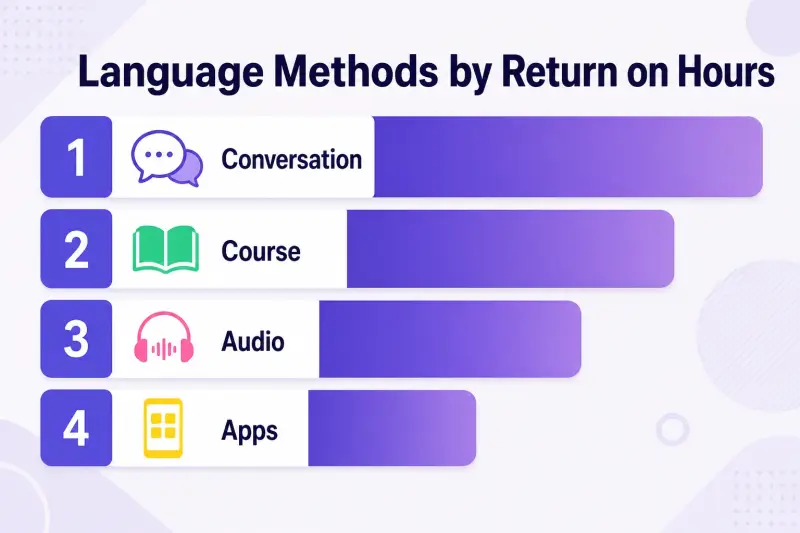
The methods, ranked by return on the hours you put in
The ranking below measures what each method trains per hour and the limitation that appears when it is used alone. It is not a claim that one method should replace every other part of a learning plan.
| Method | What it actually trains | When you feel the effect | What it cannot do alone |
|---|---|---|---|
| Language exchange with native speakers | Retrieval under time pressure, listening to real speech, correction on your own mistakes | Week 1 for confidence, week 4-6 for fluency of delivery | Give you the starting vocabulary if you have none |
| Audio courses (listen and respond) | Pronunciation, sentence patterns, speaking reflex | 2-3 weeks of daily 30-minute sessions | Take you past intermediate, or teach reading |
| Spaced review (flashcards, review apps) | Long-term retention of words and phrases | 3-4 weeks, and it compounds | Teach you to use the words in real time |
| Gamified apps | Streak habit, first few hundred words, basic patterns | Days, which is why they feel good early | Produce spontaneous speech or handle correction |
| Structured course or textbook | Grammar sequencing so you are not guessing what to learn next | 4-8 weeks | Give you speaking hours |
| Passive input (shows, podcasts, music) | Listening comprehension, rhythm, vocabulary in context | 2-3 months at high volume | Work efficiently on its own at beginner level |
Two of the rows deserve the numbers behind them.
A 2022 meta-analysis pooling 98 effect sizes from 48 experiments with 3,411 learners found that spacing your review across days produced better retention than cramming the same material in one sitting. This is the least glamorous item on the list and the one that most reliably pays. Ten minutes of review a day, spread out, beats a two-hour Sunday session.
Picking up a new word from context alone typically requires 8 to 10 separate encounters with it, which is the honest explanation for why watching shows in your target language feels productive but moves slowly at the start. It works beautifully once you already have a few thousand words. It is a poor first tool.
For a deeper look at how the input-heavy approach compares with a syllabus-driven one, we broke that specific debate down in our guide to immersion versus structured learning for language learners.
The combination that actually works
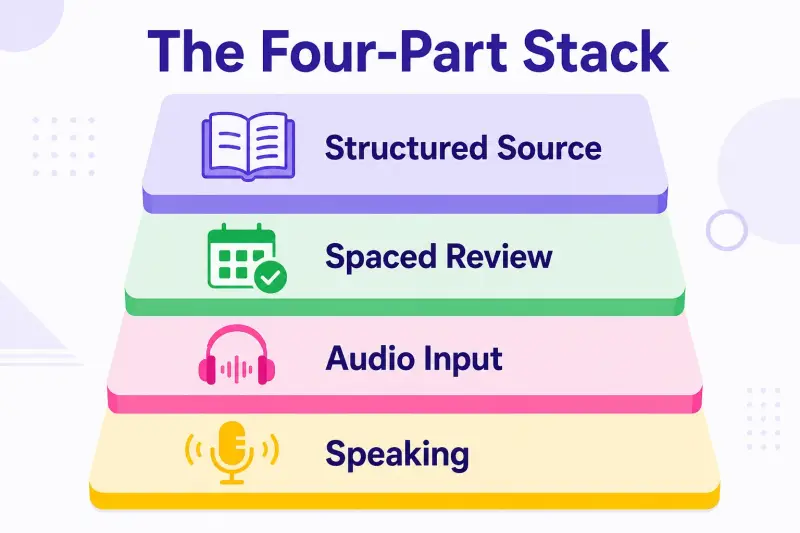
Learners who reach comfortable conversation consistently use some version of the same four-part stack. The proportions shift, the four parts do not.
- A source of new material (a course, a textbook, or an app) so you are never sitting there wondering what to study.
- Spaced review of whatever that source gave you, ten to fifteen minutes daily.
- Audio input at or slightly above your level, for ears and rhythm.
- Speaking with actual people, from week one, badly, on purpose.
The fourth item is where most self-study plans quietly fail. Reading and tapping are comfortable. Producing a sentence while a human waits for it is not. Speaking practice is the only part of the stack that trains retrieval under time pressure, and it is the component most learners postpone until they feel ready, which is a state that never arrives on its own.
If you want the three main method families compared head to head, see our breakdown of Duolingo, Pimsleur and language exchange as competing methods.
Where the practice partner comes in
This is the part the HelloTalk platform supports directly. HelloTalk has 70M+ registered users across 200+ countries studying 260+ languages, and the traffic across the platform runs to over 1 billion messages daily. That volume is the reason the fourth item in the stack stops being a scheduling problem.
Four things do the work:
Chat-based learning. You text a native speaker, and translation, phonetic transcription and read-aloud sit inside the same message thread. Tap a word you did not catch, hear it, see how it is written, keep going. Real-time grammar correction flags your errors while the conversation is still live, so you are not learning a mistake for three weeks before someone points it out.
Moments. Post two sentences about your day in the language you are learning, publicly. Several native speakers correct the same post, which shows you the range of natural options rather than one teacher's preference. Scrolling other people's Moments is also the cheapest window into how the language sounds when nobody is teaching.
Voicerooms and Livestreams. Voice rooms run around the clock, and you can enter as a listener and say nothing. That matters more than it sounds: the first ten hours of listening to native speakers talk to each other builds ear comfort with zero performance pressure. Livestream mini-lessons add structure when you want a topic rather than a free-for-all.
AI learning tools. AI pronunciation scoring tells you which sound you are missing instead of giving you a number. AI grammar correction explains the fix, in the moment. Image translation handles the menu, the sign, the packaging photo. 90% of HelloTalk's core features are free, which matters when your plan needs to survive twelve months, not two weeks.
Common mistakes that repeat
- Collecting methods instead of hours. Four apps, no schedule. Pick two tools and a time slot.
- Waiting to speak. The vocabulary threshold people set for themselves before their first conversation is usually about ten times higher than necessary. Two hundred words is enough to talk badly for fifteen minutes.
- Reviewing only new material. New content feels like progress; review is what keeps it.
- Choosing a method that does not fit the goal. Travel in six weeks and passing a written exam are different jobs. We mapped that out in how to choose a language learning method for your specific goal.
- Ignoring the language's difficulty tier. Expecting Spanish-speed progress in Arabic will end your motivation by month three.
FAQ
What is the single most effective way to learn a language? Regular conversation with native speakers, supported by spaced review of what comes out of those conversations. No other single activity trains comprehension, production and correction at the same time. It does need a starter vocabulary from some other source first.
How many hours a day should I study? Between 45 and 90 minutes, split across the day, beats a single long block. The Cambridge estimate of 350 to 400 hours for B1 means an hour a day gets you there in roughly a year for a language close to your own.
Are apps like Duolingo useless then? No. They are efficient for building a daily habit and a first few hundred words, and the free tier costs nothing. They stop being enough at the point where you need to produce unscripted speech, which for most learners is somewhere in month two or three.
Can I learn a language purely by watching shows? Not from zero, efficiently. Because a word usually needs 8 to 10 encounters in context to stick, pure input is slow at the beginner stage. From roughly B1 onward it becomes one of the best hours you can spend.
Do I need a tutor, or is a language exchange partner enough? For most goals, an exchange partner plus a structured course covers it. A paid tutor is worth it for exam preparation, professional accuracy, or if you need someone to explain grammar in your own language.
How do I know if my method is working? Record yourself answering the same three questions once a month. Fluency of delivery is easier to hear than to feel. If month three sounds like month one, the missing piece is almost always speaking hours.
Is it too late to start as an adult? No, and adults have an advantage children do not: you can be told a rule and apply it deliberately. What adults lack is unstructured exposure hours, which is exactly the gap conversation practice fills.
Pick your two tools, block the time, and start talking in week one. If you want a native-speaker partner for that fourth piece of the stack, you can start on HelloTalk and have your first conversation today.