Which Two Korean Methods Pair Well, and Which Ones Overlap?

How Many Resources Is Right?
Two. Sometimes three, if one is passive listening you do while commuting. The learners who stall longest usually run four apps that do the same job.
The trap is that resources feel different on the surface while doing identical work underneath. A Korean textbook chapter and a drill app lesson both hand you input and both check whether you recognized it. Stack them and you get twice the input and no evidence you can produce a sentence. That is why HelloTalk sits in both tables below as one row, not a whole stack: it fills output and correction, and leaves ordered input to something else.
So the question is not "which Korean resource is best." It is "what job is unfilled." A survey of what moved the needle over three months lives in this three-month test of Korean resources. This article answers a narrower version: given what you use, what is worth adding second.
The Short List
There are effective resources to learn Korean fast, but only three types earn a place in a stack. Everything else is a variation on one of them.
The first is structured input. A course, textbook, or grammar series that introduces patterns in an order that builds. You need it early because Korean word order and particles do not reveal themselves through exposure alone.
The second is corrected output. You produce Korean, a person or tool tells you what was wrong, and you say it again. Almost every stalled learner has left this job unfilled, because it is the only one that feels uncomfortable. The single most common reason a Korean learner plateaus after six months is that nothing in their study routine ever forces them to produce a sentence that gets corrected.
The third is comprehensible exposure. Dramas, podcasts, variety shows, lyrics. Not for grammar, and not really for vocabulary. It is there so Korean at native speed stops sounding like noise, and so you still open your notes in month four. The same argument aimed at the speaking barrier is in how speaking practice changes Korean progress.
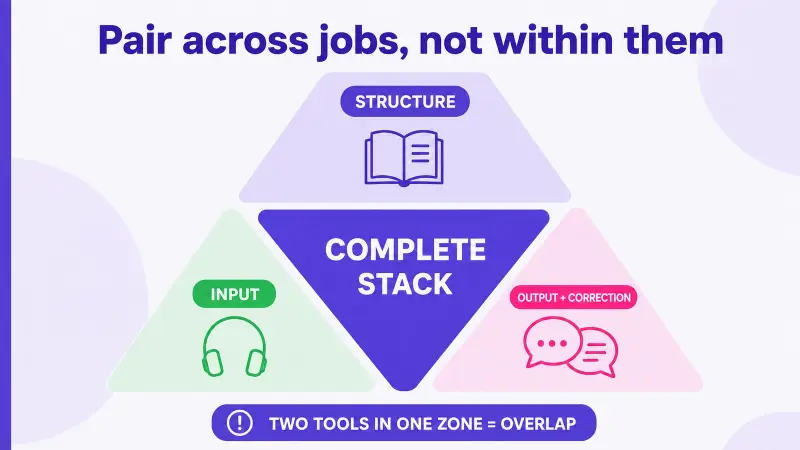
Three jobs. Two resources can cover all three if one covers two, which is why pairing matters more than picking.
What Each Type Covers
Before comparing pairs, see what one resource does alone. The table scores each type against the four jobs a routine has to fill: input, output, correction, and motivation. Read the Correction column first, since most stacks leave it empty.
| Resource type | Input | Output | Correction | Motivation |
|---|---|---|---|---|
| Textbook or structured course | Strong, ordered by difficulty | Written exercises only | Answer key only, not your own sentences | Low after the first weeks |
| Drill and streak apps | Moderate, vocabulary heavy | Tapping and word banks | Right or wrong, no explanation | High early, fades fast |
| Dramas, podcasts, music | Strong but unordered | None | None | Highest of any type |
| Text chat with native speakers | Moderate, real phrasing | Constant, low pressure | Direct, from several people | High when replies come fast |
| Voice calls or voice rooms | Moderate, fast and messy | Heavy, real time | Partial, people rarely stop you | Depends on the partner |
| HelloTalk | Light, no structured grammar course | Strong, text and voice both | Strong, native speakers plus AI explanations | High, replies and rooms run all day |
| AI pronunciation and grammar tools | Light | On demand | Immediate, with explanations | Neutral, no social pull |
| Paid tutor or class | Strong, tailored | Scheduled | Thorough | Tied to the calendar |
Two things fall out. Correction is scarce, and motivation clusters in the row with no output at all, which is why so many people watch plenty of Korean television and still cannot order coffee in it.
The Overlap Map
Now the pairing question. This table takes common two-resource stacks and separates what the second one repeats from what it adds. The middle columns are the point: a big overlap and a thin net-new means two resources doing one resource's work.
| Pairing | Where they overlap | Net new | Who it suits |
|---|---|---|---|
| Textbook + drill app | Ordered input, recognition checks | Vocabulary repetition, little else | Almost nobody past week three |
| Textbook + native speaker chat | Barely anything | Output, correction, live phrasing | Beginners with 30 minutes daily |
| Drill app + dramas | Passive input, vocabulary exposure | Listening speed, motivation | Nobody, both output jobs stay empty |
| Dramas + speaking partner | Vocabulary and phrasing source | Production, correction, reasons to talk | Intermediates who understand more than they say |
| Paid tutor + exchange partner | Correction and speaking time | Volume and unscripted hours | Learners with an exam or move date |
| AI grammar tool + native speaker | Correction of your own sentences | Nuance and tone on top of speed | Anyone whose partner replies slowly |
| Textbook + AI grammar tool | Rule explanations | Feedback on sentences you wrote | Learners too shy to message a person |
| Drill app + HelloTalk | Vocabulary review | Corrected output, voice time, real phrasing | Streak keepers who never speak |
Row three is the one to stare at. A drill app paired with drama watching can produce months of daily study with no corrected output at all, which is why it is the most common stack among people who describe themselves as stuck. The fix is not more hours. It is swapping one half.
Notice the tutor row and the AI row overlap on the same job. The second just buys more of what you already have.
Three Pairings That Work
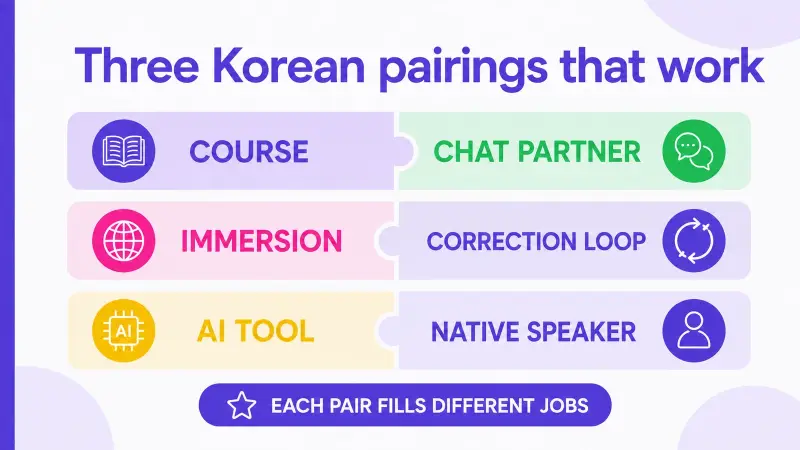
Three combinations cover all four jobs without paying twice for one.
Structured course plus a text chat partner. For the first six months this is hard to beat. The course supplies particles and verb endings in a sane order, and the chat supplies pressure to use them today. HelloTalk's chat carries in-chat translation, romanization, read-aloud audio, and in-chat correction inside the thread, so you can send shaky Korean without leaving the app and still read the reply.
Immersion content plus a correction loop. The intermediate stack, for when the gap is between recognition and production. Take a phrase you heard, write three sentences with it, post them, collect fixes. HelloTalk's Moments feed suits this shape, since one short public post can come back with corrections from several native speakers. Getting the same sentence corrected by three different people surfaces the difference between a rule mistake and a phrasing choice, which a single correction never shows. When typed fixes stop stretching you, HelloTalk's Voicerooms run around the clock and let you listen first, and HelloTalk's Livestreams add short interactive lessons.
AI tools plus people, on the same sentence. These overlap on paper and complement in practice. HelloTalk's AI grammar correction returns an explanation immediately, closing the loop at midnight when nobody answers. HelloTalk's AI pronunciation scoring flags the syllable that came out wrong, which humans politely skip.
HelloTalk reports 70M+ registered users across 200+ countries and keeps 90% of core features free, so the output half does not have to be the expensive half. VIP tiers are regional monthly, yearly, or lifetime options (see in-app quote). The Spanish version of this breakdown sits in this comparison of Spanish learning apps.
Frequently Asked Questions
Can I learn Korean with only one resource? You can start, but not finish. A single resource almost always leaves output or correction unfilled, and those two jobs decide whether you hold a conversation.
Is a textbook still worth it when apps exist? For Korean, usually yes, at least early. Particles and verb endings need explanations in a deliberate order, and most app lessons give them in fragments. Once you build sentences alone, its value drops.
Do dramas actually teach Korean? They teach listening tolerance and keep you interested, which matters over a year. They do not teach production, and subtitle-heavy watching passes for study while nothing gets corrected.
How do I know if two resources overlap too much? Ask what each makes you do, not what it teaches. If both have you recognizing and neither has you producing, they overlap. Two resources that both end with an answer key are one resource.
Should I pay for a tutor and use a language exchange? Only if you want volume. Both fill the same output and correction jobs, so the second adds hours rather than coverage. Free exchange practice plus structured input often gets further.
When should I add a third resource? When all four jobs are filled and one is thin. Adding passive listening to a working pair is low risk. A fourth quiz app is how routines become busywork.
Is AI correction good enough to replace native speakers? For speed and grammar rules, it is close. For tone, register, and whether a sentence sounds natural to someone your age, it is not. The pairing beats either alone.
When One Half Stops Paying Off
Stacks expire. The textbook that carried you through month three starts feeling like reading about Korean instead of using it, and that feeling is usually right.
Whichever half you would be sad to lose is the half still working. If you cannot answer that about a resource, you already know which to cut. Pick the pairing that leaves no job empty and start the output half at HelloTalk.