Moving to a Spanish-Speaking Country in Six Months: Which Practice Comes First?

Landing Day Minus Six Months
A move puts a real date on your Spanish. You are no longer asking how to get good at Spanish in general, you are asking what has to work on the day you walk out of an airport with two suitcases.
Six months is enough, but only in the right order. Most people spend month one on grammar drills and month six panicking about listening. The first thing that breaks abroad is not your sentence construction. It is that someone answers your question at full speed and you catch three words out of eleven.
So the plan below runs as a countdown. Each block has one job, one signal it is done, and a list of things to ignore. General app rankings for a learner with no deadline are in this comparison of Spanish learning apps. This article answers the version with a plane ticket attached.
What to Start With
If you want to start learning Spanish fast before a move, the resources and apps worth your time are the ones that front-load listening. The fifty situations you hit in week one are all things people say to you, not things you say to them.
You say "una habitación para dos noches" perfectly well. Then the receptionist says something about the deposit, the elevator being out, and breakfast until ten, and you have no idea which of those needs an answer. Your output was fine. Your input was the problem.
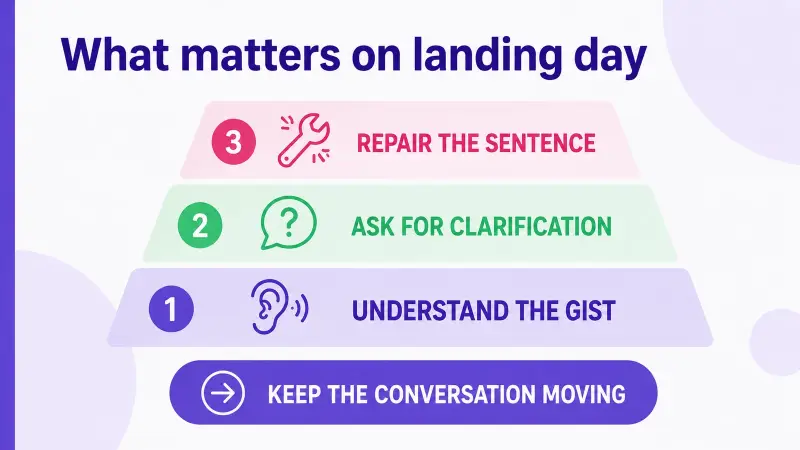
In the first weeks after a move, almost every conversation that goes wrong goes wrong on the listening side, because the other person controls the speed and you do not. So spend six months on resources that put unscripted Spanish speech in your ears daily and give you a way to check what you missed.
That rules things out. Apps that only test recognition through multiple choice train you to spot Spanish, not to survive it.
A language exchange app does something a course cannot here. HelloTalk's Voicerooms run around the clock and you can sit in one as a silent listener for weeks, closer to eavesdropping on a cafe than to a lesson. HelloTalk's in-chat translation, phonetic transcription, and read-aloud playback run on any message inside the chat window, so a voice clip you understood 40% of becomes one you understand fully on the second pass without switching to a dictionary app. A breakdown of which tools get you talking soonest sits in this ranking by time to first real conversation.
Here is the countdown in one place. Read the last column as seriously as the second, because most plans fail from doing too much rather than too little.
| Months left | Practice first | Signal you are done | Do not practice yet |
|---|---|---|---|
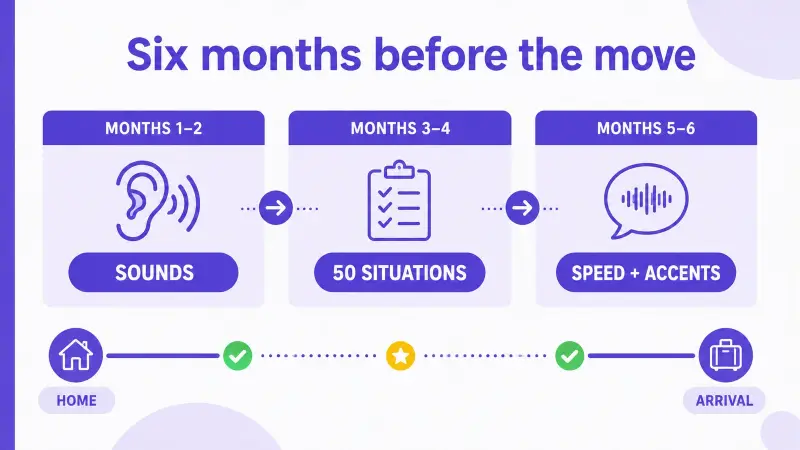
| 6 to 5 | Sounds, rhythm, daily listening, 300 concrete nouns | You repeat a 10-second clip back without reading it | Subjunctive, past tenses, idioms |
| 4 to 3 | Fifty arrival situations, plus numbers and dates | You get through a full role-play without English | Literature, news, essay writing |
| 2 to 1 | Speed, repair phrases, your target country's accent | You survive a 15-minute call without a script | New grammar, new apps, a perfect accent |
| Every month above | HelloTalk, for live partners plus in-chat correction on what you fumbled | A native speaker fixes your line and you reuse it the next day | Using HelloTalk as your syllabus, since it does not sequence grammar or run a graded course |
Months One to Two: Sounds
Start with your mouth and ears, because everything later sits on top of them. Spanish has five clean vowel sounds that never drift the way English vowels do. Fixing them early is cheap. Fixing them in month six is not.
Spend two months on vowel accuracy, the rolled r, and where the stress lands. Say things out loud daily, even badly. Reading Spanish silently for two months builds a vocabulary your mouth has never once produced, which is why so many people arrive able to read menus and unable to order from them.
Pair this with listening you do not fully understand yet. Ten minutes of a podcast where you catch a third beats an hour of beginner audio where you catch everything.
For feedback, HelloTalk's AI pronunciation scoring flags which syllables came out wrong, catching errors you cannot hear in your own voice. Then send the clip to a native speaker and see whether a person agrees.
Vocabulary here should be boringly physical. Bus, bank, pharmacy, pain, cheap, broken, late. Nobody's first month abroad hinges on the word for "nevertheless."
Months Three to Four: Fifty Situations
Now build the list. Write down fifty things that will happen in your first month: opening a bank account, buying a SIM card, telling a landlord the water heater is dead.
Work through them one at a time. Write the script, get it corrected, say it until it comes out without reading. A situation is only ready when you can handle the reply you did not expect, not just when you can deliver your own line. So for each script, practice the three likeliest responses coming back at you.
Here public correction beats private study. HelloTalk's Moments feed lets you post a scripted exchange and collect fixes from several native speakers on the same text, and their disagreements are informative, since that is where regional usage differs. HelloTalk reports 70M+ registered users across 200+ countries, so finding people in your destination city is realistic.
Drill numbers separately. Prices, phone numbers, and dates come fast and are the most common thing to miss. The same logic applied to another language is in this three-month experiment with Korean.
Months Five to Six: Speed and Accents
The last two months are not about learning more. They are about handling what you know at conversational speed, with interruptions, from someone with a specific accent.
Narrow your listening to the country you are moving to. Mexican, Argentine, Colombian, and Castilian speech differ in rhythm, vocabulary, and in Argentina's case in verb forms. Two months of this stops the accent from feeling like a separate language.
Then practice repair. Learn "más despacio, por favor" and "perdón, ¿la última parte otra vez?" until they are automatic. The phrase that keeps a conversation alive is not a correct sentence, it is a fluent request for the other person to repeat themselves.
Book real conversations now. Fifteen unscripted minutes where you get lost and recover beats an hour of tidy practice. HelloTalk keeps 90% of core features free, so daily calls and corrections cost nothing, and HelloTalk's VIP tiers come as regional monthly, yearly, or lifetime options (see in-app quote).
What to Skip Before You Land
Skip the subjunctive as a study project. You will absorb it from usage faster than you will drill it, and almost nothing in your first month requires it.
Skip formal writing and literature. Skip any chapter teaching imperfect versus preterite through fill-in-the-blank exercises, since that distinction settles through hearing stories told.
Skip perfecting your accent. Being understood is the bar. Skip collecting apps, since two tools used daily beat six tried once.
Frequently Asked Questions
Is six months enough to be conversational in Spanish before moving? Enough for daily errands, small talk, and simple problems, yes. Not enough for fast group conversation. Most people who practice speaking daily land able to function alone and unable to follow a dinner table of four.
Should I take a formal course or use an app? A structured course helps in the first two months when you need grammar scaffolding. From month three onward, time with actual speakers produces more, because the remaining gap is speed rather than knowledge.
How much time per day does this countdown need? Around 30 to 45 minutes daily, split between listening, speaking out loud, and reading corrections. Consistency matters more than length, since daily contact beats a weekend cram schedule.
What if I do not know exactly where I am moving yet? Stay neutral. Standard Latin American Spanish is understood widely, and accent-specific listening only needs the final two months.
Can I get by on English while I learn there? In big cities, partly. The catch is that defaulting to English freezes your Spanish at arrival level, because the situations that force improvement are the ones you can avoid.
Is it better to study before moving or to learn once I arrive? Preparing first is far cheaper in stress. Arriving at zero means doing paperwork, housing, and banking in a language you cannot use, the least forgiving conversations there are.
What should I practice in the very last week? Nothing new. Reread your fifty situations out loud, run one long call, and sleep. New material in the final week does not stick.
Your First Two Weeks There
The first days will feel like your six months did nothing. That feeling is normal and it is wrong. Airports, immigration desks, and rental agents are the hardest Spanish you will hear all year, delivered by people repeating a script for the four hundredth time.
For week one, keep the goal small: three errands in Spanish daily. Coffee, groceries, one administrative thing. Do not fight for the fourth. Fatigue from a full day of second-language listening arrives around hour six.
Week one is also for making your errors public. Tell the neighbors and the building manager you are learning and want corrections. A barista who fixes your order every morning is a daily lesson you did not have to schedule.
By week two, add one thing you do not need. A gym class, a meetup, a conversation with someone who is not paid to talk to you. The learners who stay on a steep curve after arriving are the ones who build one social routine in Spanish within the first month, before the expat shortcut becomes a habit.
Keep the correction habit running. Post the sentence you fumbled at the pharmacy, get it fixed, use it tomorrow.
Start the countdown at HelloTalk, whichever month you are on.