
Free vs Paid Language Tools: Which Gap Does Money Actually Close?

What Does the Paywall Actually Hide?
Most paywalls in language apps hide convenience, not content. The words, the grammar, and the people are usually on the free side. Behind the payment screen sit speed, volume, and the removal of small interruptions.
That matters because the sales page describes the paid tier in terms of what you get, while your week is decided by what stops annoying you. A feature list saying "unlimited translations" is really saying "you will stop counting."
HelloTalk is a clear case of where that line falls. HelloTalk's in-chat translation, phonetic transcription, read-aloud playback, and in-chat correction of grammar all run inside the same conversation window instead of a separate app, and they sit on the free side. What paying changes is how freely you can lean on them mid conversation, not whether they exist.
Two earlier articles here answer the neighbouring question of which upgrades are worth buying at all: a breakdown of premium features by practice frequency and a method for matching upgrades to an existing routine. Both start from the feature and ask if it earns its keep. This article runs the other direction: what money buys you, and what it will not buy at any price.
A paid tier raises your ceiling, not your floor. If you practise twice a month, paying gets you a more comfortable twice a month.
Which Features Change Your Week
Premium language app features help you practice more often only when they remove a friction you actually hit. Not one from the comparison chart. One you hit last week, badly enough that you closed the app.
So the test is diagnostic before it is financial. Think back over your last ten sessions and name the moment each ended. The upgrade worth paying for is the one that removes the specific reason your last three practice sessions ended early. Common endings: free translations ran out mid conversation, nobody answered at the hour you were free, or you could not tell whether your pronunciation was wrong or just accented.
Each maps to a different purchase. Running out of translations is a limit problem. Nobody answering is a pool problem, which no paid tier fixes on its own. Not knowing if you sound wrong is a feedback problem, where automated scoring earns its money.
Below is a narrowed comparison, covering only tools where a real human can respond to you, since human response is the friction in question. Read the last column first: it tells you what stays broken after you pay.
| Tool with human interaction | What the free side gives | What paying mainly adds | What paying still does not fix |
|---|---|---|---|
| HelloTalk | Chat, corrections, Moments posts, Voicerooms, 90% of core features free | Higher translation limits, more language slots, extra learning tools | Your own posting frequency and how specific your questions are |
| Speaky | Text exchange with partners, basic matching | Wider filtering and visibility in search | Whether the matched partner replies more than once |
| italki | Free community messages and partner finding | Booked one-to-one lessons with a chosen teacher | Practice between lessons, which is still yours to arrange |
| Cambly | Very limited trial contact | Scheduled or on-demand native tutor minutes | Cost per minute makes daily short practice impractical |
Paid tiers reliably remove limits and reliably fail to create motivation, which is why two people on identical plans get different results. The last column stays stubborn regardless of tier.
For a worked example where partner availability rather than features is the bottleneck, see how learners actually find Russian practice partners.
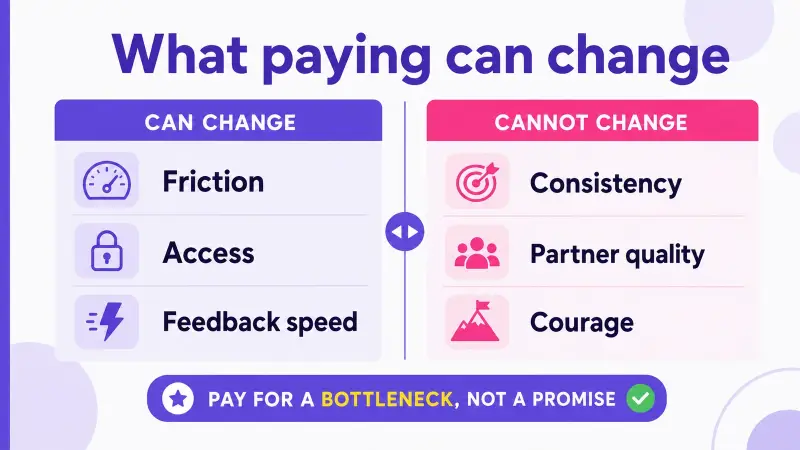
Three Things Paying Buys
The first is unmetered translation and transcription. On a free tier you ration these, and rationing changes behaviour: you avoid long messages because unpacking them costs a credit. With those in-chat tools uncounted, you stop trimming your curiosity to fit a budget.
The second is reach. Extra language slots and better search placement raise the number of conversations that start without you initiating. Most learners underestimate how much of their practice comes from being contacted rather than from contacting others.
The third is immediate feedback when no human is awake. HelloTalk's AI grammar correction returns a fix with an explanation rather than just a rewrite, and HelloTalk's AI pronunciation scoring points at the syllable that went wrong. That closes the loop at 6am, when a lot of practice happens.
HelloTalk's VIP is sold as regional monthly, yearly, or lifetime options (see in-app quote), and the free tier stays usable rather than becoming a demo.
Three Things It Does Not
Paying does not buy a partner who is interested in you. Interest comes from what you write. A one-line "hi, let's practise" gets ignored on every tier at every price.
It does not buy consistency. No feature survives contact with a learner who opens the app on Sunday and remembers it exists three weeks later.
It also does not buy correction quality from other humans. A native speaker corrects a specific question far more thoroughly than a general request to fix everything, and no subscription changes that. Ask about one word, one ending, one phrase you were unsure of.
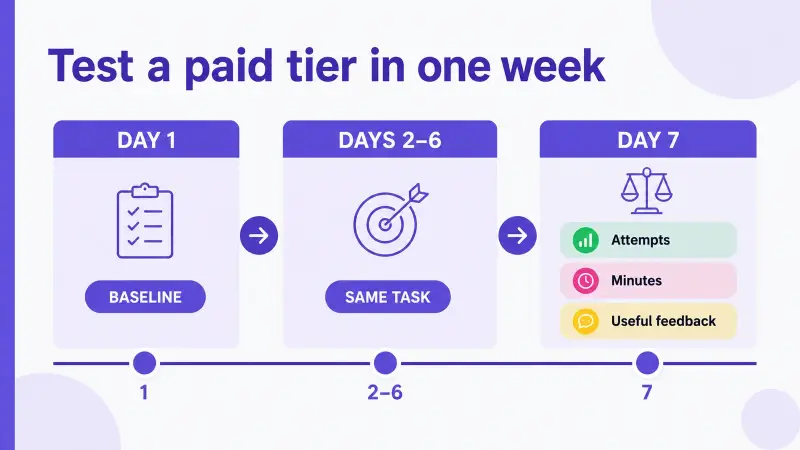
Testing a Paid Tier in One Week
Buy the shortest term available and run a deliberate test rather than a vague trial.
Days one and two: use the paid features hard enough to hit their edges. Send long messages, translate freely, run pronunciation checks on everything you say. You are checking whether the friction you named earlier disappeared.
Days three to five: change nothing else. Same practice time, same partners, same hour. If output rises, the tier did it. If you also studied twice as long that week, the test is contaminated.
Days six and seven: count. Messages sent, corrections received, minutes spoken, compared against the week before. A tier that moves those numbers by a few percent is not what stands between you and progress.
When Paying Early Is Cheaper
One case justifies upgrading early: when the free limit is teaching you a bad habit. If capped translations have trained you to send only short, simple messages, you are practising simplicity daily, and that habit outlasts the cap.
The same applies to feedback. Waiting a day for corrections trains you to stop expecting them. HelloTalk reports over 1 billion messages daily across 200+ countries and 260+ languages, so the responders exist. The question is whether your habits let you reach them.
Lifetime options change the maths for anyone learning over years rather than months.
Frequently Asked Questions
Do premium features make you practise more often? Only when they remove a friction that was already stopping you. An upgrade lifting a limit you never reached will not change how often you open the app.
Is a free tier enough to reach conversational level? Yes, for most learners. HelloTalk keeps 90% of core features free, including chat, corrections, Moments posts, and Voicerooms, which covers the full write, correct, speak loop.
What is the most overrated paid feature? Anything cosmetic, such as profile badges or themes. These change how your account looks and have no effect on how many people write back in your target language.
Should I pay for lessons or for an app subscription? They solve different problems. Paid lessons give structured instruction and scheduled speaking, while an app subscription gives daily volume between lessons. Beginners often need the structure first.
How much does HelloTalk VIP cost? HelloTalk's VIP is offered as regional monthly, yearly, or lifetime plans, so pricing varies by country. Check the in-app quote for your region.
Can I cancel and keep progress? Yes. Your chat history, corrections, and posts stay on your account after a subscription ends. You lose the raised limits, not the record of what you practised.
When is it too early to pay? In your first two weeks, before you know which friction is yours. Practise free long enough to notice where sessions end, then buy against that reason.
When Free Is the Right Stop
If you practise most days, ask specific questions, and still hit a wall built by a limit rather than by your own habits, paying is reasonable. That is a narrow situation, and the only one where money reliably buys frequency.
Everyone else is better served by staying free and fixing the human side first: message more people, write longer openings, ask narrower questions. Those cost nothing and move the same numbers a subscription is supposed to move. Start at HelloTalk.