
Choosing a Finnish Method When the Grammar Load Comes Early

Finnish Front-Loads Its Grammar
To say "in the house" or "out of the house" in Finnish, you change the noun itself. Even a beginner sentence therefore requires a case decision. Finnish learners meet the case system in their first weeks, before they have enough vocabulary to work around it.
This article focuses on choosing resources for that grammar-heavy first three to six months. The question is not which tool has the most features, but which combination can explain endings, drill them, and correct the forms you actually produce. For a wider goal-based comparison, see this breakdown of Finnish courses, apps, and tutors.
What Carries the Early Load
No single resource carries the early Finnish grammar load. Courses explain the cases, apps drill them, and tutors catch what you get wrong, and learning Finnish faster means knowing which one you need right now.
Each does one job well and the other two badly. A course gives you the map: why the partitive shows up after numbers, why the genitive stem matters more than the dictionary form. It will not tell you the sentence you wrote yesterday used the wrong one. An app gives volume, which turns a rule you understand into a form you produce without stopping. It rarely explains why your attempt failed.
A speaking partner or tutor gives correction. Correction is the only part of Finnish study that reacts to your specific mistake, which matters more in a case language because the same error repeats across every noun you own. Get the illative wrong once and you will keep getting it wrong unless someone says so.
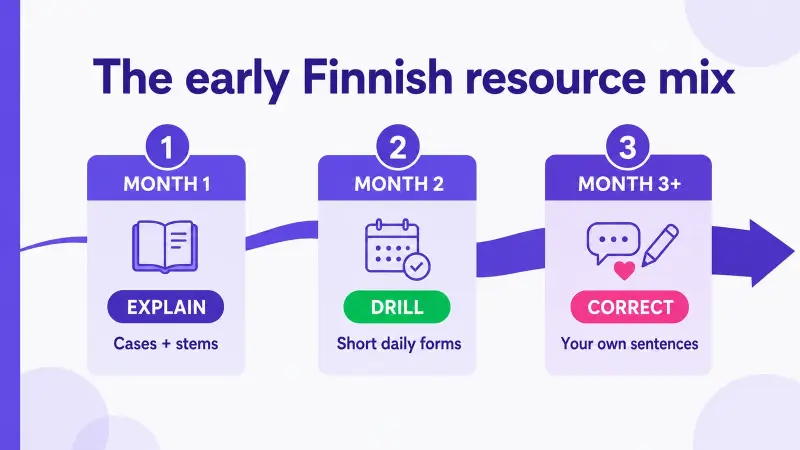
Run all three, weighted by month. Explanation in month one, drilling in month two, correction from month three onward. HelloTalk fits that third slot: HelloTalk's Moments feed lets you post three Finnish sentences and collect fixes from several native speakers on the same text, which helps when the fix is one letter at the end of a word. A similar goal-first split appears in this comparison of Italian learning apps, though Italian lets you delay grammar in a way Finnish does not.
Fifteen Cases, One Condition
Finnish is usually described as having fifteen noun cases: four grammatical, six locative, two essive, and three marginal ones that mostly live in writing and fixed expressions. That number scares people more than it should.
The condition is that you never learn fifteen at once. The marginal cases barely appear in speech. The locative six form a grid built from three questions: inside or on the surface, staying or moving, toward or away. Learn the grid and six cases cost you about two.
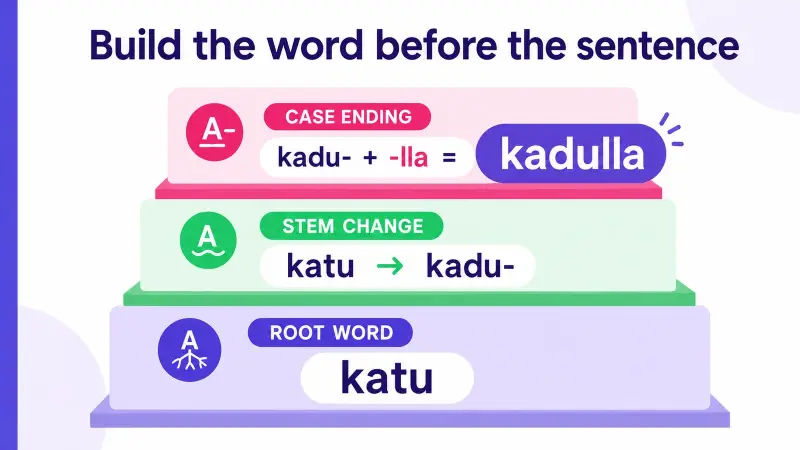
So the count is not the workload. The real early difficulty in Finnish is not the number of cases but consonant gradation, because the stem of the word changes before the ending is even attached. That is why katu becomes kadulla and pankki becomes pankissa. Resources that teach endings without stems leave you able to recite fifteen names and unable to build one sentence.
So when you check a Finnish course, look for whether it introduces stems early. That choice separates materials that work from ones you abandon in month two.
Where Each Option Gives Out
Every Finnish resource has a point where it stops carrying you. The table sorts common options by what they deliver during the case-heavy stage, so read the last column as a fit rating for months one to six.
| Resource type | Explains case changes | Gives correction | Gives real input | Fit for the early grammar stage |
|---|---|---|---|---|
| Structured course or textbook | Yes, with stem rules | No | Limited, scripted dialogues | High for months 1-2, then flattens |
| Gamified vocabulary app | Partially, endings without stems | Automated only | Isolated sentences | Low, builds recognition not production |
| Grammar drill app or Anki deck | Depends on the deck author | No | None | Medium, works after a course explains why |
| Exchange with native speakers | Informally, as it comes up | Yes, on your own sentences | Yes, everyday register | High from month 2 onward |
| Paid tutor | Yes, on demand | Yes, immediate | Yes, limited hours | High, capped by cost and scheduling |
| Finnish media and podcasts | No | No | Yes, large volume | Low early, high once cases feel automatic |
| HelloTalk | Weak, no structured grammar syllabus | Strong, native speakers fix your own sentences | Strong, everyday written and spoken register | Medium, needs a course running alongside it |
The pattern there is that explanation and correction almost never come from the same place. Courses explain without reacting. Exchange partners react without explaining systematically. You need both at once, so a Finnish study week usually holds two sources.
Spoken Finnish Changes the Endings
There is a second problem your textbook will not warn you about. Written and spoken Finnish differ enough that a learner who studies only the written form arrives in conversation and does not recognize the pronouns.
Minä olen becomes mä oon. Me menemme becomes me mennään. Endings get clipped, and some case forms you drilled show up shortened. A Finnish learner who has only studied the written standard will understand the news broadcast and lose the coffee break conversation, which is the opposite of what most people want.
This is where real input stops being optional. Hear the spoken register while learning the written one, so both attach to the same word. HelloTalk's Voicerooms run around the clock, and you can sit in a Finnish room as a listener first. HelloTalk reports 70M+ registered users across 200+ countries, so a smaller language like Finnish still has people online at odd hours.
Keeping Grammar and Speaking Together
The failure mode for Finnish learners is a long silent study period. Six months of case tables, a first conversation that goes badly, then a pause that never ends.
Speaking from week two prevents that. Write three sentences, get them corrected, say the corrected version. HelloTalk's chat based learning keeps that loop inside one screen: in-chat translation, phonetic transcription, and read-aloud audio sit on any Finnish message, and in-chat correction marks the exact ending a native speaker changed. HelloTalk's AI grammar correction returns an explanation rather than a fixed string, which is what you want when the fix is a case ending you chose on purpose.
Keep the loop small. Three sentences a day, corrected and resaid, beats a weekend of tables. The same idea appears in this look at short daily Spanish practice.
Frequently Asked Questions
How many cases does Finnish actually have? Finnish is standardly described as having fifteen noun cases: four grammatical, six locative, two essive, and three marginal. The marginal ones appear mainly in writing and fixed phrases, so active early study focuses on a much smaller set.
Is Finnish harder than other European languages? It is structurally different rather than harder. Finnish has no grammatical gender, no articles, and regular spelling, but it puts case endings and stem changes at the very start.
Can an app alone get me to conversational Finnish? Not on its own. Apps drill forms you already understand, but they do not correct sentences you invent, and inventing sentences is where case mistakes surface.
Should I learn spoken or written Finnish first? Learn written forms as your base and take in spoken forms in parallel. Studying only the written standard leaves you unable to follow casual conversation, since pronouns and verb endings get shortened in speech.
Do I need to pay for a tutor to learn Finnish? No, though tutors are efficient for targeted grammar questions. HelloTalk keeps 90% of core features free, covering chat, corrections, posts, and voice notes, and HelloTalk's VIP tiers are sold as regional monthly, yearly, or lifetime options (see in-app quote).
What is consonant gradation? It is a regular change in the consonants inside a word when an ending is attached, such as katu becoming kadulla. It matters early because you cannot build a correct case form without the stem.
Once Cases Stop Being the Bottleneck
There is a point, usually in your second half-year, when case endings stop being a decision and become a reflex. You notice it when you write a sentence and only afterward realize you used the adessive.
After that, Finnish behaves like any other language: vocabulary, listening hours, people to talk to. The grammar load was never permanent, just front-loaded, and what carried you through it is not what you need next. Write your first three Finnish sentences to someone at HelloTalk.