
Understanding Ci and Ne in Short Italian Replies

If you recognize every word in an Italian reply but cannot tell what ci or ne refers to, read the previous turn before searching for another translation. In “Ne parliamo stasera,” the missing information is what you will discuss tonight. When the conversation leaves two possible topics open, use your next HelloTalk message to check one interpretation with the person who wrote it.
Read the Previous Turn Before Translating Ci or Ne
A short reply can carry information forward instead of naming it again. Looking up ne by itself will not tell you whether the conversation concerns a trip, some photographs or another topic. Start with the question or statement the reply answers, then read both turns together.
For practice, compare these three short exchanges. The final column restores information already supplied by the first speaker; it is not a word-for-word translation rule for every use of ci or ne.
| Previous turn | Short reply | Information carried forward |
|---|---|---|
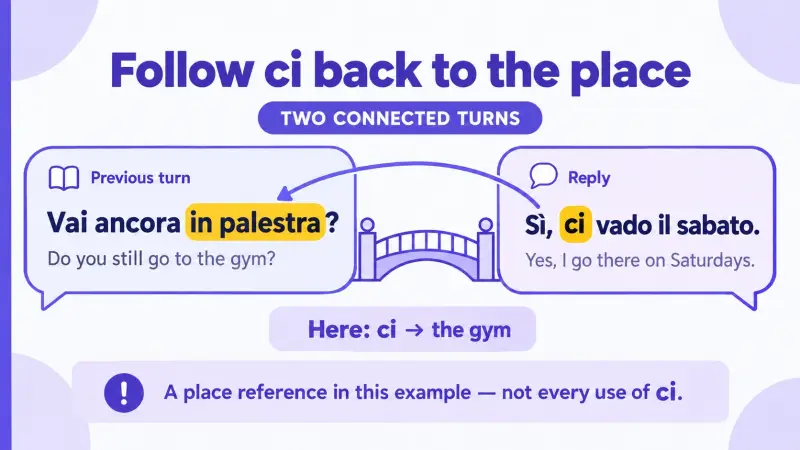
| Vai ancora in palestra? (Do you still go to the gym?) | Sì, ci vado il sabato. (Yes, I go there on Saturdays.) | The gym is the place. |
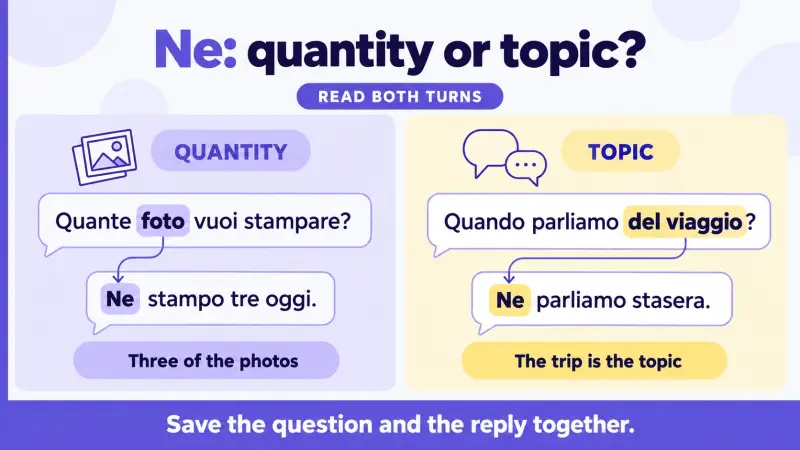
| Quante foto vuoi stampare? (How many photos do you want to print?) | Ne stampo tre oggi. (I'm printing three today.) | Three of the photos under discussion. |
| Quando parliamo del viaggio? (When shall we talk about the trip?) | Ne parliamo stasera. (We'll talk about it tonight.) | The trip is the topic of discussion. |
In these short replies, the preceding turn supplies information that ci or ne does not name again. If you can recover that information, continue reading the reply as a complete message. You do not have to stop every conversation for a grammar explanation.
This is one small part of a broader Italian learning plan. Keep your course's grammar explanation, but practice applying it to two connected turns rather than to an isolated particle.
Follow Ci Back to a Place Already Mentioned
In the gym exchange, ci points back to in palestra. The reply gives you more than “there”: it says the speaker still goes to that place and adds when. Replacing ci mentally with the gym is a useful check here because the earlier question supplies a clear location.
Now consider what you actually need to answer. If the location is settled, respond to the Saturday routine rather than asking what ci means. If two places have been mentioned and the reference is unclear, ask which place the person means in that message.
Ci can refer to a place, but it does not always mean “there.” It also has other pronoun uses, including “us” or “to us,” and appears in verb expressions. A location is a hypothesis to test against this sentence, not a meaning to force onto every ci you encounter.
Read Ne with the Quantity or Topic It Refers To
The photographs exchange combines a quantity with something already named. In Ne stampo tre oggi, tre tells you how many, while the preceding question tells you what is being printed. Keep both pieces when you explain the answer to yourself: three photos today, not simply “three.”
The trip exchange works differently. Parlare di means to talk about something, so Ne parliamo stasera carries forward the topic del viaggio. It does not say the speakers are going on the trip tonight; it says they will discuss it tonight.
Ne can carry a quantity-related reference or a topic reference; the surrounding sentence determines which reading fits. Do not swap ci and ne just because an English translation uses the same vague word, such as “it.” Check the Italian verb and what the previous turn has established.
For your notes, save the question and reply together. Keeping only Ne parliamo stasera removes the very information you were learning to track.
Recognize When a Fixed Expression Needs a Different Reading
The reference-finding method has a limit: some verb combinations need to be understood as expressions. For example, Me ne vado means “I'm leaving.” Trying to force a previously mentioned number or object into that ne will not explain the expression.
When a replacement produces a strange reading, check the whole verb expression in your course material or a dictionary. Keep enough of the phrase to identify the construction, rather than collecting a separate translation for each tiny word. A useful note pairs the expression with the situation in which it was used.
Do not put every non-location ci into the “fixed expression” box, either. Some uses are ordinary pronouns with a different role. The practical distinction is whether the sentence points back to identifiable information or whether you first need the meaning of a larger construction.
Check One Unclear Reference in Your HelloTalk Reply
Suppose your HelloTalk conversation has mentioned both a trip and some photographs, and the next message is Ne parliamo stasera. You can quote that short message and ask, “Do you mean we'll talk about the trip tonight?” You are asking the writer to identify their topic, not to explain every use of ne.
HelloTalk supports text and voice messages, so the clarification can stay in the same exchange. If the person identifies the topic, continue with something about it: what needs deciding, which photos to discuss, or what you want to ask. That is what a real Italian reply can tell you: how this person understood and continued this conversation.
Save the two original turns and any useful clarification together, then reuse the same construction when a similar topic genuinely comes up. You can also write the noun explicitly if the reference would be confusing. For broader misunderstandings, these ways to check what your partner meant help you make the request specific.
FAQ: Understanding Ci and Ne in Conversation
Does ci always refer to a place?
No. A place reference is one common use, but ci also has other pronoun roles and occurs in verb expressions. Read the sentence and its context before assigning a meaning.
Can I translate ne as “some” every time?
No. Ne stampo tre oggi concerns a quantity of photos, while Ne parliamo stasera carries a topic into the reply. One English translation will not cover both jobs.
What should I do if two topics could fit?
In the same HelloTalk chat, state one possible reading and ask whether it is the intended topic. Quoting the short reply helps the other person see exactly what you are checking.
Should I repeat the noun instead of using ci or ne?
You can repeat the relevant noun or phrase when that makes your meaning clearer. Then compare it with the shorter expression in your course or the conversation; using a particle is not more important than being understood.
Are ne and né the same word?
No. The accent distinguishes them in writing: the ne discussed here is not the conjunction né, used in negative coordination. Keep the spelling when copying an example into your notes.
Do I need all the rules before replying to a message?
You need enough understanding to answer the message accurately, not a complete grammar inventory. Start with the reference in the current exchange, and look up a larger expression when the simple reference reading does not fit.