
Why You Recognize Spanish Words in Subtitles but Miss Them in Audio

If a Spanish sentence makes sense in the subtitles but disappears when you listen, compare that same sentence with its recording before adding more vocabulary. The useful question is whether you missed the words, did not know them, or heard them without understanding the message. When the uncertainty comes from an actual conversation, HelloTalk gives you a place to ask the speaker what one phrase meant and respond to that meaning. You do not need to turn every missed sentence into a new vocabulary list.
Separate Unknown Words from Words You Miss Only in Audio
Start with the sentence that caused the problem, not with a verdict on your Spanish. Read it without its translation and decide whether you can explain what it says. A familiar-looking word is not necessarily a word whose meaning you know in this sentence.
Recognizing a written Spanish word and recognizing that word in a recording are different checks. If the written sentence is still unclear, listening again will not tell you whether the difficulty is vocabulary, grammar, or the speaker's intended meaning. Settle the written meaning first, then return to the sound.
You might understand the sentence both in writing and in audio but struggle to produce an answer. That is a different task, covered in what to practice when you can read but cannot speak. Keep this exercise focused on what reached you, before judging what you can say back.
Choose One Short Recording with a Matching Transcript
A transcript is most useful here when it belongs to the exact recording you are playing. Translated subtitles help with meaning, but they cannot show you which Spanish words you missed. Automatic captions can also contain errors, so check what kind of text the source provides.
The University of Texas at Austin's Spanish Proficiency Exercises offers Spanish transcripts, English translations, and versions without visible text. Its beginning task about what people like to do includes a simplified example alongside individual speakers' answers. Use the simplified example if a more open-ended answer leaves you with too much to compare.
For a starting point, find the transcript sentence “Normalmente, nado dos o tres veces por semana.” It means “Normally, I swim two or three times a week.” Work with that sentence and its surrounding context rather than the whole collection; the task is to compare your own listening with the text, not to identify a particular pronunciation feature in advance.
If the embedded player does not work on your device, try the source's download option or choose another recording with its own transcript. A matching transcript lets you compare your hearing with the speaker's words; a translation alone does not. Do not substitute a similar sentence from a different recording and treat it as the answer key.
Compare What You Heard with What the Transcript Says
Hide the text, play your chosen sentence, and note the words or meaning you caught. Leaving a gap is more useful than guessing a complete sentence. Then uncover the Spanish transcript and compare the gap with the original wording.
In the swimming example, you could check whether you caught the activity, the frequency, and the reference to a week. These are places to direct your attention, not a claim that the recording makes any one of them difficult. If you recognized “nado” but missed the frequency, mark that part rather than copying the full paragraph into your notes.
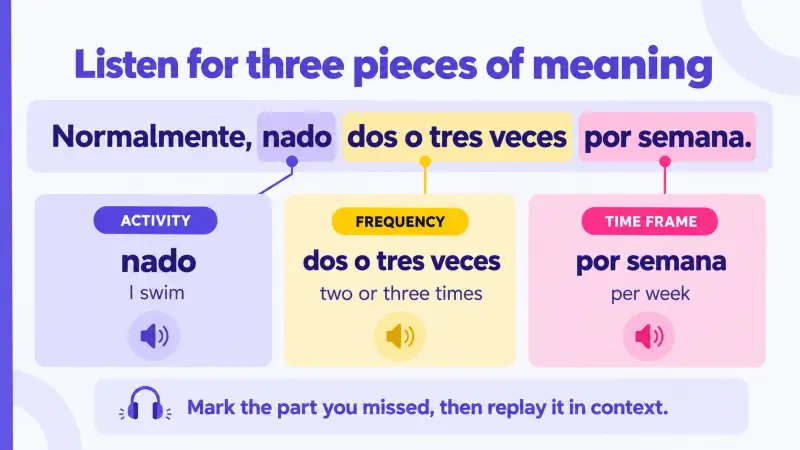
Now read the whole sentence for meaning, hide it, and listen again. Notice whether you can locate the words you had missed without watching them appear on screen. Familiarity after reading the answer is useful practice, but it is not proof that a new speaker's sentence will be equally clear.
Decide Whether to Look Up a Word, Replay a Shorter Segment, or Check the Meaning
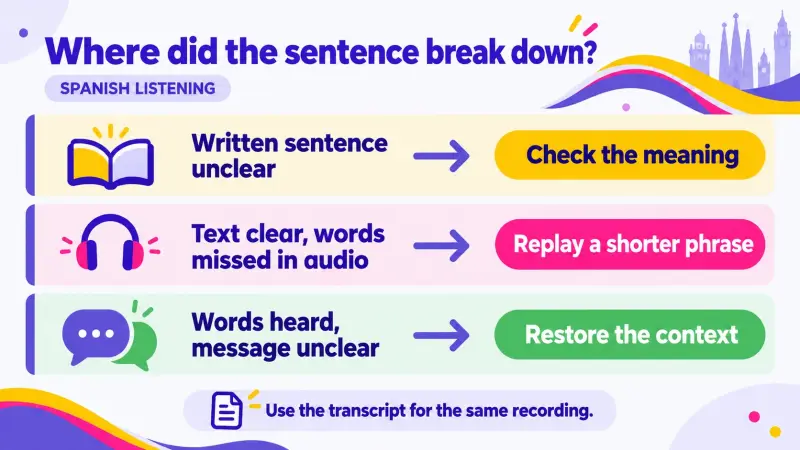
Your notes should lead to a small next action. The table below separates problems that can look identical while subtitles are switched off; it is a flexible self-check, not a listening-level test.
| What you notice | What to check | What to do next |
|---|---|---|
| You still cannot explain the sentence after reading it | The unknown word, expression, or grammar in context | Look up the unclear item, then return to the same sentence |
| You understand the transcript but did not recognize part of it in audio | The smallest meaningful phrase around your gap | Replay that shorter segment, first with the text and then without it |
| You recognize the words but cannot tell what the message refers to | The previous sentence or conversation turn | Restore the context; in a HelloTalk exchange, ask the speaker one question about the intended meaning |
| You can follow this sentence but lose track across the whole clip | How much information you are trying to hold together | Work on one sentence or shorter exchange before returning to the full clip |
A word you do not understand in print needs a meaning check, not only another replay. Likewise, replaying an entire clip is not the only option when just one phrase is missing. Shorten the unit enough to compare it, while keeping the words that explain what it refers to.
Once you can follow that unit, return to the original sentence or exchange. Otherwise, you may become comfortable with an isolated fragment without knowing how it fits the message. For the wider mix of listening, vocabulary, and conversation work, use the broader Spanish learning method guide.
Clarify One Uncertain Phrase in a HelloTalk Voice Message
For the practice recording you chose, the matching transcript provides a reference. A personal voice message instead has a speaker whose intended meaning matters. HelloTalk supports voice and text chat, so you can keep a clarification in the exchange where the uncertainty arose. Ask about the part that affects your response instead of requesting a transcription of everything.
For example, if someone mentions how often they swim and you are unsure of the number, you could write: “¿Dos veces o tres?” (“Twice or three times?”). This is a practice prompt, not a reported exchange. In HelloTalk, that bounded question gives the speaker a clear detail to confirm, and their answer helps you respond to their actual routine rather than your guess.
A speaker can clarify the meaning of their own message in a way a generic transcript cannot. If they answer, respond to the information first, then note the phrase you had missed beside its meaning. Reuse it when the same topic comes up, rather than turning the chat into an exercise correction queue.
You can use Spanish phrases for recovering a conversation when you need a different kind of clarification. Try the question in your next relevant HelloTalk exchange; while waiting for a reply, you can continue the transcript exercise independently.
FAQ: Understanding Spanish Without Depending on Subtitles
Should I turn subtitles off from the beginning?
For this self-check, start with a short attempt without text so you have something to compare. Then use the transcript to identify the gap and listen again without it. There is no need to keep struggling through a whole video you cannot yet follow.
Does missing a familiar word mean I need to learn it again?
Not necessarily. If you understand the word in its written sentence, focus on locating it in the recording. If you only recognize its spelling but cannot explain its meaning there, review that use of the word too.
Are translated subtitles enough for this exercise?
They can help you understand the message, but they do not show the exact Spanish wording. Use a matching Spanish transcript to compare the words you heard, with a translation as additional help when needed.
How many times should I replay a sentence?
There is no fixed count in this exercise. If repeating the same audio is not revealing anything new, check the text, shorten the segment, or resolve an unknown expression. Choose the next action from the gap, not from a replay target.
Should I ask a HelloTalk partner to transcribe every voice message?
Ask about the specific detail that prevents you from answering. A short clarification respects the conversation and tells the speaker what you need, while complete transcriptions can become a much larger request.
When should I move to another recording?
Move on when you want to check whether you can follow the same kind of message without already knowing its wording. If the current recording still contains too many unknown expressions, choose a more manageable sample instead of treating continued difficulty as failure.