
Telling a Past Story in Italian: Events, Background, and Follow-Up Questions

If changing an Italian past tense seems to change your story, decide first whether you are presenting an event or showing what was already happening. “I was cooking when someone arrived” and “I cooked when someone arrived” give a listener different pictures. When you need to know which picture your own sentence creates, tell the short experience on HelloTalk and ask the other person one question about the sequence they understood.
Decide What Happened and What Was Already Going On
Before choosing verb endings, name the relationship you want to convey. Perhaps a friend arrived while dinner was being prepared; perhaps the arrival was followed by preparing dinner. The facts you want to connect should guide the grammar, rather than a rule based only on how long each action took.
In these everyday stories, passato prossimo can present an event as a whole, while imperfetto can show an activity in progress or supply background. The difference between passato prossimo and imperfetto is not simply the difference between a short action and a long one. Ieri ho lavorato per sei ore. (“Yesterday I worked for six hours”) presents even that long stretch as a bounded event.
You can give an activity an ongoing view instead: Lavoravo quando è arrivato il messaggio. (“I was working when the message arrived.”) Here, working supplies the situation in which the arrival of the message occurs.
Compare Two Ways to Tell the Same Moment
Hold the people and activity constant, then change how you present the cooking. The following teaching examples let you compare the relationship, rather than memorize two unrelated sentences.
| Italian sentence | How the cooking is presented | What the listener can take from it |
|---|---|---|
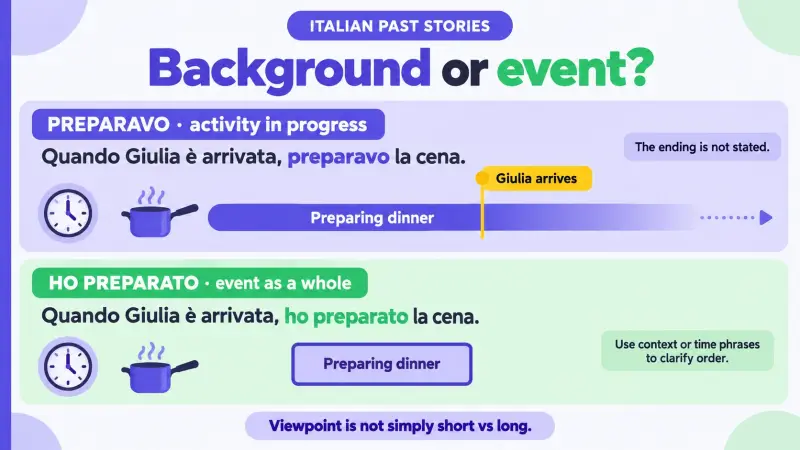
| Quando Giulia è arrivata, preparavo la cena. | An activity already in progress at Giulia's arrival | The arrival occurs against the background of preparing dinner. |
| Quando Giulia è arrivata, ho preparato la cena. | An event presented as a whole | Preparing dinner is presented as an event associated with the arrival, commonly read as following it; fuller context can make the order clearer. |
The first sentence does not say that you never finished cooking. Imperfetto can show an activity in progress without telling the listener whether it later finished. You would need another part of the story to establish that outcome.
The second sentence is not a complete timeline either. If it matters that you started cooking only after Giulia arrived, make that relationship explicit instead of expecting the tense alone to do all the work. This is a reason to revise the meaning of a sentence, not just its conjugation.
Use Time Phrases to Make the Sequence Clear
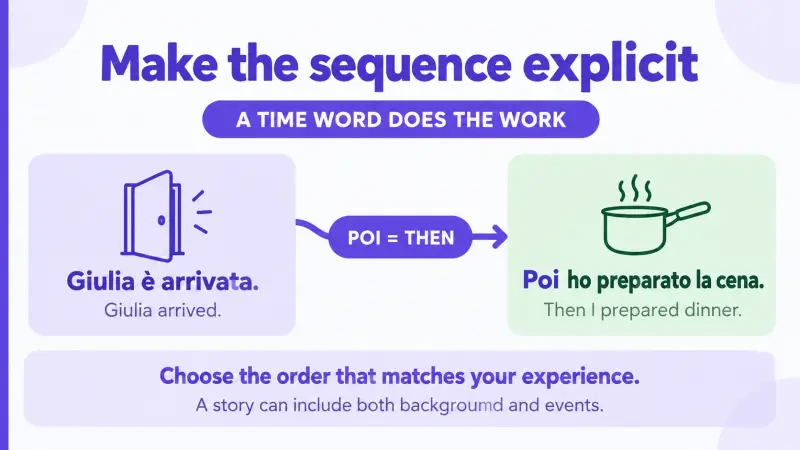
For a deliberately simple version, you could write: Giulia è arrivata. Poi ho preparato la cena. (“Giulia arrived. Then I prepared dinner.”) Poi supplies an order that the listener does not have to infer from the two verb forms alone. This is an editable practice example; choose the sequence that matches your experience.
For simultaneous background, keep the earlier version with preparavo and decide what you want to say next. Did you continue cooking, stop to talk, or serve dinner later? Add the event that matters instead of changing every verb just to make the paragraph look consistent.
A short story may need both a background and an event. There is no requirement to use the same tense throughout one message. If you are still deciding where this practice fits among other topics, see prioritizing what to study in Italian for the broader study sequence, not a rule for interpreting these sentences.
Check Verb Forms Without Letting Them Take Over the Story
Once the relationship is clear, check the forms you actually need. Passato prossimo combines a present-tense form of avere or essere with a past participle. In the examples above, ho preparato uses avere, while Giulia è arrivata uses essere and a participle agreeing with Giulia.
Check the particular verb in your course or a dictionary rather than choosing essere for every action involving movement. Keep the review small: the auxiliary, the participle and any required agreement in your sentence. For preparavo, check the first-person imperfetto form you need for “I was preparing.”
Then read the story again for meaning. Correct forms are important, but they cannot rescue a sentence that presents the wrong sequence. Keep this event-and-background practice inside the wider Italian learning route, so grammar review feeds something you want to communicate.
Use a HelloTalk Follow-Up to Check What Your Listener Understood
Take a short experience you genuinely want to share and send it as text or a voice message on HelloTalk. Add a question the other person can answer, such as whether something similar has happened to them. This gives the story a conversational purpose instead of asking someone to grade a paragraph.
If the timing is the point you are unsure about, ask a narrower question in that same HelloTalk exchange: “From this sentence, was I already cooking when Giulia arrived, or did I start afterward?” You are checking one relationship, so your partner can respond to what they understood without reviewing every past tense you used. Their answer concerns this message, not every possible use of the tense.
When a reply exposes a different reading, revise the relevant sentence and continue the story. Save the wording that expresses your intended relationship, together with a short note such as “background already in progress.” Learning from the reply to your Italian message then becomes part of choosing what to practice next, rather than another reason to collect more material.
FAQ: Passato Prossimo and Imperfetto in Personal Stories
Should short actions use passato prossimo and long actions use imperfetto?
No. Duration alone does not choose the tense: Ieri ho lavorato per sei ore presents a long period as a whole. First decide how you want the action to function in the story.
Does preparavo mean I did not finish cooking?
Not by itself. It presents the cooking as ongoing from the point being described; another sentence or the wider context would tell you whether it finished.
Does ho preparato always mean the cooking happened afterward?
No. In the comparison sentence, that is a common reading, but the exact relationship still depends on context. Use an explicit sequence such as Poi ho preparato la cena when that is what you need to say.
Can I use both tenses in the same story?
Yes. A story can combine what was already going on with events that occurred against that background. Choose each form for the relationship it expresses rather than forcing one tense onto the whole message.
Are these the only past tenses I need in Italian?
They are a useful pair for the task here, not the whole Italian past-tense system. Other forms and differences in register or regional usage exist; study them when your course or the material you encounter calls for them.
What should I ask a language partner to check?
Ask about the part of the story whose meaning matters: whether something was already happening, what happened next, or what they understood from one sentence. In HelloTalk, keep that question beside the original message so the person has the context needed to answer.