
Restarting a Language After a Break: Where Should You Resume Your Course?

If you understand an old lesson but cannot use it without prompts, restart at the small section that addresses that gap, not automatically at lesson one. When familiar sentences still leave you stuck on an unexpected follow-up, a short HelloTalk exchange can help identify what to revisit. You might recognize a page about introductions yet be unable to introduce someone from your own life without copying its example.
Find Your Last Familiar Lesson Before Restarting the Course
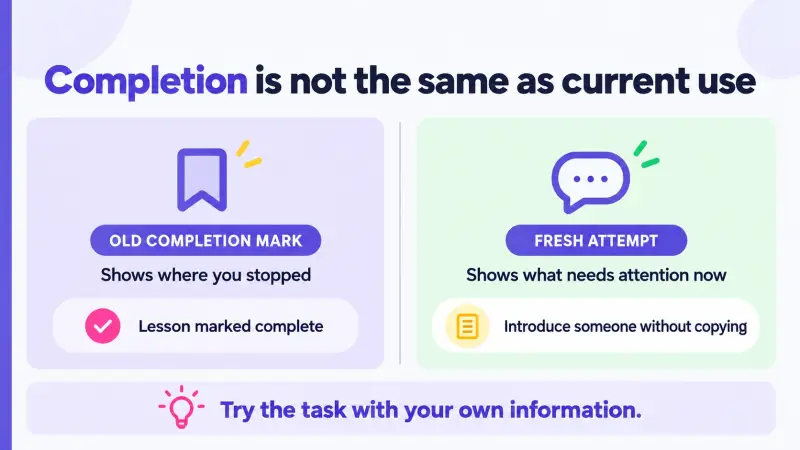
Open the course you were using and find the last section whose task you remember. Look at what it asked you to do, not just its completion mark: introduce yourself, describe a person, or ask a simple question. An old completion mark shows where you stopped, not what you can currently do without help.
For a concrete example, the Open University's OpenLearn course Getting started with Spanish 1 moves from greetings and pronunciation to names and introductions. In Week 2, section 3, “Practising the verb ser,” works with short introductions; section 6, “Giving information about people you are introducing,” moves to introducing someone else. Those are two identifiable places to revisit, rather than a vague instruction to review Spanish.
Use the equivalent tasks in your own course; you do not need to switch to this one. OpenLearn's public explanations make it a useful example here, but guest access does not include every interactive activity. The checks below are suggestions you can adapt, not its official placement procedure.
Try Its Main Task Without Looking at the Answer
Read the task, then cover the model answer. If the lesson concerns names and introductions, give your own information and ask for the other person's name in the language you are studying. Write or record your attempt before reopening the explanation, so you can see which part you actually needed help with.
The OpenLearn section on introducing people includes Esta es mi amiga Isabel. (“This is my friend Isabel.”) Understanding that sentence is one check; introducing a person you know with the appropriate name and relationship is another. Recognizing a model answer is different from supplying your own message without copying it.
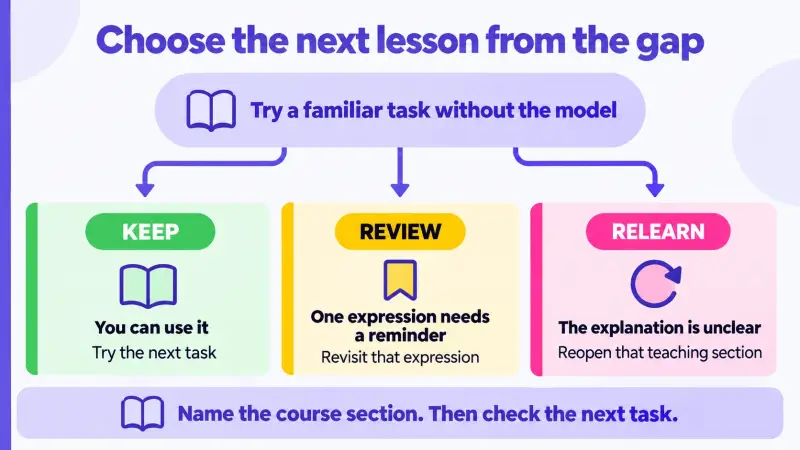
Keep the attempt small enough to locate the difficulty. If you understood the explanation but could not retrieve a familiar expression, mark that expression for review. If the explanation itself no longer makes sense, return to the relevant teaching section before attempting a larger task.
The distinction matters more than how polished the first attempt sounds. For a persistent gap between understanding text and producing a message, see what to practice when reading is ahead of speaking. That gap does not, by itself, tell you to restart every earlier lesson.
Use a HelloTalk Follow-Up to Check What the Old Exercise Does Not Show
A model answer cannot choose its own next question. On HelloTalk, use text or a short voice message to introduce a person or topic you genuinely want to discuss, then ask your partner something related. A willing partner's reply adds information you did not prepare in advance, which is the part the old exercise cannot show you.
For example, introduce a friend using language from your old lesson and ask, in wording you can manage, “Who do you usually spend your weekends with?” You can also agree on a small practice request: “Could you ask me one question about the person I mentioned?” This is an illustrative exchange, not a record of a completed test.
If a reply arrives, identify what interrupted your answer. Did you forget the expression for the relationship, need an unfamiliar word, or misunderstand the question? Ask the same HelloTalk partner to clarify one phrase if that is the missing piece; they are helping you understand their question, not deciding your course level.
Save a useful expression with the question that prompted it, then connect it to the relevant lesson. One unfamiliar follow-up does not show that every earlier lesson needs to be repeated. You can still choose a provisional restart point from your own attempt while this optional exchange is unfinished.
Sort the Lesson into Keep, Review, and Relearn
Now turn what you observed into a course decision. “Keep,” “review,” and “relearn” are three possible actions for individual parts of a lesson, not a ranking of your ability or a test score. A single section may contain material in more than one category.
The table uses the two OpenLearn introduction sections to make those actions concrete. Apply the same distinction to your own course's named sections, keeping a note of what you tried rather than relying on a general feeling of rustiness.
| Action | What you observed in the introduction task | Course decision |
|---|---|---|
| Keep | You understand the explanation and can give your own name or introduce someone without copying the model. | Retain that material and try the next task; one successful attempt is not a certificate of mastery. |
| Review | The explanation is familiar, but you need to reopen one expression to finish your own introduction. | Revisit that expression in Week 2 section 3 or section 6, depending on the task, then try a changed example. |
| Relearn | You cannot explain how the relevant form or introduction works, even after reading the old example. | Work through that specific teaching section again. Check an earlier prerequisite only if this section depends on something you no longer understand. |
A HelloTalk question may also expose a need that the old lesson never covered. Note it separately instead of treating every new word as failed retention. For material you recognize but struggle to retrieve, this guide to turning familiar sentences into usable phrases gives you a focused follow-up task.
Choose a Restart Point and Check It Against the Next Lesson
Write down an actual course location. In the example above, if self-introductions are usable but introducing someone else still needs the explanation, your restart point could be Week 2 section 6, with a short review of section 3 only where needed. If the form of ser in your own introduction is unclear, section 3 is the more relevant place to reopen first.
After that review, try the next task in your course's actual sequence. See whether the old difficulty still prevents you from doing it, or whether you have reached new material. If you are still blocked by the same form, revisit that form; if the task introduces something new, treat it as the next lesson rather than evidence that the review failed.
A useful restart decision names a course section and the task you need from it, not a number of days to become fluent again. A note such as “Resume at introductions of other people; review the relationship phrase” gives you a place to open tomorrow. You can adjust it after another attempt without throwing away the whole course.
Once that location is clear, the broader language-learning strategy guide can help you combine review, input and use. The outcome here is simpler: keep what you can use, reopen the specific gap, and continue from a lesson you can identify.
FAQ: Returning to a Language After a Break
Should I restart from the first lesson after a long break?
Not automatically. Try a familiar task first, then revisit the section that explains what you could not do. Go farther back when a missing prerequisite makes that section unclear, not just because time has passed.
What if I remember every answer in the old exercise?
Change the information while keeping the task: use your own name, a different person or another true detail. Producing that version without copying gives you a different observation from recognizing the original answer.
Does this check tell me my language level?
No. It helps choose a course location for the task you tried; it is not a formal placement test or a CEFR assessment. One introduction cannot establish your overall speaking, listening, reading and writing ability.
Do I need a language partner before choosing where to restart?
No. The old explanation and your own unprompted attempt can support a provisional choice. A HelloTalk follow-up adds a check of how you handle another person's question, rather than permission to continue the course.
What if my partner asks about something the lesson never taught?
Separate new material from something you have forgotten. Clarify the question if necessary, record the expression you need and decide where to learn it. It is not evidence that the whole completed course must be repeated.
How will I know whether I chose the right lesson?
After revisiting it, try its task with changed information and look at the next course task. If the same missing piece still blocks you, review it again or check its prerequisite; otherwise, use the next task to decide what comes next.