
Making Plans in Thai: How to Hear and Confirm the Day and Time

If you catch the number in a Thai invitation but are unsure which hour it means, identify the time-of-day expression before accepting the plan. To check a real arrangement, repeat the day and complete time to the person who proposed it; on HelloTalk, that can be the partner with whom you are arranging your next practice chat. Hearing สอง, “two,” is not enough when the phrase is สองทุ่ม, meaning eight in the evening.
Separate the Day from the Clock Time in a Thai Invitation
A weekday, a calendar date, and a clock time answer different questions. วันเสาร์ is Saturday and วันอาทิตย์ is Sunday, but a weekday alone does not identify which week's appointment you mean. Keep that separate from the hour you are trying to understand.
กี่โมง asks about clock time; วันที่เท่าไหร่ asks about the calendar date. If you already know the hour but not the date, asking for the hour again will not fill the missing part of the plan.
Choose a question or a confirmation according to the missing information. The examples below identify the relevant pieces rather than provide a complete script for every invitation.
| What is missing? | Thai component to recognize or use | What it resolves |
|---|---|---|
| Which date? | วันที่เท่าไหร่ | Requests the calendar date, rather than another statement of the hour. |
| What time? | กี่โมง | Requests the clock time of the event. |
| Which day was mentioned? | วันเสาร์ / วันอาทิตย์ | Distinguishes Saturday from Sunday; the actual calendar date still needs to be shared. |
| Does my reading match yours? | ใช่ไหม after the information you are checking | Gives the other person a specific interpretation to confirm or correct. |
You do not have to memorize every calendar expression before trying this task. Start with the day you actually need and keep a written record of it. If recognizing basic Thai words is still the main obstacle, return to a beginner starting plan for Thai alongside this small appointment task.
Tell Formal Time from Everyday Thai Time Expressions
Thai has formal 24-hour expressions as well as everyday expressions organized by parts of the day. At 14:00, for example, a formal form is สิบสี่นาฬิกา, while บ่ายสองโมง is an everyday afternoon form. Both point to the same time, although one includes fourteen and the other includes two.
The number in an everyday Thai time expression cannot always be read as the number on a 24-hour clock. สองทุ่ม is 20:00, not 02:00. The word ทุ่ม matters to the interpretation; it is not a detail to discard after recognizing สอง.
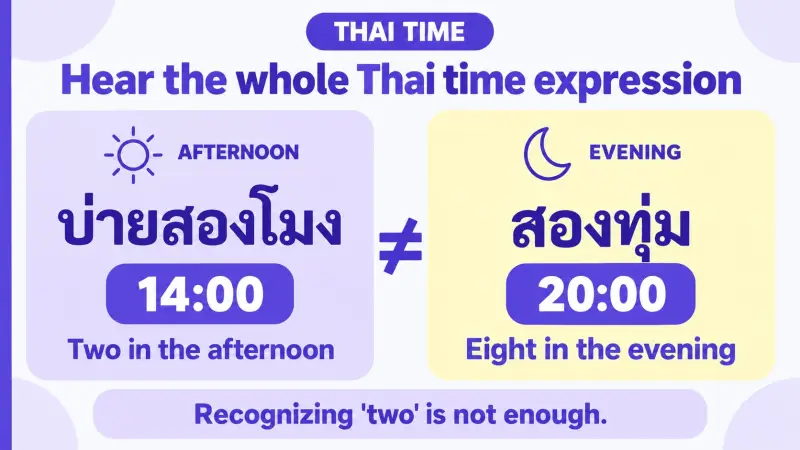
For now, learn a small contrast that fits your plans. Put บ่ายสองโมง next to 14:00 and สองทุ่ม next to 20:00 in your own notes. This gives you two complete expressions to recognize without requiring a table of every hour.
Minutes add another piece of information. บ่ายสองโมงสิบห้า means 14:15: the afternoon time expression is followed by fifteen. Keep the full phrase together when practicing, rather than isolating the numbers and guessing how they fit.
Clarify the Part of Day Before You Confirm the Hour
When the number is familiar but the period is uncertain, go back to the whole time phrase. In the examples above, บ่าย identifies the afternoon context, while ทุ่ม belongs to evening time. The difference changes the appointment, not just how formal the sentence sounds.
Recognizing a number is not the same as identifying the intended time of day. If you heard something containing “two,” do not silently choose 14:00 just because an afternoon meeting would suit you.
In a HelloTalk chat, ask the partner who proposed the time to repeat that time phrase or write it in the same thread. Explain the uncertainty narrowly: you caught the number but not the part of day. Their response is useful because they know which time they are offering, not because they must teach you the entire Thai clock system.
You can also offer an interpretation for checking. If you think the plan is for Saturday at 14:15, the confirmation in the next section makes that interpretation visible. Treat it as a question until the other person accepts or changes it.
Repeat the Thai Date and Time in Your HelloTalk Reply
Use the time you are actually trying to arrange, rather than sending an unrelated pronunciation drill. HelloTalk supports text and voice messages, so you can say the proposed time and then keep the agreed version in writing in the same conversation.
Here is an illustrative confirmation, assembled for practice rather than taken from a real chat. The speaker uses ครับ consistently:
วันเสาร์ บ่ายสองโมงสิบห้า ใช่ไหมครับ
Saturday at 2:15 in the afternoon, right?
A possible short acceptance is ใช่ครับ, “Yes.” A correction could instead be ไม่ใช่ครับ บ่ายสามโมง, “No, three in the afternoon.” The useful information in that correction is the changed hour; you do not need to turn the exchange into feedback on every sound.
If the partner corrects the time, update what you repeat. For the example above, วันเสาร์ บ่ายสามโมง ใช่ไหมครับ checks Saturday at 15:00. The new confirmation should contain the corrected time, not repeat the original suggestion and hope the difference has been settled.
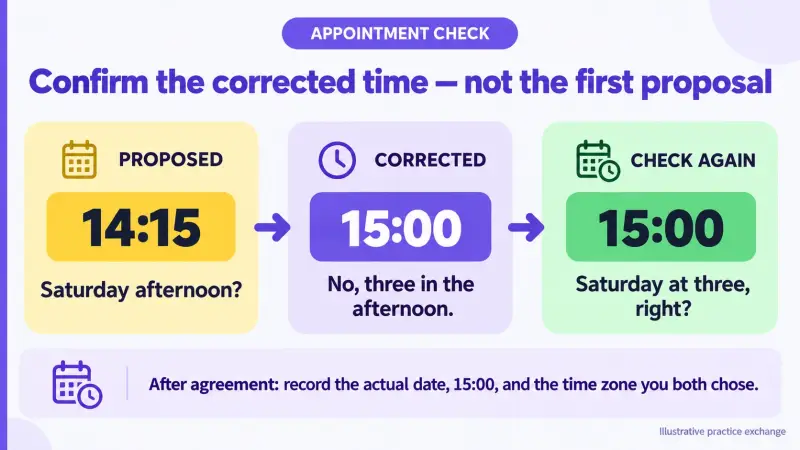
Keep this exercise focused on whether you understood the same arrangement. Broader ways of asking for clarification are covered in how to clarify and confirm a plan in conversation; this task is about applying that idea to Thai's day and time expressions.
Keep One Written Version of the Agreed Date, Time, and Time Zone
After the time is agreed, record the actual calendar date as well as the weekday. Add the 24-hour time and an explicit city or time-zone label if you are arranging an online conversation from different places. Do not infer either person's location from the language they speak.
Following the corrected example above, the note would say “agreed calendar date, Saturday, 15:00,” plus the time zone you both agreed to use. Replace those details with the real agreement; a draft note is not confirmation that the partner has accepted it. When a detail changes, update the final written version instead of keeping two conflicting versions side by side.
The learning sequence is small: recognize a complete Thai time expression, use it in a relevant exchange, then retain what was actually agreed. You can place this task within an adjustable Thai speaking and listening plan. When a willing partner is arranging the next chat with you, HelloTalk makes that scheduling exchange part of your language practice rather than a separate worksheet.
FAQ: Making and Confirming Plans in Thai
Does สองทุ่ม mean two o'clock?
It means 20:00, or eight in the evening. Read the whole time expression rather than translating สอง on its own and assuming the hour is two.
What is the difference between บ่ายสองโมง and สิบสี่นาฬิกา?
Both indicate 14:00 in these examples. The first is an everyday afternoon expression; the second uses formal 24-hour wording.
How do I check whether I understood the appointment correctly?
Repeat the specific day and complete time, followed by ใช่ไหม. The other person can then confirm that interpretation or change the part that differs from their plan.
Should I ask for the date or the time again?
Ask for the information that is missing. กี่โมง concerns clock time, while วันที่เท่าไหร่ concerns the calendar date; knowing one does not automatically settle the other.
Do I need to learn every Thai time expression before arranging a chat?
No. Begin with the complete expressions relevant to your arrangement, and use text to check an uncertain phrase. Expand the range as you encounter other hours rather than treating this first task as an exam on the whole system.