
How to Look Up Korean Conjugated Words Without Losing the Sentence

If a Korean word in a message does not match the form in your dictionary, keep the sentence and check the word's conjugation before choosing a meaning. A form such as 걸었어요 can point to more than one verb, so the surrounding words matter. If the entry still leaves the speaker's meaning unclear, return to the same HelloTalk conversation with one specific interpretation for them to confirm.
Keep the Whole Korean Sentence Before You Search
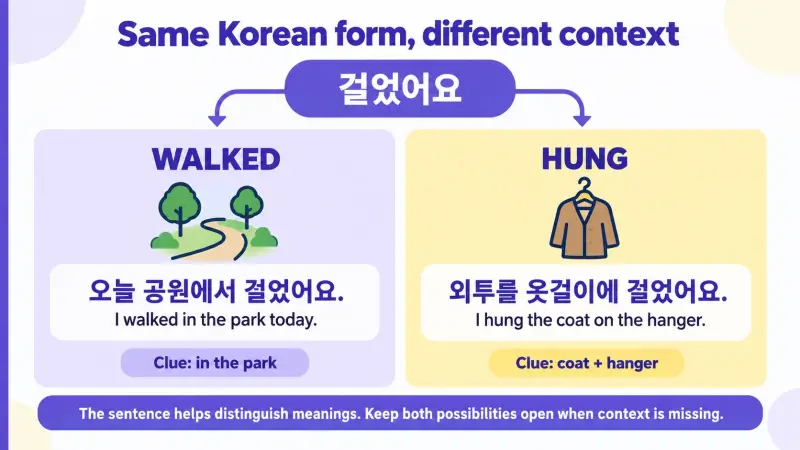
Copying only the unfamiliar word removes some of your best clues. In 오늘 공원에서 걸었어요. (“I walked in the park today”), the park helps you interpret the action. In 외투를 옷걸이에 걸었어요. (“I hung the coat on the hanger”), the coat and hanger point elsewhere, even though 걸었어요 has not changed.
Keep the previous message too if it establishes the topic. You do not need to understand every particle before searching, but preserve who or what is involved, any place mentioned, and the complete verb ending. A screenshot or a private note can hold the original while you investigate.
This is a specific job for a dictionary, not a reason to change your entire study setup. For how dictionaries fit beside lessons and conversation, see Korean learning websites by task.
Find the Dictionary Form Without Just Cutting Off the Ending
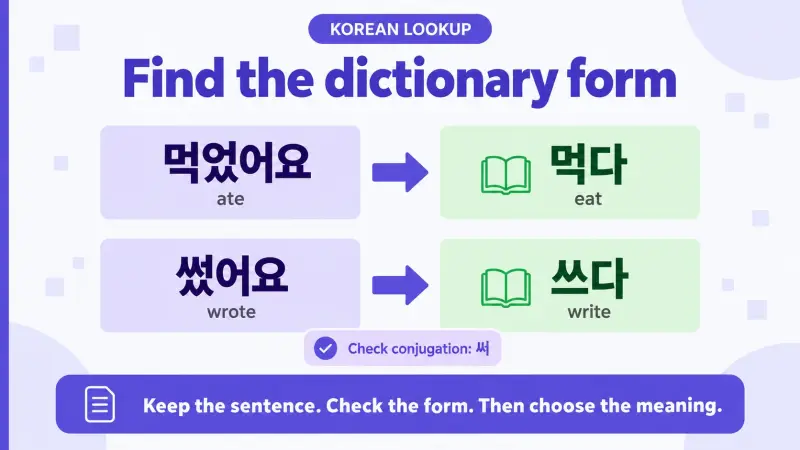
A Korean verb normally appears under a dictionary form ending in 다, but working backward is not always a matter of removing the last few syllables. From 저녁을 먹었어요. (“I ate dinner”), 먹다 is the useful entry. From 친구에게 편지를 썼어요. (“I wrote a letter to a friend”), you need 쓰다, not a word made by keeping 썼 and adding 다.
Treat a proposed base form as a candidate to check. In the National Institute of Korean Language's Korean-English Learners' Dictionary, look for the entry's conjugation information as well as its definition. The write sense of 쓰다 lists 써, which helps connect the entry to the form in your sentence.
A dictionary form is a starting point for checking a Korean sentence, not a meaning you can safely choose without context. If the first search fails, use the sentence's likely meaning to find a candidate, then compare its forms. Do not assume a dictionary will automatically recognize every conjugated form you paste into it.
Use Context When One Form Leads to Two Different Verbs
Sometimes the problem is not finding a candidate but choosing between two plausible ones. 걷다, meaning “walk,” and 걸다, which includes “hang,” can both produce 걸었어요. The Korean form 걸었어요 can belong to 걷다 or 걸다; the sentence helps distinguish the entries.
The following practice sentences show what to keep beside the word. They are teaching examples, not transcripts of real chats.
| Sentence you are reading | Candidate entry | Clue to retain | Reading supported here |
|---|---|---|---|
| 저녁을 먹었어요. | 먹다 | 저녁, dinner | Ate dinner |
| 친구에게 편지를 썼어요. | 쓰다 | 편지, letter; 친구에게, to a friend | Wrote a letter |
| 오늘 공원에서 걸었어요. | 걷다 | 공원에서, in the park | Walked in the park |
| 외투를 옷걸이에 걸었어요. | 걸다 | 외투, coat; 옷걸이에, on the hanger | Hung the coat |
The table is not a rule that a particular noun always selects a particular verb. It shows how the candidate, conjugation and sentence need to agree. If your original message supplies too little context, keep both possibilities open instead of inventing the missing event.
Check the Meaning and Sentence Pattern Inside the Entry
Once the form matches, read beyond the first English gloss. The official learner dictionary supplies separate senses, examples and sentence patterns. Finding the right Korean entry does not yet establish which of its meanings the speaker used.
For the letter example, look for the writing sense of 쓰다 and an example involving something written. Compare how the entry connects the action to its object and recipient. This is more useful than saving a list of unrelated English translations under one Korean word.
Stop when you can explain the whole sentence in plain language. If your explanation still leaves out the letter, the person receiving it or the action, you have not yet connected the entry back to the message.
Confirm Your Reading in the Same HelloTalk Conversation
When two readings remain possible, send your interpretation in the original HelloTalk chat so the other person can check what you understood. For the park example, a bounded question could be: “By 걸었어요 here, do you mean you walked in the park?” Use wording you can manage, and ask about that one meaning rather than requesting corrections to the entire conversation.
HelloTalk supports text and voice messages, so you can continue in the format you were already using. The other person's role here is to clarify what they meant, not to deliver a complete lesson on Korean verb forms. If they confirm the park reading, answer the message itself, perhaps by asking about the walk, rather than ending the exchange at a grammar check.
For a message with several possible misunderstandings, these ways to ask for clarification without losing the conversation help you narrow the question. While waiting, you can still record the dictionary evidence and leave the uncertain interpretation marked as unresolved.
Save a Sentence You Can Use Again, Not Just a Translation
Keep a compact note with the original sentence, the selected dictionary form and the clue that made the meaning fit. For the park example, that might be 오늘 공원에서 걸었어요. / 걷다 / a walk in the park. Add a clarification from your conversation only if one actually arrives.
Then use the pattern for something true about your own day, checking any word you change. The next task is to turn a sentence you read into something you can say, not to memorize every sense of the dictionary entry. Your note should help you retrieve a usable expression and remember why it means what it does.
FAQ: Looking Up Korean Conjugated Words
Can I always remove the ending and add 다?
No. Some forms involve changes that make this shortcut unreliable, as 썼어요 and 쓰다 illustrate. Check the candidate entry's conjugation instead of treating your first guess as a finished lookup.
Why do two dictionary entries fit 걸었어요?
걷다 and 걸다 can share this conjugated form. The surrounding sentence, such as a walk in a park or a coat on a hanger, helps you choose the relevant entry.
Should I translate the whole sentence first?
A translation can suggest a possible reading, but it does not replace checking the Korean form and context. Keep the original visible so you can test the suggestion against what was actually written.
What if I know the dictionary form but still cannot understand the message?
Check the entry's separate meanings and sentence examples. If the remaining uncertainty concerns what the person meant, ask them one specific clarification in the same HelloTalk conversation.
Do I need to save every meaning of a new verb?
Not for this task. Save the meaning used in the sentence, its dictionary form and enough context to recognize that use again; add other meanings when you meet them.
Can a partner's explanation replace the dictionary?
A partner can clarify their own message and suggest a natural way to express your idea. A dictionary remains useful for checking other forms and uses beyond that exchange.