
Choosing Spanish Resources for Where You Will Use the Language

If you know where you will use Spanish, keep the useful parts of your course and add material that matches the people and situations you expect to meet. A lesson can teach you how to ask about opening hours without showing every answer you might hear at a local shop. When you need to know how someone would phrase that exchange in their own setting, use HelloTalk to ask a partner about that specific situation. Their answer is a useful sample, not a reason to throw away everything you learned elsewhere.
Start with Where You Will Use Spanish and What You Need to Do
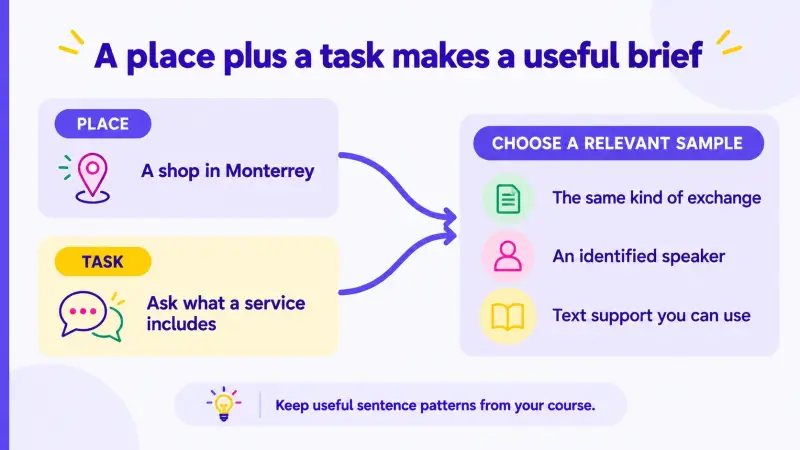
Write down a place and an action, not just an accent label. “Mexico” is a destination; “ask about a service at a shop in Monterrey” gives you a task to prepare for. The second description tells you what kind of vocabulary, recording, and conversation would be relevant.
You do not need a complete regional vocabulary list before starting. Choose an exchange you expect to use, such as introducing your job, asking what a service includes, or understanding a food description. Keep the sentence patterns from your course, then look for examples of that task in the setting you care about.
If you are preparing for a move, your arrival date can help you decide which tasks need attention first. The guide to planning Spanish practice before a move covers that broader decision. Here, the narrower question is which material to use for the task you have chosen.
Check the Speakers Behind a Resource's Regional Label
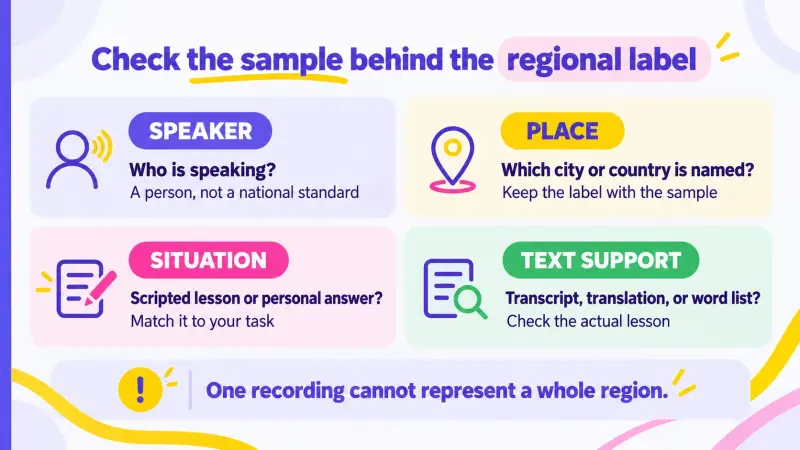
A label such as “Mexican Spanish” is a starting point, not a description of every person you will hear. Check whether the resource identifies its speakers, gives a city or country, and explains the setting of the recording. A scripted beginner exchange and a spontaneous personal answer can serve different purposes even when both carry the same regional label.
The University of Texas at Austin's Spanish Proficiency Exercises makes this distinction visible. Its task about what people like to do includes a simplified version and individual answers labeled with places such as Monterrey, Santiago, Quito, and San José. You can compare answers to the same task without assuming the speakers will use identical words.
A speaker's location label identifies a sample; it does not make that person a national pronunciation standard. A sample may help you become familiar with that speaker's wording, but it cannot cover every age group, workplace, or social setting in a country. Keep the label attached to the sample rather than turning it into a rule about everyone there.
Also check what support the specific lesson provides. A transcript, a translation, and a vocabulary list do different jobs, and a site's general “beginner” label does not tell you which is included on every page. Choose something you can actually work with, not just something bearing the right country name.
Keep Your Course or Add Regional Input: Compare the Options
You may need a small adjustment rather than a replacement course. The resources below show different ways to make that adjustment; compare their role in your current task, not which one supposedly owns the best Spanish.
| Resource | What its description or material identifies | Useful role in your selection | What it does not establish |
|---|---|---|---|
| UT Austin Spanish Proficiency Exercises | Simplified and individual answers, with speaker locations and Spanish transcripts | Add a named speaker's answer to a topic you already know | One answer does not represent a whole region |
| Wlingua Spanish | Publicly described Spain and Mexico options, with recordings by speakers from both | Check whether an available course option already suits your destination | A regional option does not prove the course fits your level or every local task |
| University of Surrey Spanish resources | Basic sound practice and selected regional-variation exercises | Look more closely at a particular sound question after choosing relevant material | The regional exercises are not comprehensive coverage of Spanish variation |
| HelloTalk | Text and voice exchanges with language partners | Ask a willing partner how they would express your exact message in their own setting, because the situation affects the wording | A partner's city or answer does not establish a national rule or teaching qualification |
Changing the region of your listening material does not require discarding sentence patterns you can already use. If your course remains understandable and relevant, retain it as the sequence you follow. Add a regional sample beside the lesson instead of starting a second full course by default.
An existing variety option may be enough when you want more regular exposure to speakers from a particular place. Wlingua's public description, for example, lists Spain and Mexico choices; check the option available to you before deciding to switch materials. That is a feature to consider, not a claim that either option produces faster learning.
If the location matches but familiar words still disappear in the recording, the problem may not be your choice of region. Use the comparison exercise for recognizing familiar Spanish words without subtitles before collecting more resources. For a wider choice of course and practice types, see Spanish apps and resources by learning need.
Ask a HelloTalk Partner How They Would Say It in That Situation
A resource gives you examples to study; a conversation lets you check how a message works for a particular person. On HelloTalk, give a willing partner your draft, who you are speaking to, and what you want to find out. That context makes the question more answerable than “How do people speak Spanish in your country?”
For example, you could send: “I'm asking a bakery employee when the shop closes. I'd say ‘¿A qué hora cierran?’ Would you use that question in this situation, or a different wording?” The Spanish question means “What time do you close?” This is a suggested practice message, not a reported conversation or a claim that one question is suitable in every setting.
If your uncertainty is about hearing the response rather than composing the question, ask whether your HelloTalk partner is willing to send a short voice reply for that example. HelloTalk supports voice chat, so the answer can become a sample you listen to and respond to within the same exchange. Keep the request to that task instead of asking for a complete pronunciation lesson.
When a reply gives you an alternative, ask what changes: the situation, the level of formality, or simply that person's preference. A useful regional note records the expression and its situation together, rather than replacing one country label with another. Save the wording with that context in your own notes, then use it when a similar situation comes up.
Keep Useful Alternatives Without Treating One Speaker as a Whole Region
Suppose the course phrase and your partner's alternative both fit the intended meaning. Keep both, with a short note explaining where each example came from. You do not need to declare the course wrong merely because a real conversation offered a different wording.
If the answers differ, return to the situation before asking which phrase is “correct.” On HelloTalk, you could ask the same partner, “Would you also say that to a customer, or mainly to a friend?” Their clarification tells you more about their usage; it does not settle how everyone in the region speaks.
Keep, supplement, or switch is a decision about the resource's fit for your task, not a ranking of Spanish-speaking regions. Keep a course that gives you useful progression, supplement it when you need different listening samples, and consider a switch when the material repeatedly fails to address the work you need to do. You can make those decisions while a conversation is still awaiting a reply.
For your next practice session, choose one lesson, one relevant sample, and one question to try in a suitable HelloTalk exchange. Keep the resulting notes small enough to use again. The aim is a better match between study and use, not a larger collection of regional labels.
FAQ: Choosing Spanish Resources for a Destination
Should I restart my course if it uses Spanish from another country?
Not automatically. Check whether its sentence patterns and tasks still help you do what you need. You may only need an additional listening source or a few context-specific expressions.
Is one regional variety the most neutral choice?
Choose by the people and situations you expect to encounter rather than a claim of universal neutrality. A course's regional label cannot describe every speaker, and your practical needs may involve more than one variety.
Can one HelloTalk partner tell me how an entire country speaks?
A partner can explain their own wording and experience, especially when you give a specific situation. Treat that response as a sample. It does not establish how everyone in the same country would speak.
Do I need to copy a local accent before using Spanish there?
You can begin with useful messages and relevant listening material rather than making accent imitation a prerequisite. When a particular phrase causes confusion in a HelloTalk exchange, ask the partner about that phrase and its meaning instead of requesting a judgment on your entire accent.
What if a resource has the right region but is too difficult?
Try a shorter sample or one with more useful text support. If you still cannot work with it, choose a more manageable resource and return later. A regional match alone is not enough reason to keep struggling with unsuitable material.
What should I save when someone suggests a different expression?
Save the expression, its intended meaning, and the situation in which that person would use it. Keep your existing version when it remains useful. These notes preserve the distinction without turning an individual preference into a universal correction.