
Finnish Listening Practice: Short Dialogues, Easy News, or Spoken Videos?

If the Finnish transcript is understandable but the recording is not, keep the topic and try a shorter passage before changing resources. If you can follow that prepared passage but lose track of an unfamiliar answer, a short voice exchange on HelloTalk lets you check what happens when another person chooses the words. The useful question is not whether a video says “beginner,” but whether you can work out the particular information you need from it.
Choose the Information You Want to Catch, Not an Easy Label
Give the recording a small job. In a name-and-spelling dialogue, that might be identifying the name and the letters used to spell it; in a weather item, it might be identifying the temperature. These are different listening demands, even when both resources are presented as beginner-friendly.
An “easy Finnish” label does not tell you whether a particular topic or speaking task is familiar to you. A short item about an unfamiliar subject can require more background knowledge than a longer conversation about something you already do.
Before pressing play, finish this sentence: “After listening, I want to know ___.” Keep the blank concrete enough that you can tell whether you found the information. “Understand more Finnish” is a learning goal, but it does not help you choose between today's clips.
The wider choice between courses, apps, and teaching support is covered in these Finnish resources by learning goal. Here, the decision is smaller: which recording gives you a manageable listening task now?
Compare a Short Dialogue, an Easy News Item, and a Spoken Finnish Video
Consider three concrete samples rather than three vague categories. The comparison below uses their published topics, lengths, and available text support; it is not a ranking of measured speech speed or audio clarity.
| Material | Information to listen for | Sample length | Text support and its limit |
|---|---|---|---|
| University of Turku: Dialogi: Miten se kirjoitetaan? | A name and how it is spelled | Under half a minute | The teaching collection presents spoken and written forms. The video lists automatic captions; a complete manual transcript is not established here. |
| Yle Selkouutiset, 22 October 2026 | One fact from a familiar section, such as the weather | The webpage audio is 2 minutes 36 seconds for the whole item | The page has separate written news sections. The length of the weather section alone is not specified. |
| Puhutsä suomee?: Tää vai toi leffa? | Which film the speakers are considering | 1 minute 4 seconds | The course supplies vocabulary and language activities. Its authors say complete situation-video transcripts are available by request, not as an assumed public transcript. |
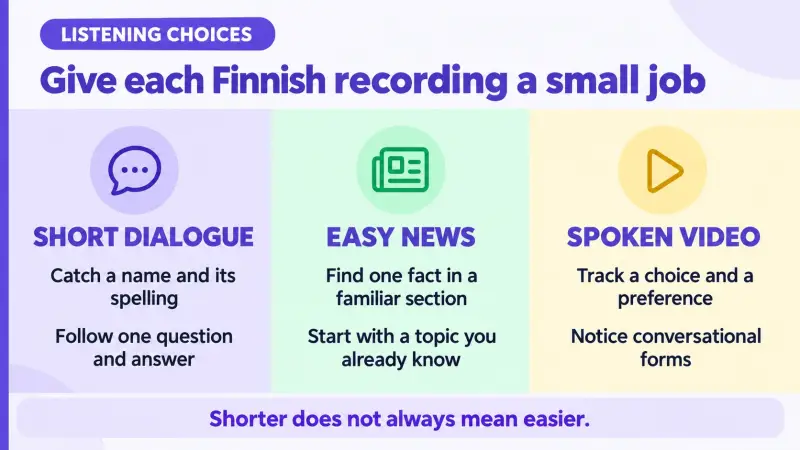
The Turku example offers a tightly bounded exchange. That makes it a sensible candidate when you want to follow one question and its answer, rather than keep track of several news topics.
The Yle page lets you choose a familiar written section before tackling the whole recording. Its weather item and its other news sections need not be equally approachable for the same learner. Check the topic, not just the total duration.
The Puhutsä suomee? sample adds a different demand: following conversational choices and spoken forms. The course describes features common in the capital region, so treat it as a particular spoken-language sample rather than a model of every Finnish speaker.
A shorter clip is not automatically an easier clip: topic, text support, and the language used still matter. Choose the sample whose difficulty you can identify, not merely the one that finishes first.
Check What the Text Support Actually Gives You
Open the supporting text before committing to a resource. A word list explains selected vocabulary; a transcript shows the sequence of what was said; captions may have been generated automatically. Those supports solve different problems.
A vocabulary list is not a complete transcript, and automatic captions should not be treated as a verified answer key. If a word sounds different from a caption, do not immediately decide that your listening is wrong. Check an accompanying explanation or a more reliable text source first.
Try reading the part relevant to your chosen question. If it is still unclear on the page, repeated listening alone may leave you guessing at unfamiliar meanings. A more familiar topic can be a better starting point than replaying the same difficult passage indefinitely.
If the main mismatch is between the written form you learned and a conversational form, use this explanation of spoken and standard Finnish in different situations. You do not need to restart your whole course to investigate that particular difference.
Keep, Shorten, or Change the Material Based on Where You Get Stuck
Make the next choice from what happened in this attempt. These are practical options, not a placement test or a percentage you must reach before moving on.
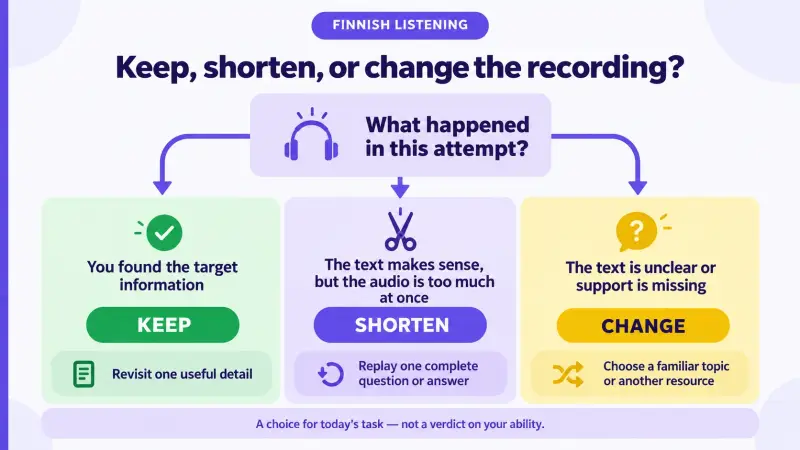
Keep the material when you can find the intended information and identify a useful detail to revisit. For example, you may know which film is being discussed but want another listen to the phrase that introduces a preference.
Shorten the passage when the text makes sense but the recording contains too much to hold together. Replay one complete question or answer, then put it back into the exchange. Cutting through the middle of a meaningful phrase can make the task less clear rather than easier.
Change the topic or resource when the supporting text itself requires extensive decoding, or when you cannot obtain the support you need. This is a choice about today's task, not a verdict that you are bad at listening.
Sometimes the same kind of sound distinction keeps causing trouble across otherwise familiar material. If that distinction is Finnish vowel or consonant length, a focused look at resources for Finnish long and short sounds is more useful than repeatedly switching news channels.
Use a Short HelloTalk Reply to Check How Well the Material Fits
Once a familiar recorded exchange is manageable, you can bring its topic into a HelloTalk voice conversation. A willing partner's answer is useful here because it is their own information, not the answer you have already read under the recording.
After working with a film-related clip, for instance, use HelloTalk text chat to set a small request: “I'm practicing short Finnish replies about films. Could you send a voice note naming a film you enjoyed and one reason?” This is a suggested exercise, not a transcript of an actual exchange.
If a reply arrives, listen for the film and the reason before trying to account for every word. You can then ask the same HelloTalk partner to repeat one unclear phrase or type that phrase in the chat. The request stays small enough for them to understand what you need.
Keep a personal note of the wording you understood, the wording you needed help with, and what made the difference. If text clarified the answer, return to a short listen-and-read task; if the words were unfamiliar even in writing, choose material on a more familiar topic or review that vocabulary first.
A familiar recording and a new personal reply are different listening tasks; difficulty with the second does not erase what you understood in the first. You can still choose, shorten, or replace your study material independently of this optional exchange. When you want that extra check, HelloTalk provides the conversation in which a partner can answer your particular question.
FAQ: Finding Finnish Listening Material You Can Work With
Should a beginner start with dialogues or news?
Start with the task you can identify and the support you can use. A short dialogue about a name may be more approachable than unfamiliar news, while a familiar weather section may suit you better than a conversational video with several new forms.
Does every Yle easy-news item have the same difficulty?
No single label establishes that. Check the subject and the written section for the particular item; do not assume that understanding one weather segment means every news topic will be equally familiar.
Should I keep captions on all the time?
Use them for a purpose, such as checking a phrase after an initial listen. Then try the same short passage without reading. Also check whether the captions are automatic before treating their wording as definitive.
How short should my practice clip be?
Short enough to keep the question or answer you are following intact. There is no fixed duration in this approach: shorten a passage when its length prevents you from tracking the information, not simply to meet a timer.
Do I need a language partner before choosing the next resource?
No. You can judge topic familiarity, text support, and manageable length on your own. A HelloTalk voice reply adds a different check when you want to see how your understanding handles someone else's unprepared answer.