
Spoken Finnish vs Standard Finnish: What Should a Beginner Learn First?

You drilled minä olen until it felt automatic. Then a Finnish speaker sends you a voice note, and what comes out is mä oon. Same meaning, same verb, and nothing in your course warned you. For a moment, the course and the conversation feel like two different languages.
They are one language doing two different jobs. Your course taught you standard Finnish, the form learners usually meet first in books and apps. The voice note used spoken Finnish, the less formal register you meet in casual conversation. Neither one is broken.
So which do you learn first? Learn standard Finnish as your foundation, and train your ear on spoken Finnish from the first week, so familiar words do not turn unrecognizable in real conversation. You do not have to pick a side. You have to split the work, and keep your grammar map stable while your ear learns that minä, mä, and even an omitted pronoun can all point to the same speaker.
The rest of this article is that split in practice: what each register is for, which forms change most often, how to run both tracks in one routine, and how to test what you hear without turning one speaker's habit into a rule. If you are still choosing courses, apps, or tutors more broadly, the Finnish resource guide by learning goal covers that bigger decision.
Build Your Foundation in Standard Finnish, but Listen to Spoken Finnish From Day One
Standard Finnish, often called yleiskieli or kirjakieli in learning contexts, is worth building on because it is the form everything else refers back to. The Institute for the Languages of Finland, or Kotus, describes yleiskieli as the shared form used in news, notices, nonfiction, learning materials, and instructions across Finland. Your dictionary speaks it, your course speaks it, and when an ending confuses you, standard Finnish is where you go to get unconfused.
Spoken Finnish still belongs in week one, just with a smaller job: recognition. You are not trying to talk like the voice note yet. You are trying to make sure mä oon stops sounding foreign when you already know minä olen. When you are unsure what to say, produce the standard form and keep going.
In practice, both registers show up in the same study session doing different work. Here is how the split looks task by task, including what to write down so the spoken side does not stay a blur:
| Beginner task | Standard Finnish track | Spoken Finnish track | Evidence to save |
|---|---|---|---|
| Learn a new sentence | Read and write the standard form | Hear one or two attested spoken versions | The exact pair and its source |
| Review grammar | Identify the stem, ending, and sentence function | Notice which sounds or words became shorter | One change you can explain |
| Prepare to speak | Build a clear sentence you can control | Practice recognizing the likely reply | A phrase you understood in context |
| Review a conversation | Correct the standard form if needed | Record the wording the speaker actually used | Speaker, setting, and intended meaning |
Early spoken-Finnish study should reduce listening surprises, not replace the standard system before you understand it. The same balance runs through input and output in language learning: input gives you forms to notice, and output shows which forms you can actually retrieve.
Kirjakieli and Puhekieli Serve Different Situations, Not Different Levels of Correctness
It is tempting to rank the two registers. Either standard Finnish is "correct" and spoken Finnish is sloppy, or spoken Finnish is "real" and standard Finnish is textbook language nobody uses. Both rankings will steer you wrong.
Kirjakieli is tied to standardized written Finnish, though people can also use a more standard style in formal speech. Puhekieli covers spoken and informal language broadly, and Kotus is careful to note that it is not one unified variety. Region, age, profession, relationship, and how formal the situation is all shape what a person actually says.
Register is a context decision, not a ladder from incorrect Finnish to correct Finnish. You might write Olen Laura in a formal introduction, hear Mä oon Laura over coffee, and meet something in between somewhere else. The grammar underneath is related even when the surface looks different.
Before you copy a new form into your own speech, run it through three questions:
- Was it spoken, written, or typed in an informal chat?
- Who used it, with whom, and in what situation?
- Have you heard the same pattern from more than one source?
Your answers give the form a label: "standard," "common in one source's colloquial sample," "regional," or simply "needs more examples." A label like that will serve you far better than deciding a form is universally natural because you heard it once.
Compare Common Pronoun, Verb, and Word-Form Changes Side by Side
The fastest way to stop being surprised is to study the pairs that keep coming back in short everyday sentences. Kielibuusti's teaching materials, created by contributors from Haaga-Helia University of Applied Sciences and the University of Helsinki, put standard Finnish next to examples of Southern Finnish colloquial speech. That regional label matters: the right-hand column below shows attested examples from that material, not an all-Finland replacement chart.
| Function | Standard Finnish | Colloquial example in the Kielibuusti material | What to notice first |
|---|---|---|---|
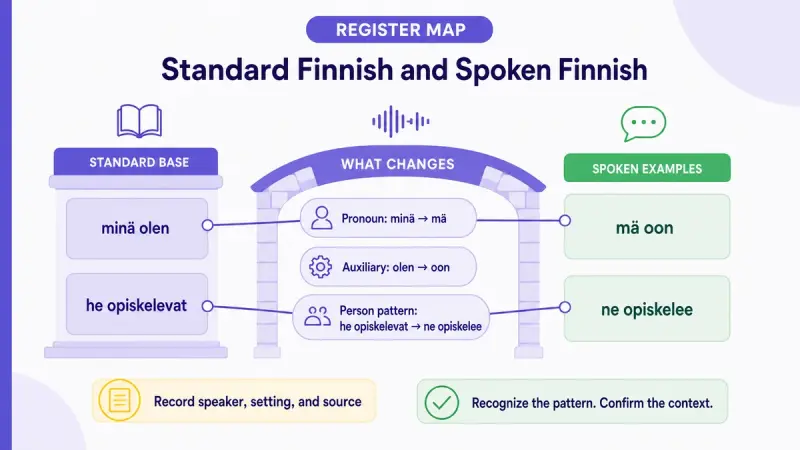
| I | minä | mä | A shorter pronoun may appear, or the pronoun may be omitted in standard-style writing |
| you, singular | sinä | sä | The same contrast repeats across inflected forms such as sinun and sun |
| I am Laura | Olen Laura | Mä oon Laura | Both the pronoun and olla can look different |
| we study | Opiskelemme | Me opiskellaan | Colloquial speech can use me with a passive-form verb |
| they study | He opiskelevat | Ne opiskelee | The pronoun and third-person plural verb can both change |
| I have visited | Olen käynyt | Mä oon käyny | The auxiliary and the participle ending both deserve attention |
| I need to go to sleep now | Minun täytyy nyt mennä nukkumaan | Mun tarvii nyt mennä nukkuun | Several changes can stack inside one ordinary sentence |
Kotus uses the related pair minä syön and mä syön to make the point that standard language and dialects share core grammatical principles. Its other contrast, he kulkevat next to ne kulkee, shows exactly why you can know every dictionary word in a sentence and still miss it at conversational speed: two small changes add up fast.
Do not turn the right-hand column into a second conjugation table to memorize. Group the pairs by what changed: pronoun shortening, person marking, a shortened auxiliary, a shortened participle, a reduced word form. A small map of recurring changes transfers to new sentences; a long list of isolated spellings does not.
Case endings add one more layer on top of all of this. Keep that topic separate for now, and reach for the guide to which Finnish cases beginners should learn first when you are ready to prioritize endings by everyday function.
Build a Two-Track Routine Instead of Replacing One Form With the Other
A routine that works gives each track its own output. The standard track should leave you with a sentence you can take apart and rebuild. The spoken track should leave you with a labeled example you can recognize the next time it appears.
Pick one small topic, such as introductions, plans, food, or travel, and run this cycle:
| Step | Standard track | Spoken track | Time-boxed result |
|---|---|---|---|
| 1. Prepare | Write three short standard sentences | Mark the two words most likely to sound different | Three controlled sentences |
| 2. Listen | Keep the intended meanings visible | Hear a clip, voice note, or conversation once without pausing | A first-pass meaning check |
| 3. Compare | Identify the standard stem and ending | Transcribe only the changed form you heard | One or two paired forms |
| 4. Confirm | Check the standard form in a reliable reference | Ask what the spoken form means and where it is common | A context label, not just a translation |
| 5. Reuse | Write a new standard sentence with the same pattern | Recognize or cautiously reuse the spoken pattern in a similar setting | One later example |
Alternate which track leads. One day, start from a course sentence and listen for variants. The next day, start from a real message and reconstruct the standard version so you can see its grammar.
The split also keeps progress measurable. Standard accuracy shows up in short writing and parsing checks. Spoken growth shows up in forms recognized, meanings confirmed, and variants compared. Minutes studied, on their own, tell you nothing about which track is actually moving.
Use HelloTalk to Hear, Compare, and Confirm Spoken Forms Across Speakers
Sooner or later you need real voices to compare against your course, and this is where the routine leaves the textbook. The HelloTalk platform offers Finnish partner discovery along with messaging, Moments, Voicerooms, Livestreams, correction and translation tools, and AI learning tools, and each of those does a different job in the two-track plan.
In chat, send a short text or voice note built from a standard sentence you prepared, then compare the reply with your prediction. HelloTalk's built-in correction and translation tools help you take a message apart, while the other person's wording gives you one contextual example, not a universal answer.
Moments widens the sample. Post your standard sentence next to a form you heard, name the situation, and ask whether the second form is familiar and where people would use it. Voicerooms and Livestreams work well as listening logs: write down the exact phrase and the topic, then wait for repeated evidence before calling anything a pattern.
Before you post or speak, HelloTalk's AI Grammar tool can check your standard written version, and HelloTalk's AI tools can help you rehearse a planned sentence privately. HelloTalk works best here as a comparison loop across chat, Moments, live audio, and AI preparation, not as an authority that turns one colloquial form into a rule.
| HelloTalk environment | Focused task | What to record | Boundary |
|---|---|---|---|
| Text or voice chat | Ask about one form inside a complete sentence | Original message, meaning, and correction or explanation | One partner represents one usage sample |
| Moments | Compare a standard form with an attested spoken form | Responses that agree, differ, or add context | Replies may reflect different regions and ages |
| Voicerooms or Livestreams | Listen for one known contrast | Exact phrase and conversation topic | Do not infer a rule from an unidentified clip |
| AI tools | Prepare a standard sentence or rehearse pronunciation | Draft before human interaction | Automated feedback does not establish social or regional usage |
Keep the exchange fair by offering the same help in your own language, and keep each ask narrow. The language exchange guide covers how to structure both sides, and the speaking practice guide covers preparation and reflection more broadly.
Treat Regional and Speaker Variation as the Next Layer, Not a Universal Rule
At some point you will hear a form that contradicts your notes. That is not a crisis; it is the next layer. Kotus states that Finnish spoken in Finland includes multiple dialects and also varies with age, profession, formality, and other factors. This is exactly why Kielibuusti labels its examples as Southern Finnish colloquial speech: a form can be common and useful without being the only spoken form.
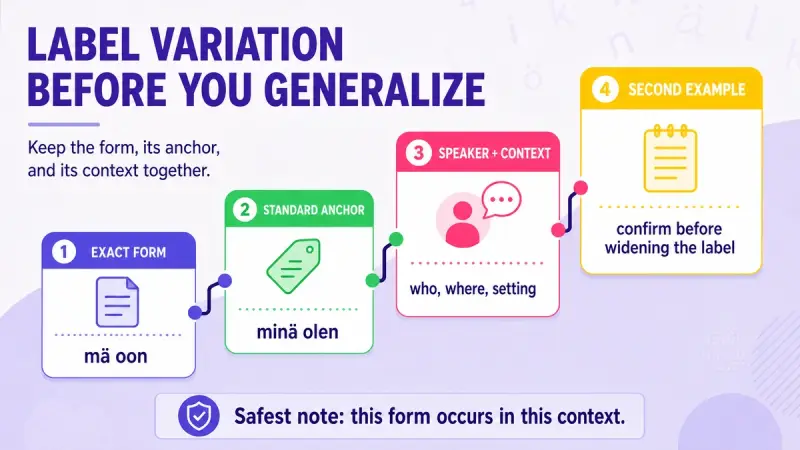
Once the foundation pairs feel familiar, start a variation log. Give each entry four fields: the exact form, the standard comparison, the speaker or source context, and a second confirming example. When later evidence conflicts, keep both examples and narrow the label instead of deciding that one person is wrong.
The safest beginner conclusion is "this form occurs in this context," followed by comparison across speakers. Regional detail earns your attention when it explains something you keep hearing, not when it asks you to memorize several dialect systems at once.
Frequently Asked Questions
Can I speak standard Finnish in an everyday conversation?
Yes. It may sound more formal or book-like in some casual settings, but it stays understandable and gives you a structure you can control. Watch how people respond and add common spoken forms gradually.
Should I write mä and sä as a beginner?
Learn to recognize them early. Use them when the context is informal and you have evidence the style fits, and keep minä and sinä for neutral, standard situations.
Is Helsinki spoken Finnish the same as puhekieli?
No. Southern or Helsinki-area patterns show up often in learning materials, but puhekieli is a broad label. Other regions and speaker groups can use different forms.
Do I need two separate vocabulary lists?
Usually not. Keep one entry with a standard headword and attach spoken variants with context labels. Separate lists hide the connection between forms.
When should I start producing spoken forms myself?
Start with forms you have heard repeatedly and can place in a familiar context. Recognition moving faster than production is normal, and the two-track plan expects it.
Standard Finnish gives you the shared map; spoken Finnish shows you how that map sounds in real voices and informal writing. Keep the two linked by exact examples, and let repeated evidence decide which spoken forms earn a place in your active vocabulary.
When you are ready to hear those voices for yourself, open HelloTalk and start collecting your first paired examples. One labeled form in your log today is worth more than a perfect plan you never test.